Learn how Peoria's proposed General Plan amendments and a proposed regional airpark are connected
City wants new land-use category for strategic state land
City of Peoria
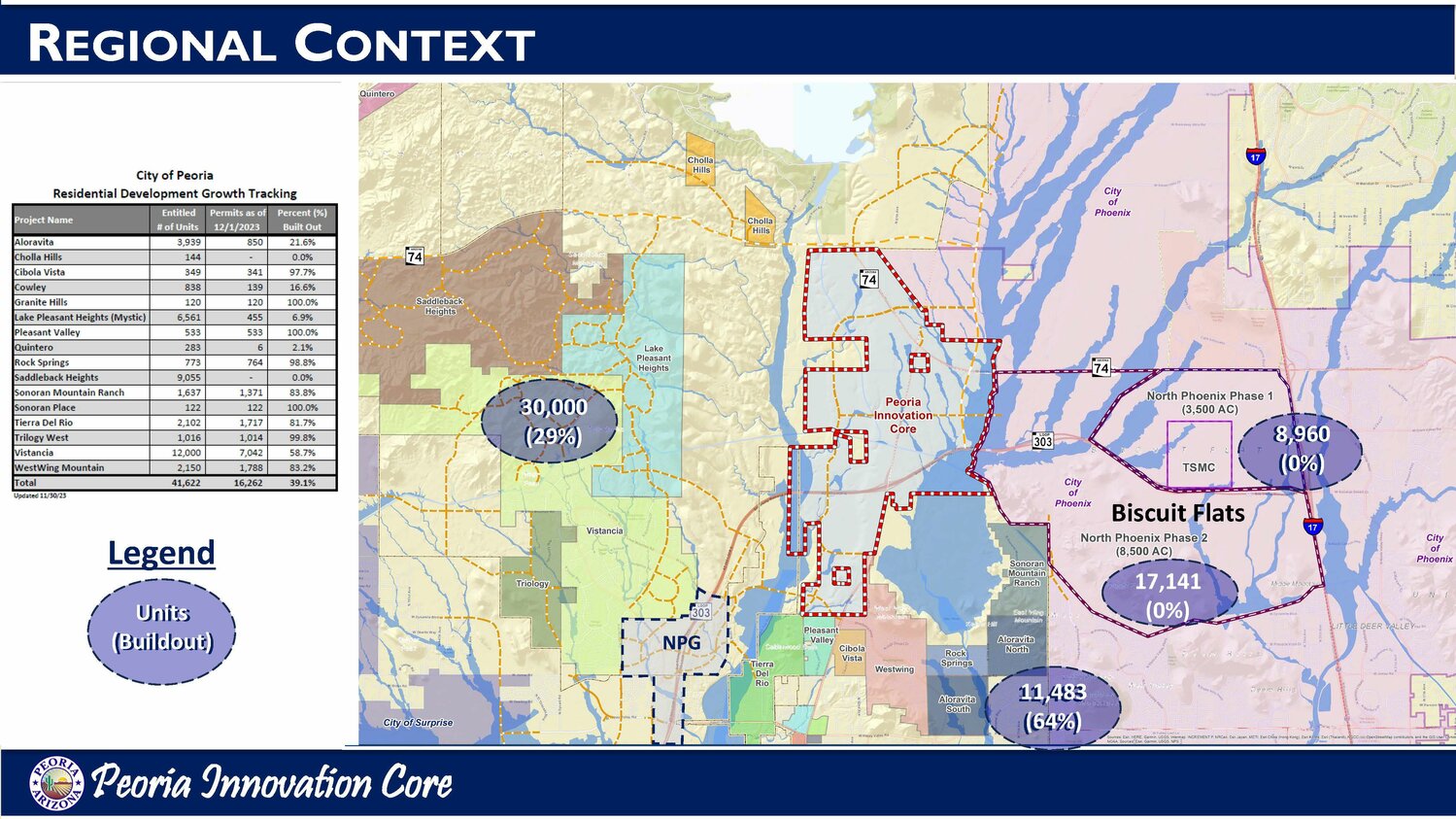
The map marks the North Peoria Gateway, adjacent to Vistancia’s commercial core known as Five North, and Peoria Innovation Core, spanning from Pleasant Valley north to State Route 74. Both are strategic areas in the northern part of the city targeted for development, namely for a new airpark.
Posted
Upcoming General Plan Open House Meetings
April 23: 6-7 p.m., Rio Vista Recreation Center
April 25: 6-7 p.m., Virtual – TEAMS Meeting. Meeting ID: 251 641 864 151; Passcode: h35urp; Dial-in by phone +1 623-233-2753,647835216#; Conference ID: 647 835 216#
June 6: 6 p.m., Planning & Zoning Commission Study Session, City Council Chamber, 8401 W. Monroe Street.
July 18: 6 p.m., Planning & Zoning Commission Public Hearing #1 at Rio Vista Recreation Center, 8866 W Thunderbird Rd.
Aug, 15: 6 p.m., Planning & Zoning Commission Public Hearing #2, at City Council Chamber, 8401 W. Monroe Street
Sept. 17: 6 p.m., City Council Hearing, City Council Chamber, 8401 W. Monroe Street.
The city of Peoria wants to use 8,300 acres of Arizona state land across the northern part of the city — a size greater than the Vistancia master-planned community — for a new airpark and other possible future developments.
To help facilitate this, Deputy City Manager Mike Faust said the city is planning to amend its General Plan to create a “more intentional, better suited land-use category for strategic state land.”
But some Peoria residents are calling it a “land grab” and take issue with the city moving forward with plans for an airpark when they say the project has not been property vetted by residents and a feasibility plan has not been completed or shared with the public.
“Any lease or disposition of State Trust Lands is governed by Arizona’s Enabling Act, Constitution, and strict statutory requirements. This (new land use) category improves the city’s ability to work within ASLD’s regulatory framework, while still maximizing land uses in these strategic areas for the benefit of the city of Peoria and Trust beneficiaries,” Faust said.
Assistant City Manager Rick Buss added that bringing an airpark into the city is a very long and complex endeavor.
“As we are at the beginning of multiple studies required by the FAA, as well as two economic impact studies, a decision on an airpark will likely not be made for years,” he said.
What is a General Plan?
The general plan is Peoria’s overarching city policy document that covers all aspects of the city from transportation to land use and is a tool for guiding the city’s future. It is unique to Arizona in that all municipalities must adopt one and it must be updated and readopted by voters every 10 years. By design, it is a flexible, living document, broad in scope.
But nearly four years after an update in Peoria was approved at the ballot box, city officials say “evolving economic factors and dynamic shifts in conditions make it appropriate to take a renewed look at the plan to ensure it’s best positioned to meet Peoria’s future potential.”
Planning Director Chris Jacques said about 75% of the vacant land in the city is state land, which officials are targeting for future development in north Peoria. Much of this land would need to be acquired by public auctions.
The new amendments would establish and define an appropriate balance of residential, commercial, and employment to serve the community, he said.
“Our economic future hinges on our collaboration with ASDL in entitling and unlocking state trust land for development,” Jacques said at a recent study session. “When we sit back and look at things regionally, especially with TSMC at I-17, and our renewed focus as a city, in terms of trying to expand our economic footprint in our city, it’s important that we make sure the general plan remains responsive to those conditions.”
The city has targeted two areas they call North Peoria Gateway, adjacent to Vistancia’s commercial core known as Five North, and Peoria Innovation Core, spanning from Pleasant Valley north to State Route 74.
The North Peoria Gateway consists of 1,621 acres of state trust land, and about 487 acres of unincorporated land planned for annexation. The Peoria Innovation Core consists of 6,700 acres of state land, both with Loop 303 access.
Jacques said the North Peoria Gateway is expected to be fully entitled in the third quarter of this year, including a pre-annexation agreement, annexation and entitlements to come before planning and zoning as well as city council.
But Councilmember Brad Shafer, who represents the district where all this land is located, said the timing, only a few years after voters approved the general plan, seems convenient given the timing of the proposed airpark, which he says most north Peoria residents oppose.
The general plan amendments are scheduled to go before the planning commission in June, July and August, with final approval expected to go before council in September.
Shafer said changes to the general plan should not be at the will of a select few, but should go to the voters.
“They approved the general plan and they should have a vote on the changes,” Shafer said. “Some members in the current administration prefer to move at the speed of business but this is not a business. This is the city we live in, this is our home and ‘we the people’ are in charge, and our residents should have the right for their voices to be heard, especially when it comes to such significant revisions that would negativity impact so many of our valued residents.”
Minor/Major amendments
The city wants to change the criteria of a “major” and “minor” change as it pertains to the general plan and land use.
Under today’s rules, big projects such as an airport would require a major general plan amendment to move forward in the city. Requirements would include the project be presented at a public hearing within 12 months of when a proposal is made, a review and notification process, and two separate planning commission hearings before going to the council for final approval, where a two-thirds majority vote is required.
Current rules also state anything bigger than 80 acres would require a major general plan amendment.
The proposed rules would widen this threshold from 80 acres to 640 acres.
Shafer said that is about 100 acres larger than the Vistancia Commercial Core, or nearly eight Paloma Parks, and it is too much.
“This means that residents will have significantly less say in what gets built around them,” he said.
Shafer also has concerns about other proposed changes to the general plan, including a proposal that would add a definition that allows any state trust land, no matter the size in acreage to be a “minor change.”
“That means the entire 8,300 acres of state trust land in north Peoria would be considered a ‘minor change’ and require minimal public input,” Shafer said.
Another proposal would change Park/Open Space and Waterway land to state trust land.
“If this is passed, 10 years from now, north Peoria will have no open spaces, and will be nothing more than a concrete jungle that will be hardly recognizable.”
All this activity has motivated many residents in the northern part of the city to speak out. At least two Facebook pages and online petitions have been initiated opposing this expedited movement toward land development.
Peoria resident Chris Smith, who is admin on the “North Peoria Community - No To Peoria Municipal Airport” Facebook page that has garnered more than 830 members in a few weeks, said he launched the page to create public awareness about the situation, which he argues amounts to a “land grab.”
He said he voted for Mayor Jason Beck, but his lack of transparency has lowered his trust.
“I want to ensure the town understands that they work for us. We need to be given courtesy and respect for these things to be transparent, and in my mind they haven’t been. From my perception, the mayor is more focused on what is good for corporations and not the citizens. The way he frames things, he is running the city like a business, but it’s not his business, it’s our business,” Smith said. “There is no going back if an airport is approved.”
Philip Haldiman can be reached at phaldiman@iniusa.org, or on Twitter @philiphaldiman. We’d like to invite our readers to submit their civil comments, pro or con, on this issue. Email AZOpinions@iniusa.org.
Meet Philip Haldiman is an award-winning journalist who most recently took first place for investigative reporting in 2023 from Arizona Newspapers Association. He joined Independent Newsmedia, Inc., USA, in 2015, covering Sun City West his first year. Since 2016, he has covered the city of Peoria. Prior to coming to INI, he was a reporter with The Arizona Republic for seven years, covering numerous cities throughout the Valley. Before that, he was a freelance writer.
Community: Haldiman spearheads the Peoria Independent Hometown Heroes Awards program, honoring local individuals and businesses that give back to the community. He has hosted local candidate forums over the years and is a member of the Society of Professional Journalists. Haldiman also served as a member of the Journalism Program Community Advisory Board at Glendale Community College. Outside journalism, Haldiman served as a member of the city of Peoria Complete Count Committee for the Census, 2019-2020. Lastly, he has served as a member of his HOA governing board since 2021.
Education: Arizona State University with a BA in Journalism and Mass Communications and a BA in Theater.
Random Fact: Haldiman is a fourth-generation Arizonan as well as wrote and produced an autobiographical comic book about his time spent in Hollywood and his life as a cult film star.
Hobbies: He enjoys hiking Arizona’s mountainous landscapes and is currently working on a play for the stage.
Peoria,
Arizona,
North Peoria Gateway,
Vistancia,
commercial core,
Five North,
Peoria Innovation Core,
Pleasant Valley,
State Route 74,
airpark,
airport,
general plan,
Amkor,
TSMC

 By


Comments
No comments on this item Please log in to comment by clicking here