Grandson of Cesar Chavez unveils plaque in Mesa honoring civil rights leader
(Connor Van Ligten/Independent Newsmedia)
Members of the Cesar Chavez foundation, Mesa City Officials and more present the plaque honoring Cesar Chavez's life and legacy in Mesa.
(Connor Van Ligten/Independent Newsmedia)
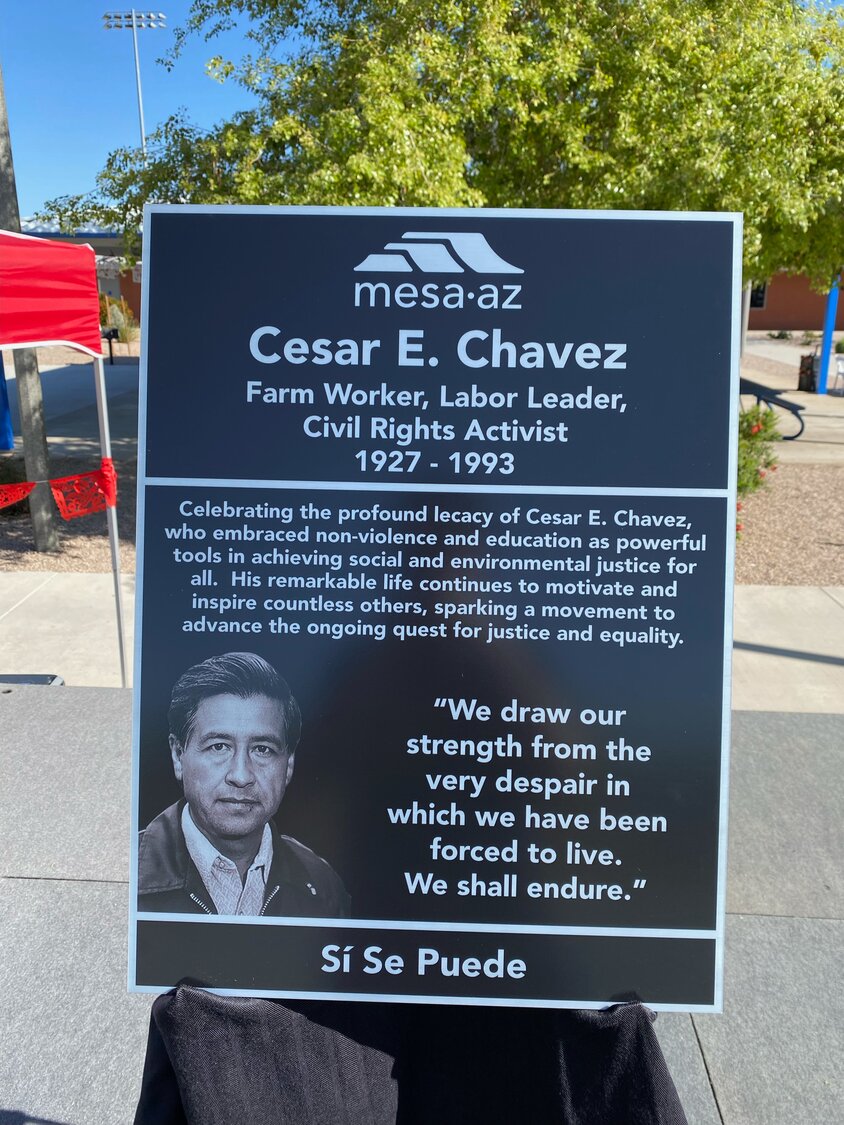
A close-up of the Cesar Chavez plaque unveiled in Mesa.
(Connor Van Ligten/Independent Newsmedia)
Andres Chavez, grandson of Cesar Chavez, speaks to members of the Society Car Club in front of two lowrider vehicles at the Cesar Chavez plaque ceremony in Mesa.
The city of Mesa honored the late civil rights leader Cesar Chavez on Friday, March 29, by unveiling a plaque in his name at the Eagles Community Center.
Volunteers, city officials and members of the Cesar Chavez Foundation took part in the ceremonies at 828 E. Broadway Road while also helping to plant a tree in the park outside the Community Center.
Andrea Alicoate, from the Mesa Regional Foundation for Accessibility, Diversity, and Inclusion, spoke about how it was important for this plaque to Mesa in particular.
“We were wanting to utilize this park as a beacon for spreading education and keeping Cesar Chavez’s memory and heritage alive,” Alicoate said. “This street, this neighborhood, is our Hispanic roots. It’s where the original Hispanic neighborhoods and communities planted their roots and origin in Mesa. It was really important for us to amplify that culture and heritage in a place so fitting. The plaque dedication is symbolic of giving back to the community a piece of their culture.”
Andres Chavez, grandson of Cesar Chavez and executive director of the National Chavez Center arm of the Cesar Chavez Foundation, spoke on the meaning of the plaque unveiling being in Mesa and how his grandfather’s legacy remains large even multiple decades after his death.
“This is a historic neighborhood and the city of Mesa wanted to do something that spoke to the community’s pride,” Chavez said. “We’re always surprised. It’s been 31 years since my grandfather passed away, yet we see countless communities who choose to honor his life. I think there’s a few reason why. He believed in the importance of service and serving others. The cornerstone of the farmworker movement was getting farmers to work together. People from all backgrounds and ethnicities, which made up one of the most multicultural movements this country has ever seen. Cesar also believed that no matter your background, upbringing, education, or ethnicity, you can accomplish anything with hard work.”
That last comment is the embodiment of Cesar Chavez’s motto: Sí se puede, which translates to “yes, it can be done.” It was a rallying cry of the United Farm Workers union Chavez led for many years. And that term is further immortalized on the plaque, which also features a Chavez quote that reads: “We draw our strength from the very despair in which we have been forced to live. We shall endure.”
Community involvement was an important part of the event in all aspects. The creation and unveiling of the plaque would not have been possible without the partnership between the Cesar Chavez Foundation and the city of Mesa as well as help from the Mesa Regional Foundation for Accessibility, Diversity, and Inclusion. A booth for West Coast Arborists, a forest management company, was present at the event, as was the Society Car Club, which brought two lowriders with them.
“Low riders have always been a great expression of Latino and Chicano culture, and since this is a cultural celebration of a Chicano figure, it’s very fitting that we have a low rider here,” Chavez.
Chavez honors his grandfather’s legacy through the work the Cesar Chavez Foundation does, but a lot of that work is not just honoring a legacy, but helping the workers of today and those of the future.
Chavez says it’s something that aligns with the goals his grandfather had as well.
“My grandfather understood that farmworkers weren’t just workers. They dealt with a lot of issues outside of the workplace. So the Cesar Chavez Foundation really works to address some of the most basic needs that people have in their communities,” he said.




Comments
No comments on this item Please log in to comment by clicking here