Desert Ridge High School in Mesa has one of the best robotics teams in all of Arizona. They now have a chance to prove they are one of the best in the world as they prepare for the VEX Robotics World Championship in Dallas, which takes place in late April.
In March, Desert Ridge’s 99067A Mechanical Jagwires punched their ticket to Dallas by winning the AIA Robotics State Championship on their home soil. Another Desert Ridge team, the 99067B Nano Jagwires, qualified via winning the Build Award and will be heading to Dallas as well. Seven other Arizona teams, including an independent Chandler team also qualified.
High school robotics go beyond a simple extracurricular activity. The events in Arizona are officially licensed by the AIA. Schools across the country compete in regional events to earn a spot in the VEX World Championships in Dallas every year.
VEX, a robotics company owned by Innovation First Inc., organizes the worldwide competition that features teams from around the U.S. as well as international teams from China and Japan. Last year, the 99067B Nano Jagwires team from Desert Ridge made it to the top 16 of the World Championships.
The championships take place at the Kay Bailey Hutchison Convention Center in Dallas. The event has all the pomp and flair of a typical athletic event or concert. Student and team member Abhinav Jinka described his experience competing in that type of atmosphere at last year’s top 16 run.
“We’re in this big auditorium at the convention center. The lights are all dark, there are three fields in the center of the auditorium, they have pyrotechnics going off,” Jinka said. “The auditorium is totally filled up with around 5,000-10,000 people. It’s totally surreal. The atmosphere is intense.”
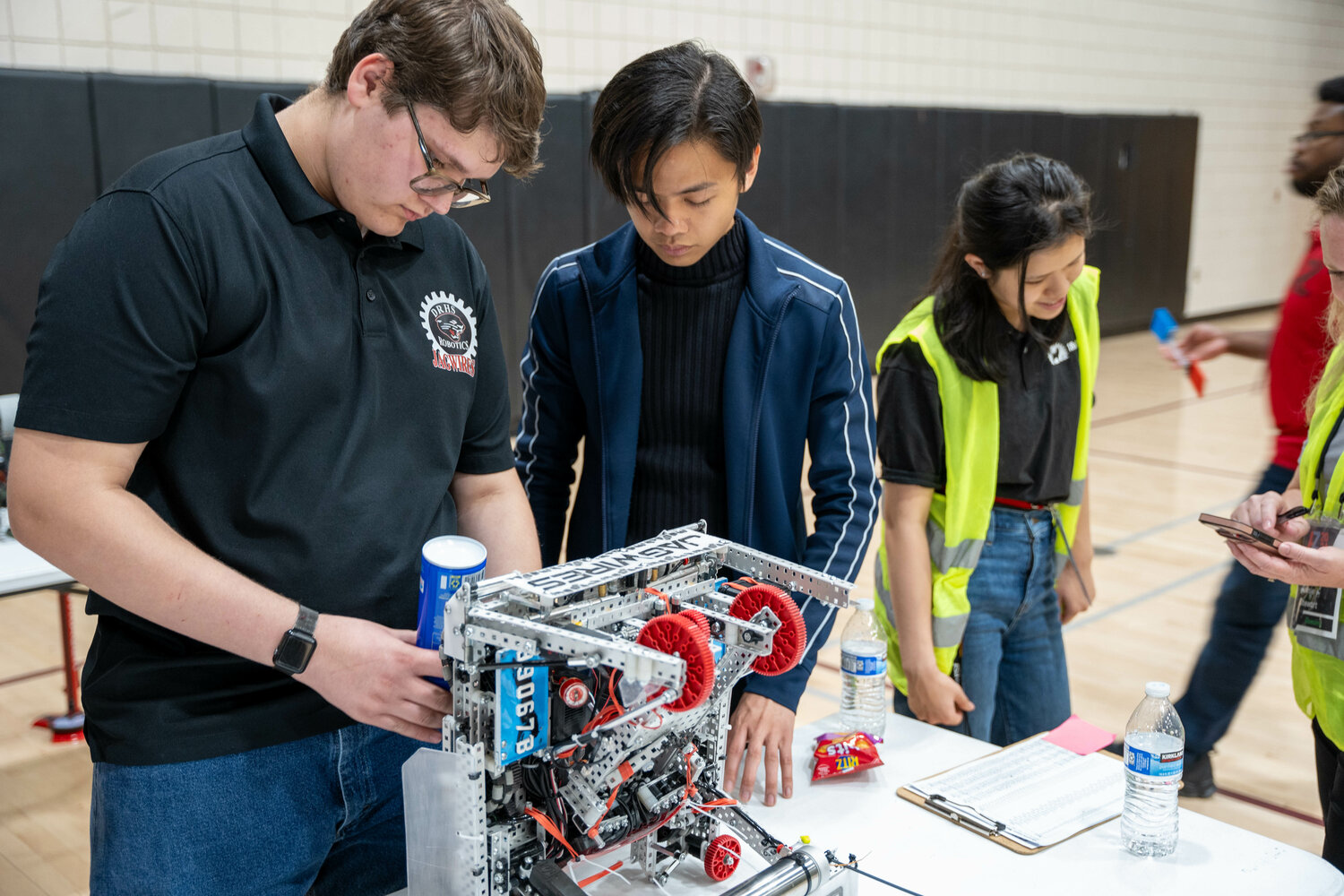
A lot goes into the robotics program at Desert Ridge. Wendi Harden, a mathematics teacher, is the manager. Students fill various team roles, from programmers to builders to testing to piloting the actual robot. The rules for each competition change every year, so the team has to build their robot around those rules.
“Typically we start by identifying the game problems. So, this year, the game required scoring balls into a goal and traversing a barrier,” said student and team member William Buckner. “Then we try and figure out our solutions to those problems based off the engineering and design process. Going from that, we prototype designs or look for previous designs for inspiration to see if that attempt has succeeded or failed. If a previous attempt was successful, we try to incorporate aspects of that into our own design while also improving on it.”
Buckner said designing and building a robot can take as short as one day or as long as a few weeks depending on the event’s complexity and how much time the team has for the upcoming competition. Often, the robot’s design may change as the strategies for that current season evolve.
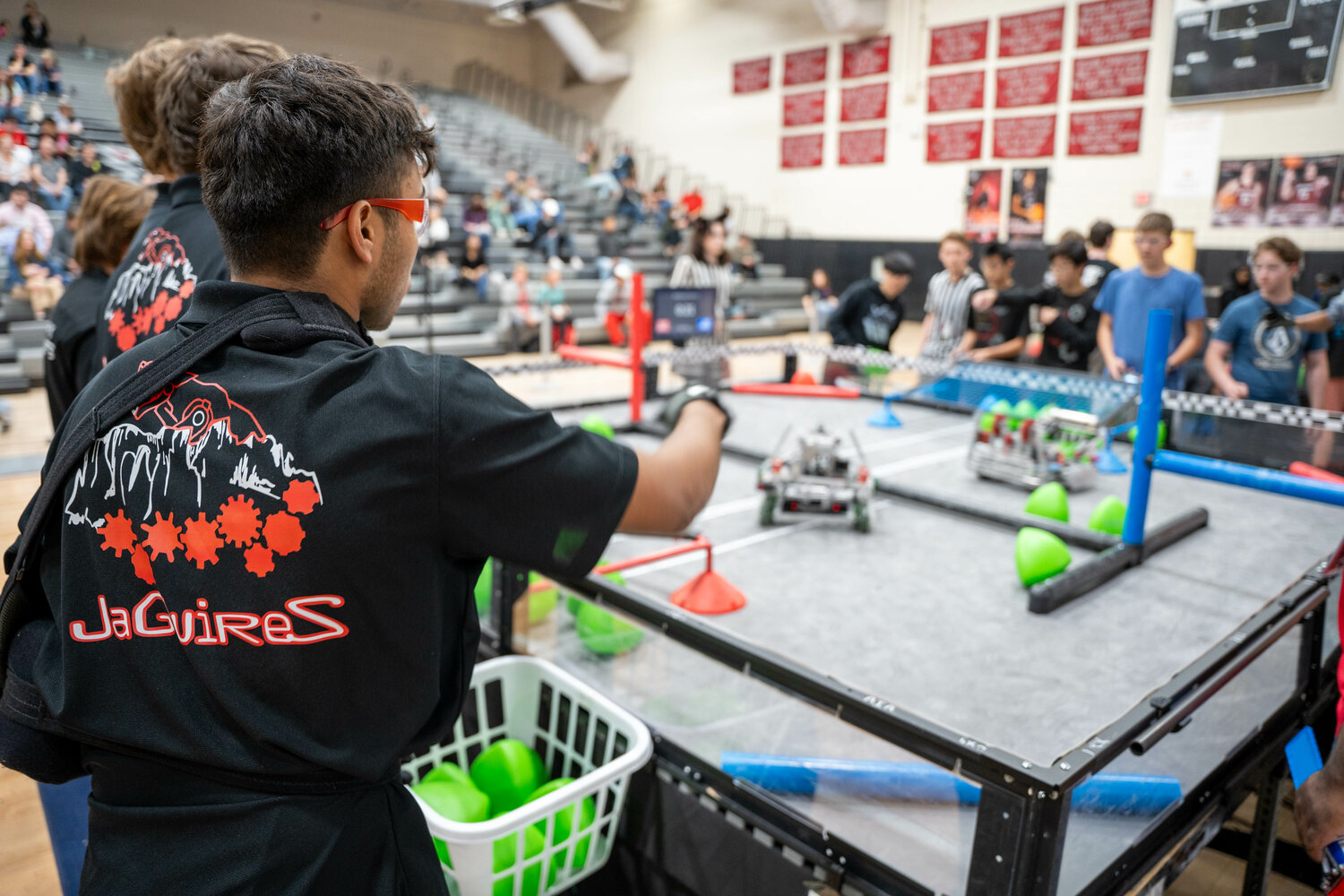
For example, the current season used a course where two robots compete to pick up foam balls and score them into the opposing goal. However, the course has various obstacles that influence a robot’s design. For example, the middle of the course contains a pipe that a robot needs to traverse. It also contains barriers on either side of the course that robots need to be small enough to fit through in order to get to the opponent’s goal.
During a match, a robot is manually controlled during some segments, while automated in other segments, meaning the team has to strategize around those phases as well.
“At the beginning of the season, our designs were a lot more focused around using a catapult system for shooting the balls into the goal. But the strategies have evolved, and people changed their design around that. So now designs are more focused around speed,” said team member Parker Wakefield.
Harden said having a robotics gives students a place to fit in and participate in a competitive environment outside of a physical sport. It allows them to apply STEM skills they learned in an extracurricular fashion that is fun and engaging.
A lot of what Harden does is a labor of love. The team has to raise funds on their own to travel to events or host competitions. Many team activities take place after school hours, requiring students to stay after school in order to get work done for the team.
“I think that this should be done more often and more schools should have team, rather than just doing classwork. (team member) Jackson here had to do math so many times to do a turn curve right, he uses velocity and radiance. He was using what he learned in physics and calc to program. We take the English component of education and build these massive, MLA-formatted books of information on our robots. This is a very well-rounded program that makes you use all of your resources,” Harden said.
Harden also believes robotics can be a gateway for students to get into STEM and possibly pursue a career in that field.
“Google just got behind VEX and gives major money to any school that doesn’t have a team so they can start one,” Harden said. “Google knows that the more kids touch and play with a robot, and actually physically do things, the better chances that they understand STEM. Regardless of whether they go on to be engineers or go on to be salespeople or a CEO, at least they’ve been in the STEM world. They understand a circuit, they understand how powering works.”
Regardless of what happens in the future, the team’s goal in the present remains the same - to claim victory on the World Championships.



Comments
No comments on this item Please log in to comment by clicking here