Gilbert’s long-awaited independent audit of its water metering system found the town’s utility billing is highly accurate, with issues affecting a small share of customers and no evidence of a widespread system failure.
The preliminary findings from Kimley-Horn show that about 97% of the town’s roughly 93,000 water accounts were billed correctly over a six-year period, while about 2.9% experienced at least one anomaly requiring further review.
“This audit confirms the system is fundamentally sound while clearly identifying targeted improvements that will further strengthen accuracy and customer confidence moving forward,” an auditor said.
The presentation, delivered during both a study session and regular meeting with identical content, represents a high-level overview.
The final report — delayed as additional meter testing data is incorporated — is expected by the end of the month.
No system-wide problem, but individual impacts
Auditors emphasized that the issues identified were limited in scope and did not point to a systemic breakdown in the town’s water billing system.
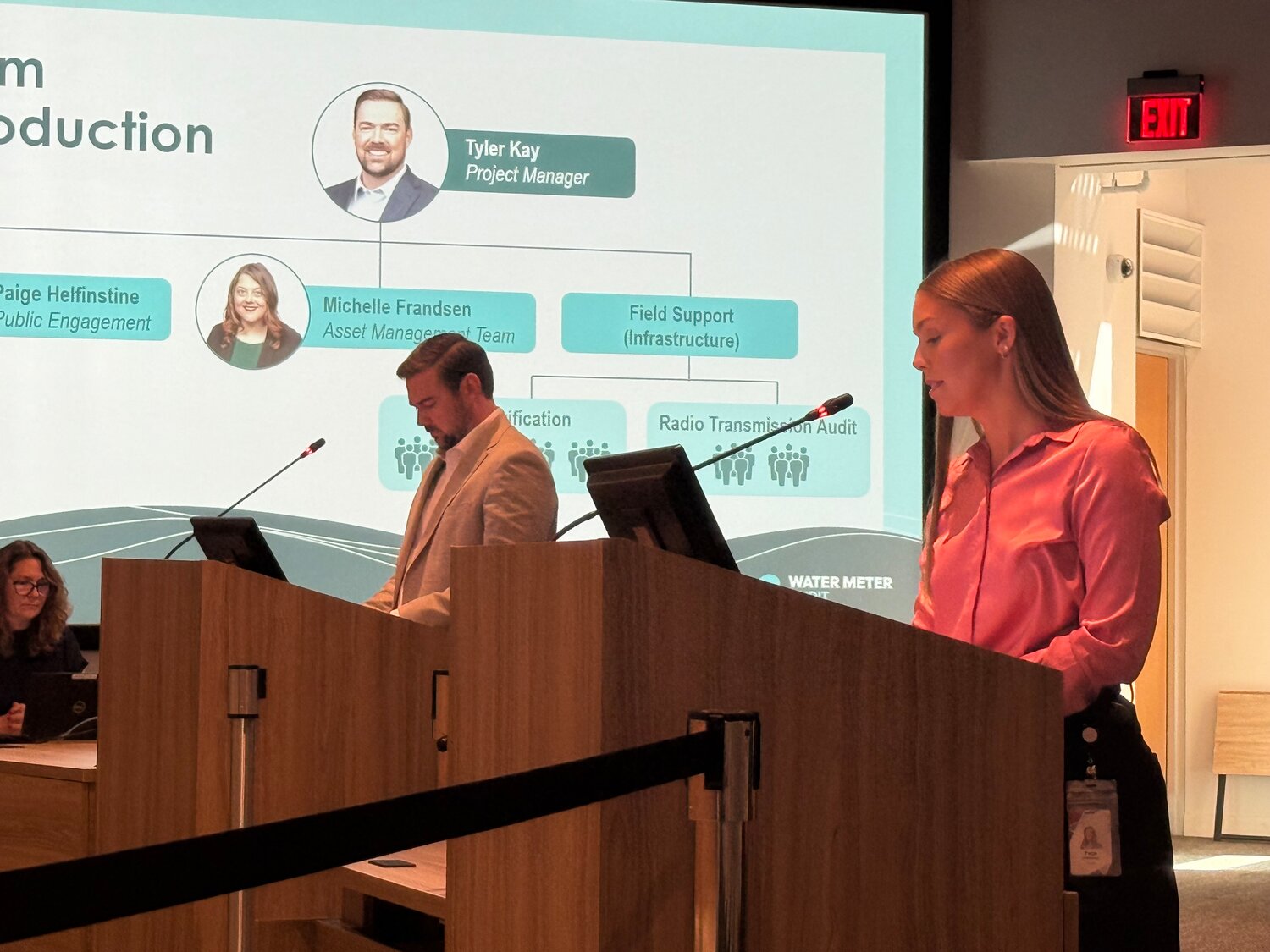
“There is not a singular issue that has affected a majority of customers,” said Paige Helfinstine, a marketing analyst for Kimley-Horn who headed public engagement on the audit.
Instead, anomalies were typically short-lived, lasting about five months on average, and often had relatively modest financial impacts.
Over the six-year audit period, customers who were overbilled paid an average of about $125 more than they should have, while underbilled customers averaged about $110 less.
Town staff echoed that conclusion while noting the importance of addressing individual cases.
“The audit results are important," Finance Director Håkon Johanson said. "They confirm no systemic issues with our water meter system."
What the audit examined
The audit reviewed Gilbert’s water system from end to end, including:
Physical meter performance;
Radio transmission accuracy;
Billing data and calculations;
Business practices and customer service procedures.
The firm analyzed more than 50 million data points and reviewed six years of billing records from 2020 through 2025.
Field testing included removing and evaluating more than 450 meters and nearly 400 radio transmitters using statistically valid sampling methods designed to reflect systemwide performance.
Key issues identified
While the system overall performed well, the audit highlighted several recurring sources of error:
Multiplier settings: Incorrect configuration of meter multipliers — used to convert readings into billable units — was a leading cause of billing discrepancies.
Billing codes: Hundreds of residential accounts were assigned incorrect rate classifications or meter sizes.
Rounding and calculation inconsistencies: Older billing software introduced some inconsistencies that have since been improved.
For example, auditors identified 506 residential accounts with multiplier issues, sometimes resulting in overbilling or underbilling depending on the configuration.
“Multiplier configurations are one of the quietest sources of revenue loss or billing errors in a water system,” said Tyler Kay, the water-wastewater project manager at Kimley-Horn who served as the audit's project manager.
Despite those findings, overall billing calculations were highly reliable, with 99.5% of more than 7 million transactions calculated correctly.
Meter, technology performance
The physical infrastructure itself showed strong performance, with most issues tied to age rather than defects.
Newer meters performed especially well, while older meters were more likely to fall slightly outside industry accuracy tolerances. Even then, the financial impact was limited.
“The results show that meters are failing due to age and use, not because of manufacturing issues,” Kay said.
Radio transmitters — which send usage data to the billing system — were found to be highly reliable, with more than 99% transmitting correctly.
Recommendations focus on prevention, transparency
Rather than calling for major system changes, auditors recommended targeted improvements to strengthen reliability and public confidence.
Among the key recommendations:
Implement automated checks on multiplier settings;
Add system flags for unusual usage or billing mismatches;
Expand use of advanced metering infrastructure data;
Improve customer communication about billing and usage;
Continue a planned, age-based meter replacement program.
The audit also supports the town’s existing strategy of replacing meters based on age and usage rather than undertaking a costly systemwide overhaul.
Next steps
Town officials said the preliminary findings are only the starting point, with more detailed analysis to come once the final report is delivered.
“Like the rest of the community, the town has not yet received a full, detailed report,” Johanson said.
Once complete, the town plans to review each affected account individually, issue refunds or adjustments where appropriate, and communicate directly with impacted customers.
“This is more than just fixing issues," Johanson said. "It’s about gaining back community trust."
The final report is expected to be released by the end of the month.
Please submit comments at yourvalley.net/letters or email them to AzOpinions@iniusa.org. We are committed to publishing a wide variety of reader opinions, as long as they meet our Civility Guidelines. Tom Blodgett can be reached by email at tblodgett@iniusa.org or follow him on X at @sp_blodgett.
Meet Tom Tom Blodgett joined Independent Newsmedia, Inc., USA, in 2022, when the company acquired Community Impact Newspaper's Phoenix-area properties. Raised in Arizona, he has spent more than 35 years in journalism in the state.
Community: He has served as an instructional professional in the Walter Cronkite School of Journalism and Mass Communication since 2005, and is editorial adviser to The State Press, the university's independent student media outlet. He also is director of operations for an 18U girls fastpitch softball team from Gilbert.
Education: Arizona State University with a BS in Journalism.
Random Fact: He lived in Belgium during his freshman year of high school.
Hobbies: Tweeting enthusiastically about ASU softball (season-ticket holder) and grumpily about other local sports (pessimistic fan).
Gilbert water meter audit,
Kimley-Horn audit Gilbert,
Gilbert water billing accuracy,
water meter audit findings,
Gilbert utility billing issues,
Arizona water audit,
meter multiplier errors,
Gilbert AMI system,
water billing anomalies,
Gilbert utility report

 By


Comments
No comments on this item Please log in to comment by clicking here