Arizona has little Chinese-owned land, despite national, state concerns
Recent Trump administration map highlights issue
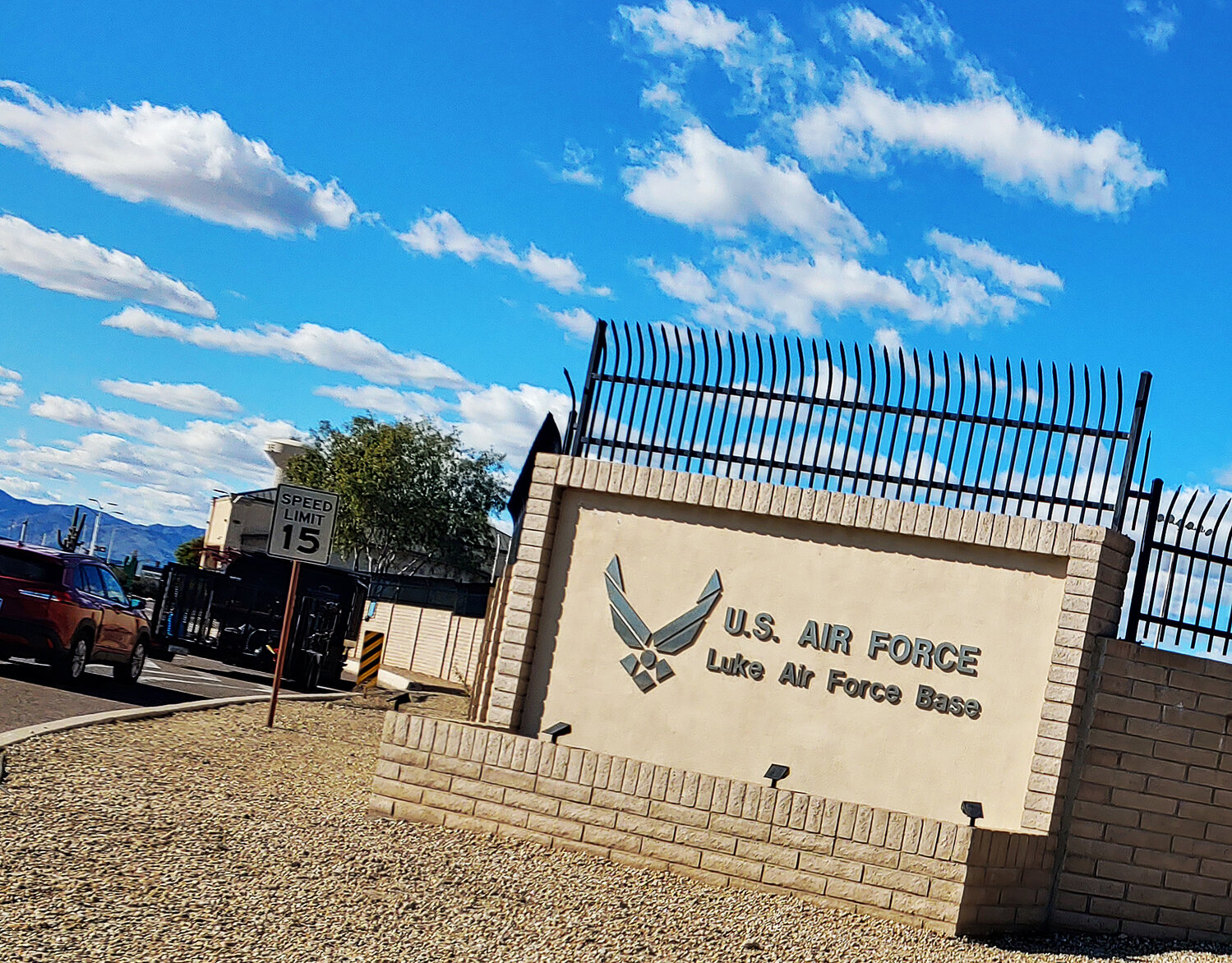
Luke Air Force Base in Glendale is now protected from having land ownership by China nearby, however China owns very little land in the state.
(Independent Newsmedia/Steve Stockmar)
WASHINGTON — The Trump administration raised alarms last week about China snapping up farmland near U.S. military sites, unveiling a ban on ownership or control by Chinese investors.
The map displayed by the attorney general and the secretaries of defense, homeland security and agriculture showed all of Maricopa County colored in. It also marked the Yuma Proving Ground — leaving an impression that China is encroaching on the Army’s premier testing facility.
But the latest federal data show only a single Chinese-owned parcel in Arizona: 322 acres in Chandler, about 110 miles from the proving ground.
You must be a member to read this story.
Join our family of readers starting at $5 for your first month and support local, unbiased journalism.
Click here to see your options for becoming a subscriber.
Register to comment
Click here create a free account for posting comments.
Note that free accounts do not include access to premium content on this site.
I am anchor
Government
Arizona has little Chinese-owned land, despite national, state concerns
Recent Trump administration map highlights issue
(Independent Newsmedia/Steve Stockmar)
Luke Air Force Base in Glendale is now protected from having land ownership by China nearby, however China owns very little land in the state.
Posted
By Derry Lenehan | Cronkite News
WASHINGTON — The Trump administration raised alarms last week about China snapping up farmland near U.S. military sites, unveiling a ban on ownership or control by Chinese investors.
The map displayed by the attorney general and the secretaries of defense, homeland security and agriculture showed all of Maricopa County colored in. It also marked the Yuma Proving Ground — leaving an impression that China is encroaching on the Army’s premier testing facility.
But the latest federal data show only a single Chinese-owned parcel in Arizona: 322 acres in Chandler, about 110 miles from the proving ground.
Apart from exaggerating the scale of the problem by coloring in the nation’s 15th biggest county — all 9,200 square miles — the map was based on an erroneous 2021 list that showed 9,892 acres owned by Chinese interests in Arizona.
It is almost identical to a map that appeared in the conservative New York Post 13 months ago. The U.S. Department of Agriculture corrected the list on which the two maps were based last September.
The map used by Trump cabinet members July 8, 2025, as they announced moves to ban China from owning U.S. farmland. The map indicates counties where China owns farmland and nearby military bases. (Courtesy of USDA)
All but one of those parcels were linked to Walton International Group, a global real estate management company based in Scottsdale.
But only the Chandler parcel had a Chinese owner. The Walton Group realized the error when the Wall Street Journal inquired about its holdings last fall. The company then successfully petitioned the USDA to correct its list.
The Walton Group land includes 8,670 acres in Pinal County and 900 acres in Maricopa County misattributed to China. The USDA now shows the owners are from Canada, Germany, Singapore and Malaysia — all U.S. allies or partners.
Most of that land has been earmarked for residential development, such as the 290-acre Vista Bonita project in Buckeye, about 70 miles from the proving range.
A 315-acre site near Eloy in Pinal County with owners in Singapore is set to become a solar panel farm managed by EDF Renewables, a subsidiary of a French energy company. The solar farm is scheduled to be operational in 2028.
That site is about 120 miles from the eastern edge of the Yuma Proving Ground.
The site in Chandler with actual Chinese ties was purchased in 1983 and is not linked to the Walton Group.
Land records from the Maricopa County Recorder’s Office, and a search of map data, show the parcel is now a subdivision with $400,000 condos and single-family homes assessed at close to $1 million.
The tract is north of the Bear Creek Golf Complex, bordered on the north and south by Ocotillo Road and East Chandler Heights Road, and on the east and west by the Consolidated Canal and South Arizona Avenue.
Nationwide, Chinese investors own 277,336 acres of U.S. farmland, according to 2023 data that the USDA updated last fall. That’s less than 1% of all farmland owned by foreign interests.
But there are legitimate concerns.
In May 2024, President Joe Biden ordered a Chinese group that runs a crypto-mining company to sell land it used for a server farm — computers, not agriculture — next to Warren Air Force Base in Wyoming, which houses nuclear ballistic missiles.
“Foreign ownership of land near strategic bases and U.S. military installations poses a serious threat to our national security,” Secretary of Defense Pete Hegseth said at the July 8 news conference with Secretary of Agriculture Brooke Rollins and other cabinet members.
Policymakers at the state level have also taken steps to address the purported threat of Chinese land ownership in Arizona.
During the most recent session of the Legislature, lawmakers sent Gov. Katie Hobbs a bill that would have prohibited Chinese entities from buying a stake greater than 30% near military bases and other strategic assets in Arizona. She vetoed the bill on June 2, calling it “ineffective at counter-espionage” and saying it would not directly protect any military assets.
When the GOP-controlled legislature sent her a similar measure a few weeks later, though, she signed it.
The new law bans land ownership by governments of foreign adversaries, defined as countries identified by the Director of National Intelligence three years in a row as a threat to national security.
That covers China, Iran, North Korea and Russia.
Holdings linked to Iran total 3,030 acres across the country, none of it in Arizona, according to the USDA data.
Russia owns 11 acres in Virginia.
North Korea owns no U.S. land.
“I’m confident this legislation will protect our military bases and critical infrastructure during a time of escalated foreign threats,” Hobbs said when she signed the law July 1.
Counting Arizona, 26 states prohibit or restrict foreign ownership and investments in agricultural land. There are no federal laws banning the practice, only the new executive action.
Rollins said the Trump administration aims to “claw back” any land already in the hands of China and other adversaries.
Rollins said the administration will take “swift legislative and executive action to ban the purchase of American farmland by Chinese nationals and other foreign adversaries.”
Attorney General Pam Bondi noted the arrests last month of two Chinese nationals caught smuggling samples of a fungus viewed as a potential bioweapon. They said it was intended for research at the University of Michigan.
Chinese Foreign Ministry spokesperson Mao Ning condemned the crackdown on land ownership as discriminatory and a violation of international trade rules.
“The U.S. overstretches the concept of national security and deprives the right of institutions and citizens of particular countries to purchase farmland,” Mao said last week.
The Government Accountability Office, the government’s watchdog agency, criticized the USDA data collection process in a January 2024 report. Among the errors GAO found was a 27,000-acre site linked to China that was counted twice.



Comments
No comments on this item Please log in to comment by clicking here