Suicide rates in both Arizona and Maricopa County continue to rise despite myriad efforts to reverse the trend.
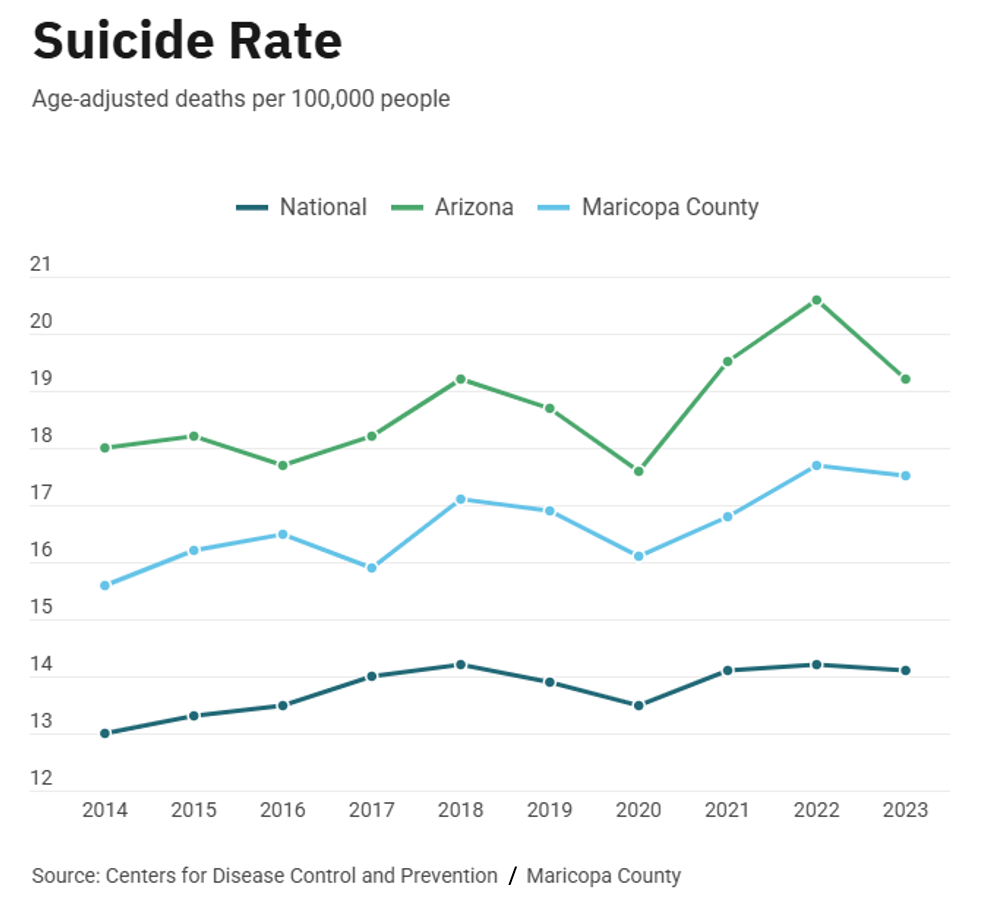
Data indicates Arizona’s suicide rate has risen steadily in recent years, with the overall rate in 2023 reaching approximately 19.22 deaths per 100,000 people — surpassing the national average, according to numbers from the Centers for Disease Control and Prevention and the Arizona Suicide Prevention Coalition for the latest year of data available.
The increase reflects a broader trend seen during the past decade, with health officials warning that without sustained intervention, the numbers may continue to climb.
In 2023, Arizona recorded 1,492 deaths by suicide. Demographic data shows that suicide does not affect all groups equally. There are wide disparities among genders.
Adults aged 45 to 64 experience the highest rates, though sharp increases have also been observed among adults aged 25 to 34. Gender disparities are particularly stark: men in Arizona die by suicide at roughly three times the rate of women.
As a result, suicide ranks as the eighth leading cause of death for men in the state, compared with the 11th for women, according to the ASPC.
Veterans represent another high-risk group. Between 2012 and 2022, veterans in Arizona were found to be more than twice as likely to die by suicide as non-veterans, underscoring ongoing challenges tied to mental health, reintegration, and access to care.
Advocates say these findings point to the need for more targeted prevention programs and expanded support services for former service members.
The data also reveal important differences in how suicides occur.
Guns are the most common method, accounting for 61.1% of all suicide deaths in Arizona. Other methods include suffocation and poisoning, with drug-related poisoning occurring more frequently among women.
Experts note that access to lethal means plays a critical role in suicide outcomes, making prevention strategies around safe storage and intervention especially important.
ASPC data shows suicide rates higher outside the Valley.
In 2022, suicide rates in Arizona’s rural counties were nearly double those in urban areas, reflecting disparities in health care access, economic conditions, and social isolation. Public health officials believe addressing these gaps — particularly in rural communities — will be key to reversing the state’s upward trend.
On a county level, suicide deaths have also trended upward during the past decade, according to www.maricopa.gov.
In 2014, Maricopa County recorded 617 deaths, a rate of 15.6 per 100,000 residents. The following years saw steady increases, reaching 674 deaths (16.5 rate) by 2016.
Although there was a slight dip in 2017 to 660 deaths, the overall trajectory remained concerning.
By 2018 and 2019, suicide deaths climbed sharply to 728 and 730 respectively, with rates nearing or exceeding 17 per 100,000.
This marked a period of heightened concern among public health officials.
In 2020, deaths declined slightly to 709 (16.1 rate), potentially reflecting early-pandemic disruptions, but this decrease proved temporary.
From 2021 onward, the upward trend resumed. Suicide deaths in the county rose to 734 in 2021 and continued climbing to 783 in 2022 — the highest level in the dataset, with a rate of 17.7.
In 2023, the total remained nearly unchanged at 784 deaths, though the rate dipped slightly to 17.5.
Help is available. Among the efforts to reduce suicide in Arizona are:
• The 988 crisis hotline — offering 24/7 call, text, and chat access to trained crisis counselors from the Arizona Department of Health Services who can help people experiencing suicidal, substance-related, and/or mental health crises, or any other emotional distress.
• Teen Lifeline — a 24/7 peer counseling hotline for young people.
• ASPC — a dedicated community-based organization committed to preventing suicide and promoting mental health and well-being throughout Arizona.
• The Mitch Warnock Act — mandating suicide prevention training for staff interacting with students in grades 6-12.
• “Cade’s Law” — expands the state’s manslaughter law to prosecute adults who encourage minors online to take their own lives.
• Suicide Mortality Review Board — Maricopa County operates the SMRB to analyze data and improve suicide prevention strategies.
If you or someone you know is struggling or in crisis, call or text 988.
Matt Loeschman has had two separate stints at Independent Newsmedia. He began as a reporter covering Peoria and later Surprise from 2000-2009. In 2017, he returned to Arizona and INI as the news editor of the Daily News-Sun (now the Phoenix Independent). He previously covered the Arizona Rattlers of the Indoor Football League for more than a decade.
Community: During high school football season since 2017, he contributes live postgame radio reports to the AIA Friday Night Football Wrap Up Show. He supports organizations such as Phoenix Children’s, Boys and Girls Clubs of the Valley and the American Cancer Society.
Education: The University of Texas at Austin majoring in Journalism-News and Public Affairs.
Random Fact: He can sing and he has been fortunate to meet many famous people during his journalism career including First Lady Hillary Clinton, King of Country Music George Strait and Oscar-winning actor Matthew McConaughey. Attended all 4 home games of the 2001 World Series.
Hobbies: Watching and playing a wide variety of sports, including golf, tennis, pickleball and softball. Playing PlayStation 5, working out, shopping and reading.


 By


Comments
No comments on this item Please log in to comment by clicking here