Mesa mayoral hopefuls speak on issues at candidate forum
(Connor Van Ligten/Independent Newsmedia)
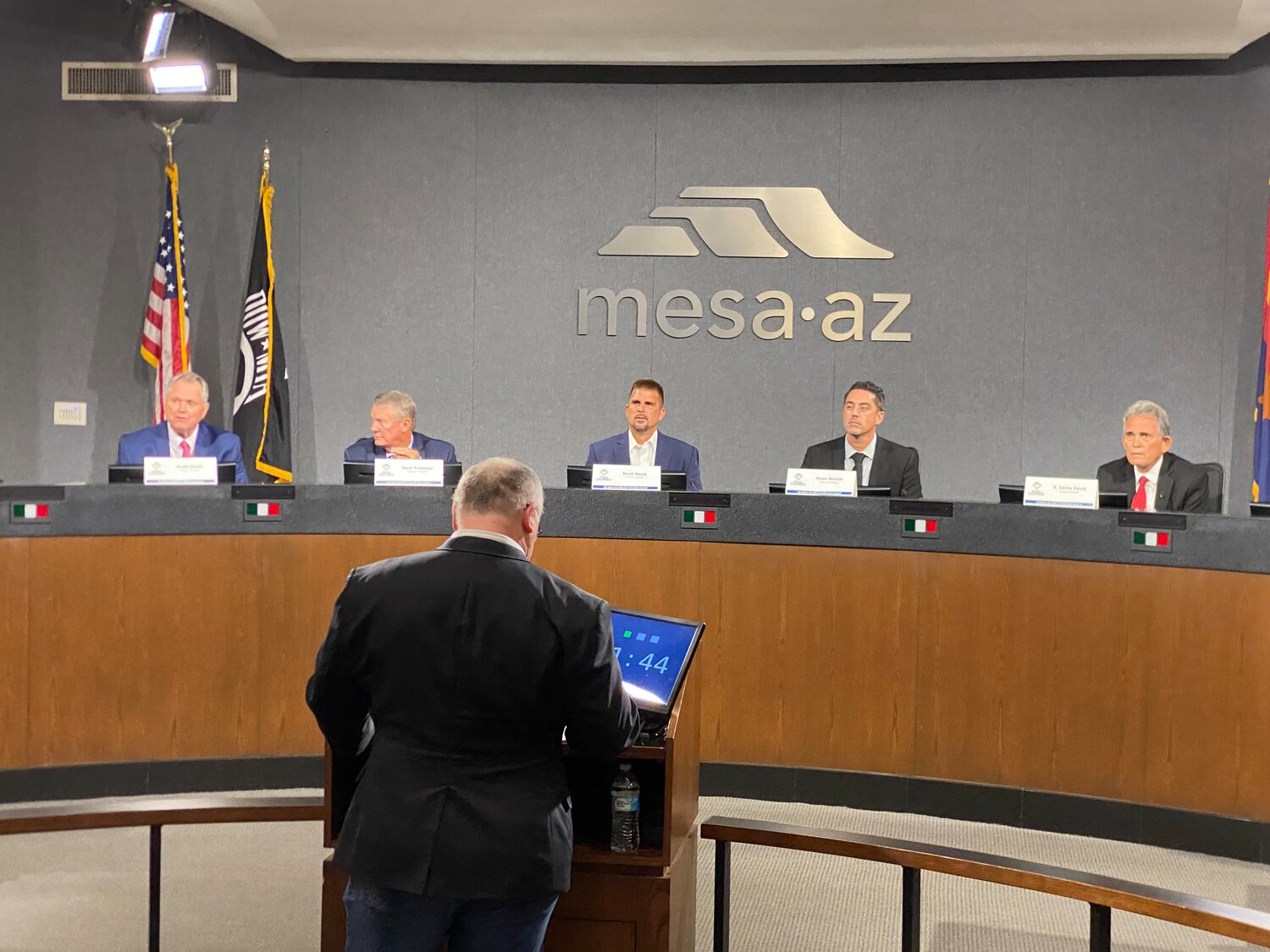
Mesa Mayoral candidates. From left at the back, are Scott Smith, Mark Freeman, Scott Neely, Ryan Winkle and Carey Davis. At the podium is Mike Broomhead from KTAR.
Five candidates for the mayor of Mesa were put on the spot during the May 14 candidate forum at the Mesa Council Chambers.
Hosted by KTAR’s Mike Broomhead, the candidates were asked various questions about Mesa’s regional transportation, homelessness, housing and more in front of a live audience. The five candidates present were District 1 Councilmember Mark Freeman; Scott Smith, who was the Mesa mayor from 2008 to 2014; former council member Ryan Winkle; small-business owner Scott Neely; and Carey Davis, who was the mayor of Sen Bernardino, California, from 2014 to 2018.
Through their opening statements and answers to questions, each candidate aimed to make themselves stand out. Neely presented his lack of a political background as a strength and said he would listen to public input over special interests, and emphasized making panhandling and homeless encampments illegal as a major policy point. Freeman pointed toward his experience as a council member and his desire to strengthen public safety and increase financial transparency.
Smith referenced his previous tenure as Mesa mayor and record of success giving him an edge over the other candidates when it came to experience, saying that he wants to pick up where he left off. Winkle emphasized his connection with the people of Mesa and his relation to the common man as well as his desire for expanding public transit and supporting small business. Davis focused on what he deemed as overspending by the city as well as strengthening public safety.
One of the key questions asked of the candidates was how important they felt regional transportation was to citizens living in Mesa and how transport initiatives should be funded. Freeman complimented the light rail and Valley Metro bus systems, but said that the low ridership meant that expanding it is not necessary.
“What I’m finding is that the transportation is necessary for our city, and how it should be funded is taxation through our city,” Freeman said. “Our city pays for the operations and maintenance of our light-rail system and the regional tax that we pay goes to the regional transportation. Essentially, we have enough and sufficient transportation to compensate for our low ridership. Our ridership has not increased. I would support more public transportation but ... people in this city choose to drive.”
Neely said that light rail does not pay for itself when you have homeless ridership. He had shared the idea of creating a commuter rail using existing space in the city, and felt that light rail was in the past. Winkle suggested expanding the bus rapid transit system and making the light rail system more attractive to the public.
Davis said that he believes in the efficacy of programs to help homeless people get off the street and off public transit. However, he expressed concern over how much the city will be spending on transit going forward.
“The city of Mesa in Fiscal Year 2023-24 is scheduled to transfer $20 million from the general fund to the transit fund. Next fiscal year, based on a March 28 report shown to the city council, the city is projected to transfer $25 million,” Davis said. “The city is considering this streetcar connection with Tempe. The city can’t afford it. We can’t afford to continue to fund a system that doesn’t pay for itself and continue to put the burden on the general fund.”
Smith, who was the CEO of Valley Metro from 2016 to 2022, spoke at length, drawing from his previous run as mayor and explained the many factors that go into transportation funding. Smith said the funding is drawn from mainly three sources — a regional tax for highways, a sales tax for streets and a gas tax for public transportation.
“All of these things add up to fund a consolidated multimodal transportation program, each of which is essential. Are there things we can do better? Yes,” Smith said. “I think most people in Mesa don’t realize that there is no public transportation east of Power Road. We don’t satisfy our public transportation needs. If you take that away, there’s a huge segment of our society who can’t go anywhere. I think we have very good freeways and streets in Mesa ... I think we do a good job of funding transportation, but I think we can be more efficient and expand on it.”
Candidates were also asked about what they would do with Mesa’s homeless population. Smith said that homelessness is a complex and nuanced issue and that finding a solution is difficult. He praised the work of nonprofit groups such as A New Leaf in helping to get homeless people off the streets but also said that a balance of empathy and accountability is necessary when dealing with the homeless population.
Davis said that he believes the city does a good job assisting the homeless population but that they could do more to develop systems to help. Freeman emphasized human kindness and believes that housing homeless communities is a big step to helping them stay off the street, and suggested using flexible housing as a method.
Neely’s view on the homeless population was more punitive and suggested a head-on approach to address the homeless population.
“An ordinance that makes panhandling and encampments illegal in Mesa. Taxpayers should not be burdened to pay for homeless hotels. We are not going to attract the homeless from around the valley to Mesa. Enough is enough,” Neely said. “About four years ago, a homeless women threatened my wife and daughter at our store with a piece of broken glass. Now my wife and daughter are arming themselves in the store. Mesa is becoming far less safe because we are attracting the wrong element.”
Winkle’s response was almost the complete opposite, and drew from his experience helping low- to moderate-income communities through his nonprofit.
“Ordinancing them or making laws against them is not going to make them go away, it’s just going to make them go somewhere else. A lot of times these people are not just someone sleeping in the park, or a drug user outside of my house in the Dobson Ranch area. There’s usually cars parked out there, it’s usually a mom sleeping there because she doesn’t have a home. There’s lots of moms sitting on someone’s couch because they don’t have a home,” Winkle said. “Homeless is not just a ‘bum on the street,’ it’s any one of us at any minute because of the cost of housing being so high. The way I look at it, we are paying for it either way, whether it be police, hospitals, fire departments, paramedic, hotels, etc. Why don’t we do it in a housing-first way? ... This is a structural change that has to happen to prevent homelessness from happening in the first place.”
Mesa is holding its primary election on July 30, although early voting will run by mail from July 3 to July 19 and from July 3 until July 26 for in-person early voting. The general election is on Nov. 5. Early voting for the general election will begin on Oct. 9 with Oct. 25 being the deadline for requesting a mail-in ballot, and Nov. 1 being the last day to vote early in-person.



Comments
No comments on this item Please log in to comment by clicking here