Student doctors at A.T. Still University in Mesa spent their Valentine’s Day providing lifesaving relief and care to victims of a deadly explosion at an outdoor music festival.
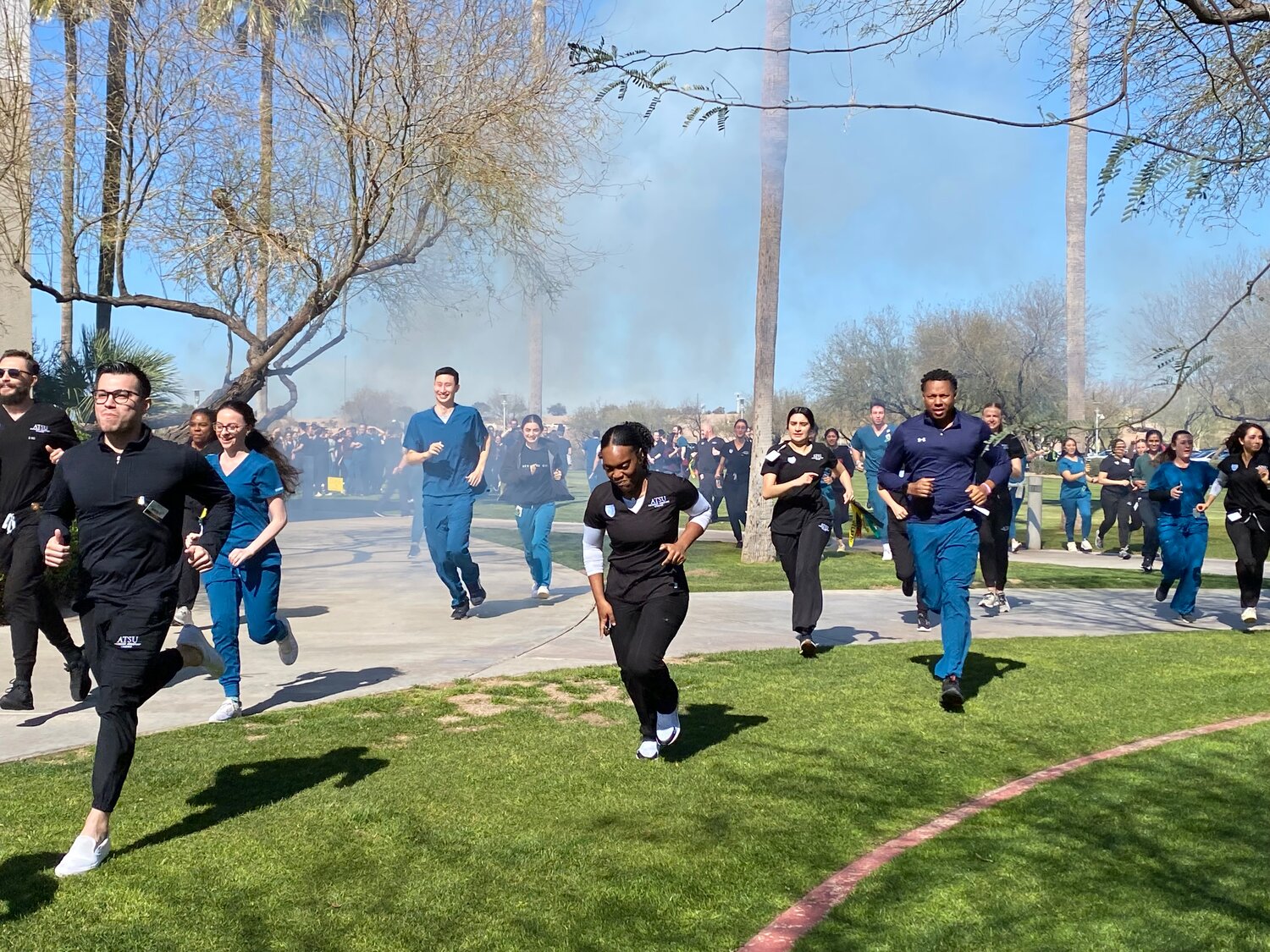
However, this mass casualty event was just a simulation taking place on the lawn in front of ATSU’s School of Osteopathic Medicine at 5845 E. Still Circle in Mesa. It’s a recent annual tradition at the school, where medical, physician assistant and occupational therapy students rush to the scene of a deadly explosion, which was just a smoke machine, and tended to festival-goers, who were actually faculty members and various volunteer actors wearing bloody and tattered clothing. Volunteers from Banner Health as well as medics and nurses from the U.S. Army were also present.
Students in teams treated the wounds of the festival-goers while also questioning and communicating with them to get information on their injuries. Others were practicing lifesaving maneuvers such as CPR on mannequins. Wandering festival-goers searching for their loved ones were approached and helped by students.
Eventually, reinforcements arrived in the form of the military and Mesa Fire and Medical Department. A rescue helicopter landed on the lawn near the festival, signaling the end of the simulation. Students were then debriefed on the event by teachers in a classroom.
This type of event is unique, much more so than a simple multiple-choice exam. But Assistant Professor Dr. Danish Javed believes it’s important for students to be tested in a live environment as opposed to inside a classroom.
“I think experiential learning is really key for some of these hands-on tasks. There’s only so much you can read about something,” Javed said. “Once you get that hands-on experience, it’s a form of learning that just can’t be replicated by textbooks. It’s good to get them exposed to this early on.”
Jordyn Yokoyama, a student involved in the simulation as a first responder, agreed and said she felt more prepared thanks to this simulation. The simulation is not graded. For Yokoyama, the lack of fear of failure makes learning more organic.
“When you’re worried about a grade, it becomes extraordinarily scripted,” Yokoyama said. “I have to do x, y, and z, and it feels less organic. With this format, since you’re not being graded, it’s easier to learn from your mistakes, whereas in a test you are worried that one mistake might ruin your grade. So with this, it’s easier to learn.”
Yokoyama said she feels a little more prepared if a similar incident occurred in real life, thanks to the simulation.
“I think I’m more prepared to do that in the future, I can’t say that things are not going to be different in a real life situation, but at least I feel that I’ve had a little hands-on experience. You know a little more what to do rather than going in blind,” Yokoyama said.
Javed said the simulation can’t be too easy to do. He said that the amount of medical supplies used in the simulation was intentionally diminished from previous years in order for students to be more ready to adapt to the situation at hand. It’s symbolic of one of the most key aspects of this entire simulation: to make quick, lifesaving decisions under duress with limited time and resources. It’s something you can’t teach in a classroom, Javed said.
“Last year, a lot of students preemptively went to the equipment tent, and then ran to their stations,” Dr. Javed said. “We intentionally made equipment scarce, so when students ran out, they had to run back or find other groups and borrow theirs. We wanted that to simulate a real-life environment where resources are scarce, so students will only grab what they need to use. That’s something much better learned experientially than through a textbook.”




Comments
No comments on this item Please log in to comment by clicking here