The Gilbert Public Schools Governing Board gave a final OK to its next budgets June 25, this time with greater certainty than its preliminary approval June 11.
That’s because the Arizona Legislature adjourned in the meantime with a state budget that increased the state’s base-level support by 2% for maintenance and operations budgets and for district additional assistance, which goes to unrestricted capital budgets.
Those were the numbers hoped for when the preliminary budget passed, but having them in place now allowed the district to more confidently project a $269.62 million M&O budget and a $50.62 million capital budget for fiscal year 2024-25.
The board approved the budget package on a 5-0 vote June 25.
Those numbers are smaller than the current fiscal year 2023-24 budget’s second revision, which is at $273.24 million for M&O and $55.27 million for capital. That’s because the district is projecting a loss of 1,200 students in average daily membership, an enrollment-based figure that is a critical part of the state’s funding formula.
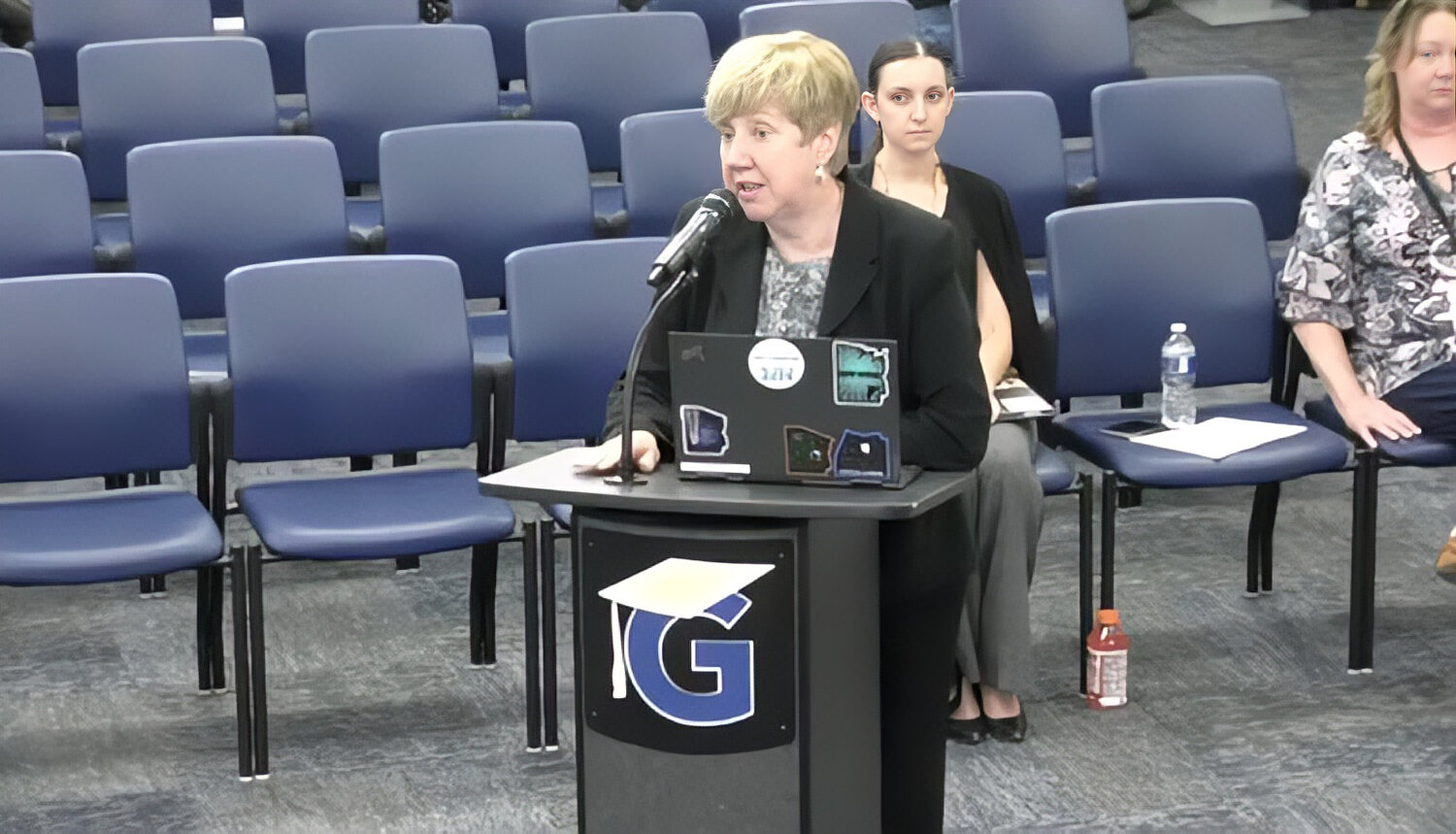
Associate Superintendent Bonnie Betz said the loss is coming from an ongoing decrease in cohort sizes, not from families fleeing the district.
“We're not expecting 1,200 students to just up and leave here in Gilbert Public Schools,” she said. “It's really about cohort movement. So since the pandemic, we have seen smaller class sizes in kindergarten coming to Gilbert Public Schools due to a variety of reasons, young families not moving in, birth rates going down, aging out of our neighborhoods, et cetera.
“So over time, so now we're seeing the effect of the cohort movement. So kindergartners become first grade. So now the first grade is less and then kindergarten is less again, and then the first graders go to second. Second grade is less, and then first grade is less than it was the year before. So really the 1,200 student loss is an accumulation over the last three years of loss.”
The loss is just a projection and the real numbers will not be known until the students show up for classes, which will lead to revisions during the school year. However, Betz said the district has made conservative projections for its budget, and the actual loss has been less than projected, outside of COVID, over the years .
That leads to optimism that the budget will increase upon those revisions and some moves, like a current projection of a $2 million transfer from the capital to the M&O budget will not end up being needed.
One important change of note is that the district did not make its increase to district additional assistance an ongoing increase from which any increase next year would be figured, rather just a one-time increase.
That could come into play at next year’s legislative session and as the district prepares its fiscal year 2025-26 budget.
There was more good news, too. Betz said the district has enough money to absorb the $5.4 million it will have to repay as part of the Qasimyar lawsuit settlement. That money will be repaid through Maricopa County to property owners whose properties were overvalued from tax years 2015-23.
The successful lawsuit against the county had to do with how certain properties were classified for property tax purposes and its effects are hitting school districts and municipalities all over the county.
Because GPS has the money on hand to pay its part of the settlement, the lawsuit has no effect on the district’s budget or its projected property tax rates, Betz said.
It has the money because GPS estimates a 3% delinquency rate on the taxes paid, but Gilbert property owners actually have been on time with their payments at a better rate than that, Betz said.
The estimated combined property tax rate is $5.4518 per $100 assessed valuation, a decrease of $0.2437, a decrease of 4.36%.
In fact, Betz said it is possible the decrease will even be larger than that, perhaps $.35 or more. That would be more than a 6% increase, which would more than offset the typical maximum 5% increase in valuations under state law.
That would mean property taxpayers could see an actual decrease in the amount of property taxes paid, not a small increase with the value increase buffered by a smaller rate.
We would like to invite our readers to submit their civil comments, pro or con, on this issue. Email AZOpinions@iniusa.org. Tom Blodgett can be reached by email at tblodgett@iniusa.org or follow him @sp_blodgett on X.
Meet Tom Tom Blodgett joined Independent Newsmedia, Inc., USA, in 2022, when the company acquired Community Impact Newspaper's Phoenix-area properties. Raised in Arizona, he has spent more than 35 years in journalism in the state.
Community: He has served as an instructional professional in the Walter Cronkite School of Journalism and Mass Communication since 2005, and is editorial adviser to The State Press, the university's independent student media outlet. He also is director of operations for an 18U girls fastpitch softball team from Gilbert.
Education: Arizona State University with a BS in Journalism.
Random Fact: He lived in Belgium during his freshman year of high school.
Hobbies: Tweeting enthusiastically about ASU softball (season-ticket holder) and grumpily about other local sports (pessimistic fan).

 By
By 


Comments
No comments on this item Please log in to comment by clicking here