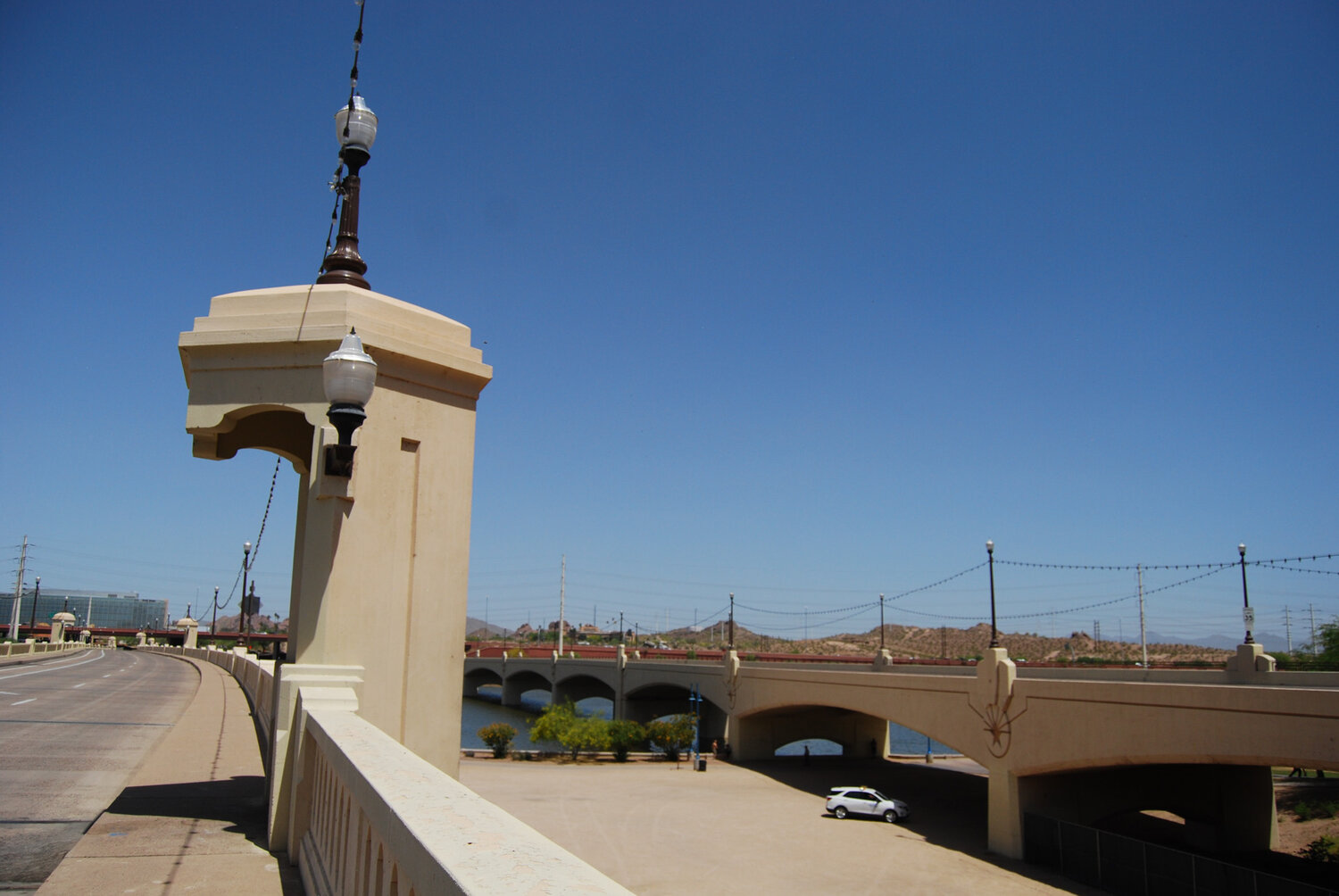
Tempe Historic Preservation Commission recently went over updates from a pilot program that is testing armrests in two of the eight alcoves along Old Mill Avenue Bridge, making changes to the historic landmark to curb the use of the alcoves as shelter spaces.
Old Mill Avenue Bridge is designated as a structure on the Tempe Historic Property Register and is listed on the National Register of Historic Places, according to a city report.
In 2022, the commission considered a plan to install permanent gates at the opening of each alcove, which the commissioners expressed serious reservations about, ultimately tabling the item for a later date. At the time, there were concerns about limiting legitimate uses and potentially damaging the structures.
Then, in 2023, the commission received an updated presentation proposing the installation of removable metal armrests in each alcove that would not create damage and would prevent individuals from lying across the bench inside.
“HPC members were very receptive to staff’s proposal and requested that staff return within six months to allow them time to test the effectiveness of installing armrests in two of the bridge’s alcoves,” the report stated.
Tempe’s Homeless Solutions Task Force was behind the initial request for permanent gates on the alcoves, after being asked to consider options to address trash, graffiti and other needs resulting from unhoused people in the alcoves, according to the report.
“Maintenance of these areas is very staff intensive (and) power washing may eventually damage the bridge materials,” it stated.
Human Services Manager of Homeless Solutions Jessica Wright spoke at the commission’s July 10 meeting about the pilot program, discussing the results since the installation of the armrests on two of the bridge’s alcoves at the southernmost end of the bridge where there has been the most use.
She explained that staff from several city departments has been conducting “Mill walks” since before the armrests were installed to understand the use of the alcoves and to provide resources and services as necessary.
Staff from the Tempe Police Department, the HOPE team, the CARE 7 team and the Homeless Solutions department take these walks daily in a number of areas identified as high need for resources, including Old Mill Avenue Bridge.
After the installation of the armrests, Wright explained that the opportunity for engagements along the bridge had decreased on their Mill walks from 50% of walks having engagement to only 12.7% from November to May.
“The pattern, however, of use stayed very consistent,” Wright said.
But, as she explained, the walks have allowed the city to engage with more unhoused people, connecting them with essential services so that they do not have to find shelter on the bridge’s alcoves and contributing to the reduction in engagement.
Wright noted that the city has been working hard to reduce the number of people experiencing homelessness, with recent numbers showing a 30% or more reduction in homelessness.
Following her presentation, the commission engaged in some discussion of the update, going over the efficacy of the armrests’ design, the way the staff has been interacting with unhoused individuals, how the alcoves are being used and whether the amount of trash has been impacted.
Notably, Wright and other city staff explained that they’ve been taking a human-centered approach to dealing with the unhoused people they interact with and that the armrests have not damaged the bridge since their installation.
When asked if the armrests have accomplished their goals of curbing the use of the alcoves as shelter spaces, Wright said that there isn’t any data to support that as there was a reduction across all eight alcoves.
“However, oftentimes trends and what we’ve seen in our practices and in best practices, are increased engagement and increased presence often leads to increased successes,” she said.
In closing, the commission decided that the pilot program should remain as is at the two alcoves, advising staff to continue collecting data on the armrests’ impact before expanding the program to the remaining alcoves.
Reporter Caroline Yu can be reached at cyu@iniusa.org. To voice your opinion on this story, connect with us at AzOpinions@iniusa.org.
Meet Caroline Caroline Yu joined Independent Newsmedia, Inc., USA, in 2020 as a summer intern covering Scottsdale. As an intern, she continued her coverage of Scottsdale, Paradise Valley and Tempe. After graduating in 2022, Caroline became a full-time reporter for Scottsdale and Paradise Valley. She is currently reporting for the Tempe market.
Community: She is a supporter of the environment and tries to get involved with related community events.
Education: Arizona State University with a BA in Journalism and Mass Communications, with a minor in French.
Random Fact: She used to be a ballet dancer for 10 years.

 By
 Human Services Manager of Homeless Solutions Jessica Wright spoke at the commission’s July 10 meeting about the pilot program, discussing the results since the installation of the armrests on two of the bridge’s alcoves at the southernmost end of the bridge where there has been the most use.


Comments
No comments on this item Please log in to comment by clicking here