Spam calls remain a frustration for Arizona residents, and new federal data show complaints are climbing again after several years of decline.
Arizona residents filed 410,521 complaints about unwanted and spam calls between October 2020 and September 2025, according to a study by SMS verification provider SMSPool. That works out to 5,384.7 complaints for every 100,000 residents, about 35% above the average state rate.
For the study, researchers analyzed the Federal Trade Commission’s National Do Not Call Registry Data Book for fiscal year 2025. The report covered 14,821,289 consumer complaints about unwanted and spam calls filed across the 50 states during the five federal fiscal years from October 2020 through September 2025.
Researchers compared the complaint totals with 2025 resident population estimates from the U.S. Census Bureau to account for differences in population size. This allowed them to compare complaint rates across states on a more equal basis. To measure changes over time, they used the year ending September 2021 as the baseline.
Arizona’s numbers have fallen considerably since that starting point, but the latest figures show complaints are rising again.
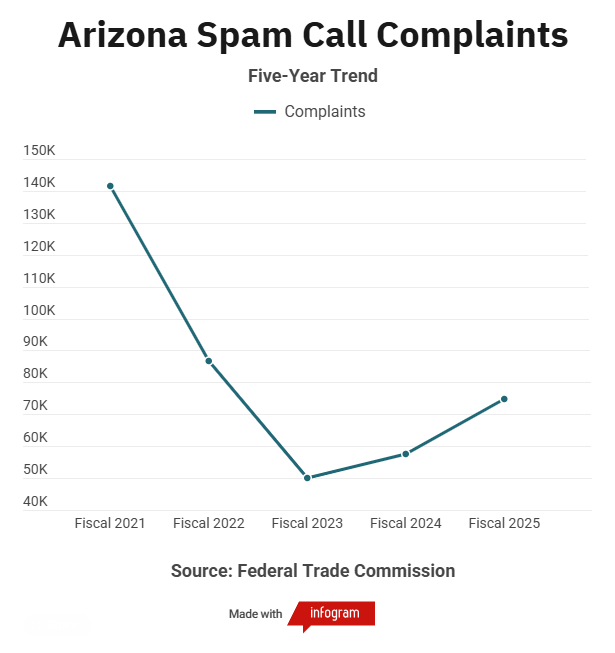
Residents filed 74,752 complaints in fiscal 2025, up from 57,599 the previous year. That represents a 29.8% increase in a single year, adding more than 17,000 complaints to Arizona’s annual total.
Complaints were highest in fiscal 2021, when Arizona residents filed 141,601 reports. The annual total then dropped to 86,564 in fiscal 2022 and reached a five-year low of 50,005 in fiscal 2023. Since then, complaints have increased for two consecutive years.
Even with that recent rise, Arizona’s fiscal 2025 total remains about 47% below its fiscal 2021 level. The longer-term decline offers some perspective, but the recent increases suggest unwanted calls continue to be a concern for residents.
How Arizona stacks up
Arizona ranked 13th nationally in the total number of complaints filed during the five-year period. Its per-capita rate, however, placed it among the states with the highest reported levels of unwanted-call complaints.
Delaware had the nation’s highest rate, with 5,736.4 complaints per 100,000 residents. North Dakota had the lowest, at 1,963.6.
Comparing complaints per 100,000 residents helps put states of different sizes on more equal footing. A state with a larger population may have more complaints overall, but its rate can tell a different story. Arizona’s high rate indicates that complaints were particularly frequent relative to its population during the study period.
Unwanted calls can range from aggressive sales pitches to suspected scams, making it difficult for consumers to know which callers are legitimate. Even calls that do not result in financial losses can disrupt daily routines and leave people wary of answering unfamiliar numbers.
The figures have limitations. They reflect complaints filed with the Federal Trade Commission, not every spam call people received. And because one person can file multiple complaints, the totals do not necessarily represent the number of individuals affected. The data also do not establish how many complaints involved attempted fraud or how much money, if any, consumers lost.
Still, the latest numbers show that after several years of declining complaints, reports in Arizona have risen sharply over the past two fiscal years, keeping the state among those with the highest complaint rates in the country.
“The fall over the past few years suggests the habits people picked up are doing their job. Screening a call used to feel rude, and these days it is ordinary,” stated Chen Bao of SMSPool in a news release.
“Set your phone to send unknown numbers straight to voicemail. Most handsets have the setting built in, it takes one toggle, and the calls you want still reach you through a message you can read at your own pace. A genuine caller says who they are and what it is about, and a recorded voice asking you to confirm your details is one you can delete without a second thought.
“Walk the older relatives in your family through the same setting,” Bao added. “They are often the ones still answering everything that rings.”
Matt Loeschman has had two separate stints at Independent Newsmedia. He began as a reporter covering Peoria and later Surprise from 2000-2009. In 2018, he returned to Arizona and INI as the news editor of the Daily News-Sun (now the Phoenix Independent). He previously covered the Arizona Rattlers of the Indoor Football League for more than a decade.
Community: During high school football season since 2018, he contributes live postgame radio reports to the AIA Friday Night Football Wrap Up Show. He supports organizations such as Phoenix Children’s, Boys and Girls Clubs of the Valley and the American Cancer Society.
Education: The University of Texas at Austin majoring in Journalism-News and Public Affairs.
Random Fact: He can sing and he has been fortunate to meet many famous people during his journalism career including First Lady Hillary Clinton, King of Country Music George Strait and Oscar-winning actor Matthew McConaughey. Attended all 4 home games of the 2001 World Series.
Hobbies: Watching and playing a wide variety of sports, including golf, tennis, pickleball and softball. Playing PlayStation 5, working out, shopping and reading.


 By


Comments
No comments on this item Please log in to comment by clicking here