Gilbert departments come together after water main break
Crews worked through a holiday weekend to fix a water line break that flooded the intersection of Cooper and Elliot roads in Gilbert.
Courtesy Town of Gilbert
One of Gilbert’s assistant town managers, Leah Rhineheimer, likes to say infrastructure is the unsung hero of a town — needed by all, counted on, but taken for granted.
When it fails, though, people notice. It is at best an inconvenience, at worst a disaster.
This is a story about how Gilbert responds when a major failure occurs, in this case, a broken pressurized water main under the street at the intersection of Elliot and Cooper roads. That failure put a major arterial intersection out of commission for six days on a holiday weekend.
You must be a member to read this story.
Join our family of readers starting at $5 for your first month and support local, unbiased journalism.
One of Gilbert’s assistant town managers, Leah Rhineheimer, likes to say infrastructure is the unsung hero of a town — needed by all, counted on, but taken for granted.
When it fails, though, people notice. It is at best an inconvenience, at worst a disaster.
This is a story about how Gilbert responds when a major failure occurs, in this case, a broken pressurized water main under the street at the intersection of Elliot and Cooper roads. That failure put a major arterial intersection out of commission for six days on a holiday weekend.
It is not a story of just digging it up and repairing it. It involves a myriad of complex issues and coordination among multiple departments — water, streets, purchasing, police, fire and rescue, digital government (communications) — plus a couple of outside contractors and public utility companies.
Water on the road
The story starts with an unknown resident. At 2:55 a.m. Friday, Dec. 30, police dispatchers received a call from that person. There’s water on the road at Elliot and Cooper.
“Truthfully, we have in the town several hundred thousand sensors to help us pay attention to and report on failures that happen within the infrastructure,” Town Engineer David Fabiano said. “And they're you and I, all the residents of the town. … We really encourage and welcome and appreciate feedback about things that people see that look unusual — something looks weird or something doesn't look right.”
Fabiano said a “huge amount” of information comes in from residents through Gilbert’s 3-1-1 app or other sources on the billions of dollars of infrastructure assets that the town owns and maintains. That could be as mundane as damage to a sign or as impactful as a water main break at a major intersection.
A Gilbert police patrol responded to the call a short time later and finds there is indeed water bubbling up in the intersection. That merits a phone call. Gilbert has a meter person staffed 24-7 to take such calls and see what is up. On this night, it’s Alex Reyes, a senior water meter technician.
Reyes can then determine if the situation requires an escalation and more resources be brought in. That is clearly the case here.
The leak
No one can say for certain what caused the pipe leak or when it started. But enough is known to have some fair ideas.
The pipe itself is 12 inches in inside diameter, made of PVC, of a type called C900. Its intended use is for water transmission while buried under roadways and is commonly used in town. The water is pressurized at 80 pounds per square inch, a pressure that would be trouble for a resident’s pipes at home. This pipe was laid in 1987.
In the intervening 35 years, innumerable tons of vehicles have run over that roadway with the water pipe underneath the ground about 10 feet.
A split in a water pipe is what flooded the intersection at Cooper and Elliot. (Courtesy Town of Gilbert)
Courtesy Town of Gilbert
The leak started as a split in the pipe, and Fabiano said several things could have caused that. One is water hammer — a pressure surge or shockwave that can happen in pipes where waterflow is controlled with valves — or, more generally, pressure transient, which is a change in pressure over time.
Another is external loading, something that could happen if the pipe was bedded poorly when it was constructed. If the pipe was out of round, for example, that puts additional pressure on the pipe’s sides. Or thermal cycling that happened as things grew warmer, then cooler.
Whatever it was, “That failure looked like it was something that was probably developing for a long time,” Fabiano said.
As to when that split developed into a leak, that cannot be pinpointed, either, but the range is a little more certain: hours at the most, likely less.
“As soon as there is a break in the line of any sort, the water's getting out,” Fabiano said. “And when the water's getting out, it's going somewhere, and when the water's going somewhere it, it's usually traveling horizontally and then it's usually traveling vertically as well because there's pressure driving it coming out of the main. … Eighty pounds per square inch is a lot of pressure, and water is really good at finding its way through.”
As an aside, Fabiano said a potable water leak is much different from a wastewater leak besides the ick factor. The pressure in sewer lines is mostly just gravity. It can take years to discover there has been a failure, usually by means of a sinkhole reaching the surface.
Where’s the leak?
While Gilbert PD and public works crews can tell there is a water leak, they cannot tell where it is coming from, at least at first.
The roadway is older. The intersection actually is slated for a capital improvement project to reconstruct and reconfigure it in just a few months. A little bit of water is coming up from cracks in the pavement at several different places — ultimately, in fact, away from where the source is.
The water is pushing out the base of the road from the cracks. There is evidence of dirt and things being pushed out of those cracks on three different intersection quadrants by the curbs where the sidewalk pedestrian ramps are.
Water from the leak pushed dirt out cracks in the road and caused the road to buckle. (Courtesy Town of Gilbert)
Courtesy Town of Gilbert
Gilbert crews do not even know if the leak is really from infrastructure belonging to the town. But the town has a blue-stake group that can locate from records where the infrastructure is located.
“There's a lot of other conflicting infrastructure in that intersection, and they were able to take a look and give SRP a call,” Gilbert Water Manager Rebecca Hamel said. “They had some infrastructure, and we narrowed it down to, ‘yeah, this is ours.’ And so then we got our distribution folks out there, got a backhoe out there, got the main isolated, and then started excavating.”
Even if it is not the leak source, that Salt River Project irrigation lateral is problematic. It is a 48-inch line, under about a foot and half of material from the street. The town’s pipe is below that, so workers will have to work under the SRP line, which becomes unsupported after excavation — a safety issue. It is a tight placement.
The town has some drawings that show the SRP line to be abandoned, but the utility is unable to confirm it immediately. It is a 120-year-old utility, and old documentation is not readily available. If it is not abandoned and the line is damaged during the water pipe repair, that is a whole new water mess. No one is going to take any chances around that line until it can be confirmed as abandoned.
Furthermore, as crews dig to the water line, the leak is getting progressively worse. The pressure of the water going through the split in the pipe finally blows out a side of the pipe in a massive tortilla-chip shape. It could easily be a few thousand gallons a minute of water coming up to the ground now.
The leak's proximity to to a large abandoned SRP line created challenges. (Courtesy Town of Gilbert)
Courtesy Town of Gilbert
The water also is blowing out material around the pipe and creating a sinkhole in the road. That’s going to make this a “much bigger and ugly” job, Fabiano said.
Answering the call
Jeanne Jensen has had the past four days off for vacation, but she has not requested Friday, which is the first day of the weekend for Gilbert employees, who typically work four 10-hour days a week. She is in bed just before 7 in the morning when she rolls over to check her email.
On it there’s a notification of a water outage. Hamel’s water team has set up an email notification system on water outages for people who need to know. Jensen, a supervisor over capital projects for the water, is one of those people. Most notifications are routine, such as for scheduled maintenance. This one is not.
“I saw (the email),” she said. “‘Oh my gosh, there's an outage. There's a main break at Cooper and Elliott. Ooh, that's a rough spot to have one. Oh, it's a 12-inch break. Oh, that's not good.’ And then the next line of the email said something like, ‘substantial asphalt repairs are going to be required.’”
There will be no Friday off for Jeanne Jensen.
This will not be just a long day for her, but a complete change in routine. Jensen is the project manager over the North Water Treatment Plant renovation and expansion, the largest capital improvement project in town history, one that figures to be her life for the next few years. She spends most of her days in a trailer on the NWTP site.
But she is also the right person for this job.
“She's an individual who's very willing to step up and lend a hand,” Fabiano said of Jensen. “And so that's something that the divisions have learned that they can reach out if they’re feeling a need. If there's something that they're like, ‘OK, what should I do now?’ And she's the one, she'll step up and help them in that situation. Part of it is that she knows how. And the other part is that she's willing to go above and beyond.”
Jensen texts the people listed in the email: Daniel Garcia, a water distribution employee, and Steve Notch, a supervisor in the water division who has responsibility over the valve maintenance program and the locators who are busy finding the utility lines.
“I just said, ‘you guys good? You need anything?’” Jensen said. “And it was one of those, ehhhh, you don't get a response. And then they said, ‘yeah, we're going to need help.’ So I got the kids organized, and I left for the site.’”
Main breaks are typically just another day in the office for the utility. They routinely respond without issue to them, but this one goes beyond that.
“Had that pipe not been so tightly placed in that intersection as well as the complexity of the intersection, just managing traffic safely and everything like that, it likely would've been something that they could have very quickly handled on their own,” Jensen said.
Notch did have one additional request.
“He said, ‘could you please bring coffee? I've been out here for a while, and I'm cold and it's raining,’” Jensen said.
By 9:30 a.m. Jensen is on site with two coffees, one for her and one for Notch.
Marshaling forces
By the time Jensen arrives, a number of critical steps have already been taken. Police, first on the scene, have established a hard closure for the intersection with signs directing traffic to alternative routes. Public Information Officer Levi Leyba also is the one who put out a first social media notice from the town, at 6:35 a.m., on the closure.
Once the blue stake group has identified the utilities in the intersection, the utilities have been called on site. SRP has identified where its active line is, away from the leak location, and even agreed verbally that the line by the leak is probably abandoned.
Kinder Morgan has a 600-psi natural gas line in the intersection but has confirmed it is unaffected.
The town also has a 42-inch gravity sewer line in the intersection. Town workers know the leak is not waste, but they have popped the manhole lid and looked to make sure the water in the area is not impacting it. All is well.
And once the source is identified, workers shut the proper valves off and depressurized the line.
Here, the town catches a big break. Only one water customer is affected by the water being shut off. And while even that could be bad — the customer is a surgical center. But when contacted, the center tells the town it is closed for the holiday weekend and will be unaffected by the water being shut off.
Shutting off a valve also means alerting the Fire & Rescue Department, so firefighters are aware, just in case.
Police also remain involved. Though signs have been put up 1 mile away in each direction that the intersection is closed, motorists still drive toward the closure, then try to cut through parking lots. That is a safety issue and draws complaints from the businesses whose lots are being used as a throughway. Police post officers to direct traffic away.
The water department also had secured a contractor to start excavation as the town looked for the leak. Gilbert has a number of job-order contractors for situations like this, including five that support the town on pipelines.
In this case, Shayne Cook at Archer Western is getting the call because that company is well positioned to take it this day. It has a yard at a nearby water reclamation plant and is in the middle of supporting the town on a manhole rehabilitation project. Thus, they also have crews that are ready though it is a holiday weekend.
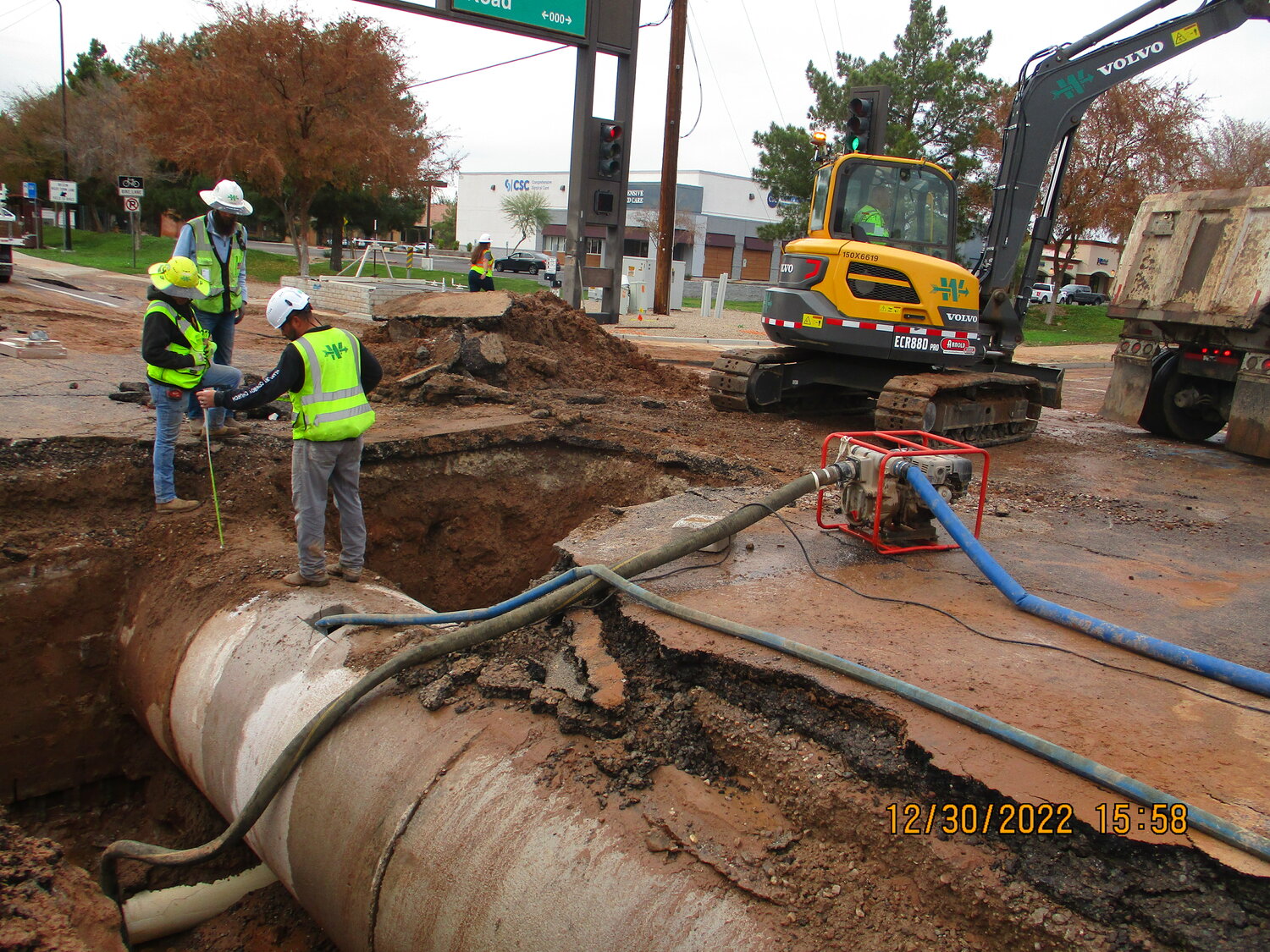
The road had to be excavated to access the leaking line. (Courtesy Town of Gilbert)
Courtesy Town of Gilbert
Proceeding with repair
The crews have to “dewater” the area from the leak as they excavate.
“The way that the line broke, and the valves that are up and downstream, they weren't able to get a tight closure,” Jensen said. “So we had some nuisance water that was continuously coming up. So we had pumps running to remove that water.”
Crews find the break in the pipe. And they also find the piece, maybe 2 feet by 6 inches in size, that was blown out from the split.
“That tortilla chip of plastic had actually gotten up through the dirt, had gotten to the surface of the asphalt and was actually found about 35 feet away from the break under the asphalt,” Jensen said. “They saw a little crack in the asphalt. They opened it up and there was this sort of little Easter egg of plastic.”
A large "tortilla chip"-shaped piece of pipe was blown out from the water line. (Courtesy Town of Gilbert)
Courtesy Town of Gilbert
About 20 feet of pipe is going to need to be replaced, but Jensen said the point is too close to SRP’s 48-inch line to thread the pipe safely underneath it. Workers will need to investigate to see if that SRP line is truly abandoned. That’s a problem without the documentation immediately available.
“There are going to be times where there's infrastructure that is appropriately abandoned but not completely documented,” Jensen said. “I can reflect on our own (documents) where some of them, especially when they date far enough back, they'll use a reference point of Mrs. Smith's mailbox, and Mrs. Smith's mailbox, there's no evidence it ever existed. Mrs. Smith has been gone for 50-plus years.”
It could take days to get an official confirmation from SRP because of the holiday, but leaving a giant hole in a major intersection for that period of time is not an option.
“So they cut a hole in the top, and sure enough it was about half full of water, but it was clearly not in service,” Jensen said.
How the water got there is uncertain. It could have been the leak. Or the line could have been intruded upon by rain over the years. Nonetheless, crews can safely proceed. Workers also need to make certain the water line on the other side of SRP’s abandoned line is not also compromised.
Because the pipe is more than 5 feet down, workers will have to shore up the work site so the sides won’t cave in on someone working in the hole. The dirt and water make it unstable. They want aluminum shoring boxes for its flexibility and lesser weight in moving it around, but they cannot get it on the holiday. They settle for steel.
Determining where the leak was, excavating and securing the site has taken some time, but the repair itself takes little time.
“They pulled (the old pipe) out, and then once it's out, the repair was actually extremely quick,” Jensen said. “They had gotten the pipe material on site. They had all the appropriate repair clamps in hand. That new piece of pipe that's in is duct iron now. It's much more robust and should hold up for a long, long time.”
It’s repaired by 1:35 a.m. Saturday, Dec. 31, and charging the water line starts by 3 a.m.
Paying the bill
Gilbert has a program for checking every water valve within a six-year cycle and is initiating a transmission main assessment. That way it can catch critical pipes that need refurbishment before a break occurs in most cases. But it cannot be in front of every break. Fabiano said the town is trying to find a balance between being “helicopter parents” on the lines and just letting them out into the wild.
“We only took out a 20-foot section of pipe,” Jensen said about the Elliot and Cooper repair. “But because of all the secondary damage, it's not unusual for a main break to be two to 10 times more expensive than a planned repair. And that's true here where 20 feet of pipe is going to cost us somewhere between $150(,000) and $200,000 for the repair. And that's a lot more than we want to spend.”
But knowing that breaks are just part of business, Gilbert is prepared for such emergency expenditures. Any expense of more than $100,000 requires approval from Town Council.
But in an emergency, when the town cannot just go through its typical procurement process, everyone up the chain of command and council is informed that there is a public works emergency. It’s part of the town’s procurement code.
“If there is something that affects the safety, the welfare of the citizens, the town staff has the authorization to move quickly to mobilize to make sure this addressed,” Gilbert Purchasing Manager Jim Campion said. “You don't want to go through the bureaucratic process, putting out a formal bid and waiting a couple months while the intersection's closed.”
Having those job-order contractors on standby is part of the process. They have competitively bid for the right to step into these situations, Campion said.
“I check my emails on the weekends and obviously Jeanne over in (capital improvement projects) wrote it up, sent an email to all the parties, me included,” Campion said of this situation.
Campion said Jensen will document the expenses and fill out the paperwork for approval from him and Public Works Director Jessica Marlow. Then it will go to council for retroactive approval.
More obstacles
Once the repair is made, the pipe is disinfected and flushed because drinking water is going to flow through it. None of the muck from the excavation can be left behind. Once that’s done, water service is restored to the surgical center. That was done by 11:15 a.m. Monday, Jan. 2.
But the street is a mess with a 10- to 12-foot deep hole at the site. The intersection is torn up. It cannot be left in this state for the weekend, much less reopened for traffic.
Archer Western could not find a concrete company that was willing to open for it on the holiday weekend. Jensen called around to the town’s other contractors. Finally, one found a company that would batch fresh concrete on site.
Crews were able to fill in the hole before the holiday. (Courtesy Town of Gilbert)
Courtesy Town of Gilbert
“We could get that hole filled in as soon as the pipe was in place — because we don't want to leave a hole that's 20 feet wide and 12 feet deep, especially while it's potentially raining and everything else,” Jensen said.
The same was true for the asphalt companies, which also closed early Friday ahead of the holiday weekend. But the pavement can wait through the weekend.
As it turns out, an extra day, too. Asphalt contractor RD Sanders inspected the site Friday to see the damage with plans to pave Tuesday after the holiday weekend. But rain on Tuesday pushed it back one day further so as not to have water in the roadway base. That was especially true here because the corner near where the leak was located was so saturated.
Finally, the intersection’s paving is completed Wednesday midafternoon, and the intersection is reopened a little after 7 p.m. Wednesday, Jan. 4. The town’s digital team, which has provided periodic updates to the community, puts out the word at 7:35 p.m. to motorists that they can resume traversing the intersection.
Aftermath
Gilbert had 10 water-main breaks in 2022, not an unusual number.
“Those are from various causes,” Hamel said. “Some of them happened because of infrastructure age; some of them happened because a contractor hit something, things like that.”
But none were as impactful as the one at Elliot and Cooper at year’s end as that one came in a busy intersection. More often it happens in a neighborhood, for example.
This one also took longer than normal because it was a holiday weekend with rain. Jensen estimates it normally could be done in about 36 hours.
The final bill on the repair came to $177,149.66. It will go to council for approval.
This repair won’t be the last time the intersection of Elliot and Cooper is worked on. It is scheduled for a $7.15 million intersection improvement project that includes widening to accommodate additional lanes as justified by traffic studies, a traffic signal and related drainage improvements. Work should start later this year.
In a sense, it is unfortunate that the leak happened at an intersection with a project of that magnitude coming up. But it could have been worse, Gilbert Assistant Public Works Director Eric Braun points out.
“Thank God it happened before and not after we finished that intersection,” he said.
Tom Blodgett can be reached by email at tblodgett@iniusa.org or follow him @sp_blodgett on Twitter. We would like to invite our readers to submit their civil comments, pro or con, on this issue. Email AZOpinions@iniusa.org.
Tom Blodgett Senior News Editor | Gilbert @sp_blodgett
Meet Tom Tom Blodgett joined Independent Newsmedia, Inc., USA, in 2022, when the company acquired Community Impact Newspaper's Phoenix-area properties. Raised in Arizona, he has spent more than 35 years in journalism in the state.
Community: He has served as an instructional professional in the Walter Cronkite School of Journalism and Mass Communication since 2005, and is editorial adviser to The State Press, the university's independent student media outlet. He also is director of operations for an 18U girls fastpitch softball team from Gilbert.
Education: Arizona State University with a BS in Journalism.
Random Fact: He lived in Belgium during his freshman year of high school.
Hobbies: Tweeting enthusiastically about ASU softball (season-ticket holder) and grumpily about other local sports (pessimistic fan).
town of Gilbert,
Gilbert Public Works Department,
David Fabiano,
Jeanne Jensen,
Rebecca Hamel,
Jim Campion,
Eric Braun,
Leah Rhineheimer,
Alex Reyes,
Daniel Garcia,
Steve Notch,
Levi Leyba,
Elliot Road,
Cooper Road,
Salt River Project,
Kinder Morgan,
Shayne Cook,
Archer Western,
RD Sanders

 By
By  “Truthfully, we have in the town several hundred thousand sensors to help us pay attention to and report on failures that happen within the infrastructure,” Town Engineer David Fabiano said. “And they're you and I, all the residents of the town. … We really encourage and welcome and appreciate feedback about things that people see that look unusual — something looks weird or something doesn't look right.”

 “There's a lot of other conflicting infrastructure in that intersection, and they were able to take a look and give SRP a call,” Gilbert Water Manager Rebecca Hamel said. “They had some infrastructure, and we narrowed it down to, ‘yeah, this is ours.’ And so then we got our distribution folks out there, got a backhoe out there, got the main isolated, and then started excavating.”
 “I saw (the email),” she said. “‘Oh my gosh, there's an outage. There's a main break at Cooper and Elliott. Ooh, that's a rough spot to have one. Oh, it's a 12-inch break. Oh, that's not good.’ And then the next line of the email said something like, ‘substantial asphalt repairs are going to be required.’”

 “If there is something that affects the safety, the welfare of the citizens, the town staff has the authorization to move quickly to mobilize to make sure this addressed,” Gilbert Purchasing Manager Jim Campion said. “You don't want to go through the bureaucratic process, putting out a formal bid and waiting a couple months while the intersection's closed.”


Comments
No comments on this item Please log in to comment by clicking here