Hobbs would welcome chance to appoint 2 to Arizona Supreme Court
Bolick, King up for election in November, targeted after abortion decision
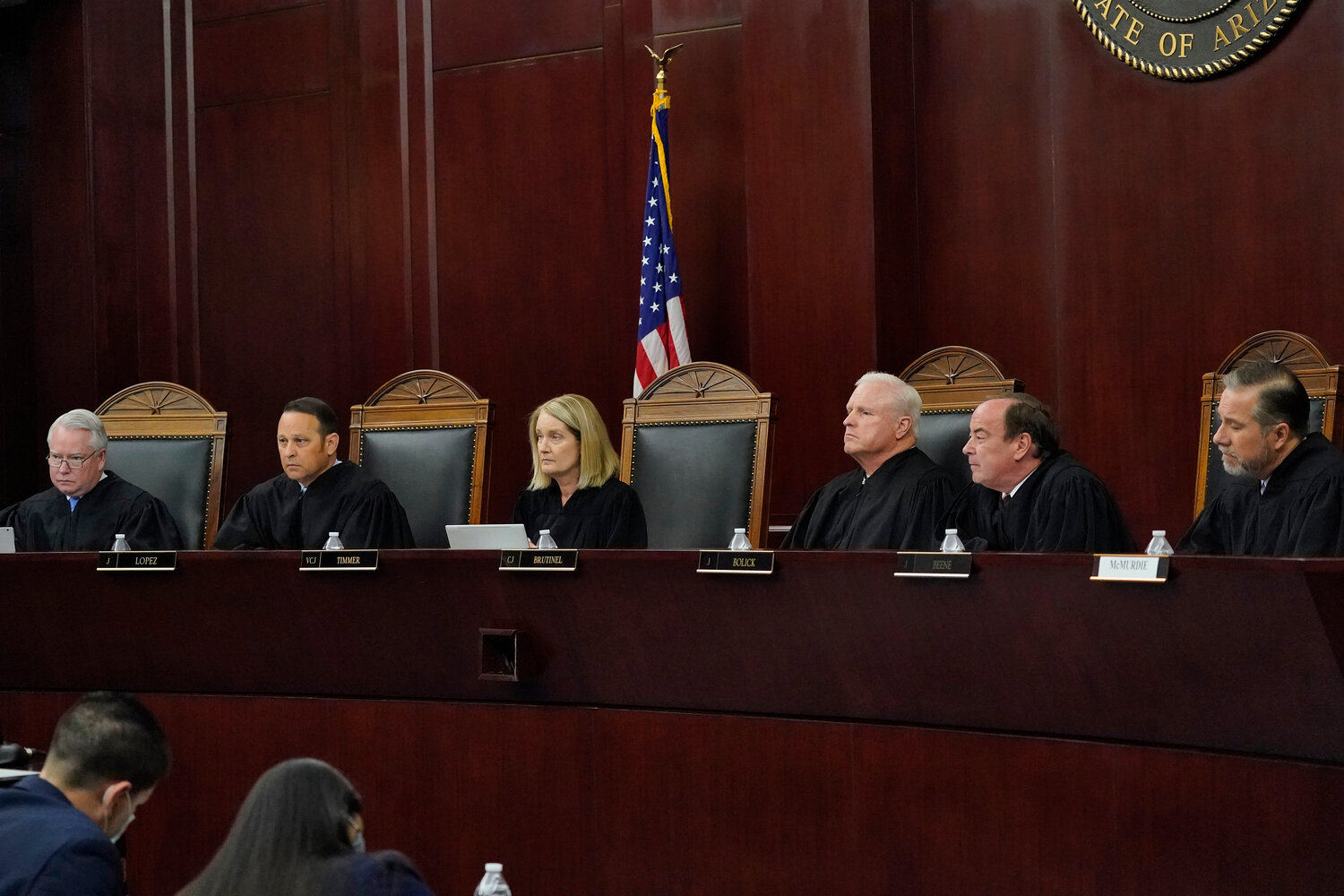
Arizona Supreme Court Justices from left, William G. Montgomery, John R Lopez IV, Vice Chief Justice Ann A. Scott Timmer, Chief Justice Robert M. Brutinel, Clint Bolick and James Beene listen to oral arguments on April 20, 2021, in Phoenix. (Associated Press/Matt York)
Matt York
PHOENIX — Gov. Katie Hobbs says she’d sure like to have the chance to put two people of her choice on the Arizona Supreme Court.
“No governor’s going to turn that down, for sure,” she told Capitol Media Services.
But Hobbs said she won’t take a side in the debate about whether justices Clint Bolick and Kathryn King, who have to stand for election in November, should be retained for six-year terms or removed — what would give her a chance to put her imprint on the state’s high court. That, she said, is a decision people will have to make when they fill out their ballots.
You must be a member to read this story.
Join our family of readers starting at $5 for your first month and support local, unbiased journalism.
Click here to see your options for becoming a subscriber.
Register to comment
Click here create a free account for posting comments.
Note that free accounts do not include access to premium content on this site.
I am anchor
Government
Hobbs would welcome chance to appoint 2 to Arizona Supreme Court
Bolick, King up for election in November, targeted after abortion decision
Matt York
Arizona Supreme Court Justices from left, William G. Montgomery, John R Lopez IV, Vice Chief Justice Ann A. Scott Timmer, Chief Justice Robert M. Brutinel, Clint Bolick and James Beene listen to oral arguments on April 20, 2021, in Phoenix. (Associated Press/Matt York)
PHOENIX — Gov. Katie Hobbs says she’d sure like to have the chance to put two people of her choice on the Arizona Supreme Court.
“No governor’s going to turn that down, for sure,” she told Capitol Media Services.
But Hobbs said she won’t take a side in the debate about whether justices Clint Bolick and Kathryn King, who have to stand for election in November, should be retained for six-year terms or removed — what would give her a chance to put her imprint on the state’s high court. That, she said, is a decision people will have to make when they fill out their ballots.
Ditto, Hobbs said, of the question of whether they should be ousted based on their ruling last month on the state’s 1864 abortion law, with Bolick and King providing two of the four votes on the six-member panel to uphold that old law.
But the governor also suggested she is opposed to a measure being pushed by Sen. David Gowan to alter the Arizona Constitution to strip voters of that power to make that choice of keeping or ousting sitting judges.
“I am glad that we have a chance at retention elections and voters can make their feelings known about it,” Hobbs said.
If voters do decide that Bolick and King have to go, that would create two vacancies for Hobbs to fill. And that could change the political balance on the court: If Bolick and King — both appointees of Republican predecessor Doug Ducey — were not there, the April 9 court ruling about abortion might have been different.
That’s because two of the six justices sitting on the case — Republican William Montgomery recused himself — actually sided with Planned Parenthood and its arguments that a 2022 law allowing abortions up to 15 weeks of pregnancy superseded the 1864 law. Hobbs appointees might have sided with them and the vote could have been 4-2 to nullify the territorial-era law, all without the need for the Legislature to subsequently vote to repeal the law.
The question of whether Hobbs gets to make her mark on the state’s high court — she has not named any of the justices now serving — is not occurring in a vacuum.
Progress Arizona, a progressive political action committee, has launched a drive to convince Arizonans to vote “no” when they are asked in November whether Bolick and King deserve a six-year term.
The organization’s Abigail Jackson made it clear that what’s driving that is their vote on the abortion issue.
“Voters across the board are angry about this ruling,” she told Capitol Media Services. “This decision is not in line with what voters want.”
Jackson said it’s irrelevant whether people believe the majority reached the right legal conclusion about the interplay between the territorial-era that outlaws abortion except to save the life of the mother and the more recent 15-week statute.
“If Arizona voters want to use the power that the constitution gives them to hold them accountable, and their main concern is this ruling, then I think voters are within their rights and power to do so,” she said.
Hobbs, asked about the issue on Tuesday, agreed.
“That is up to the voters,” she said.
It’s also not like politics has not played a role in who gets to serve on the Arizona Supreme Court.
A governor filling a vacancy does have to select from nominees screened by the Commission on Appellate Court Appointments. But that practice can be gamed, as Ducey did when he was governor, by choosing panel members from only one party.
Then there’s the fact Ducey convinced the Republican-controlled Legislature to expand the court, from five to seven, despite the fact all sitting justices from both parties called that unnecessary. That gave Ducey two immediate picks without anyone having to leave the court.
All this also comes against the backdrop of Gowan’s measure to change the system.
Right now, all Supreme Court justices stand for election on a retain-or-reject basis two years after they are first picked. If voters approve, they get six year terms.
That system, approved by voters in 1974, is what is forcing Bolick and King to face voters in November.
Gowan’s measure, by contrast, asks voters to alter the system so that, once chosen, Supreme Court justices could serve until they reach mandatory retirement age of 70 pretty much without having to fear they might be turned out of office.
Under his SCR 1044, the only time their names would have to be on the ballot would be because of bad behavior, ranging from a felony conviction to personal bankruptcy, foreclosure on a mortgage or a determination by the Commission on Judicial Performance Review that the judge does not meet standards.
Of particular note, however, is how Gowan crafted his measure.
Put simply, if voters approve SCR 1044 on Nov. 5, the constitutional change would be retroactive to Oct. 31. And that would make moot any other vote on Nov. 5 to oust either Bolick or King from the court — even if a majority of Arizonans do not want them to have another term.
Gowan already has ushered the measure through the Republican-controlled Senate on a party-line vote. But its future is uncertain as it is currently stalled in the House.

 By
By 


Comments
No comments on this item Please log in to comment by clicking here