Two Numbers Moved in September. Only One of Them Helps Sellers.
Your selling-season market update: what the summer did to the numbers.
October begins our selling season. Before buyers arrive, here's what the summer did to the numbers. Two moved in September, and they point in opposite directions.
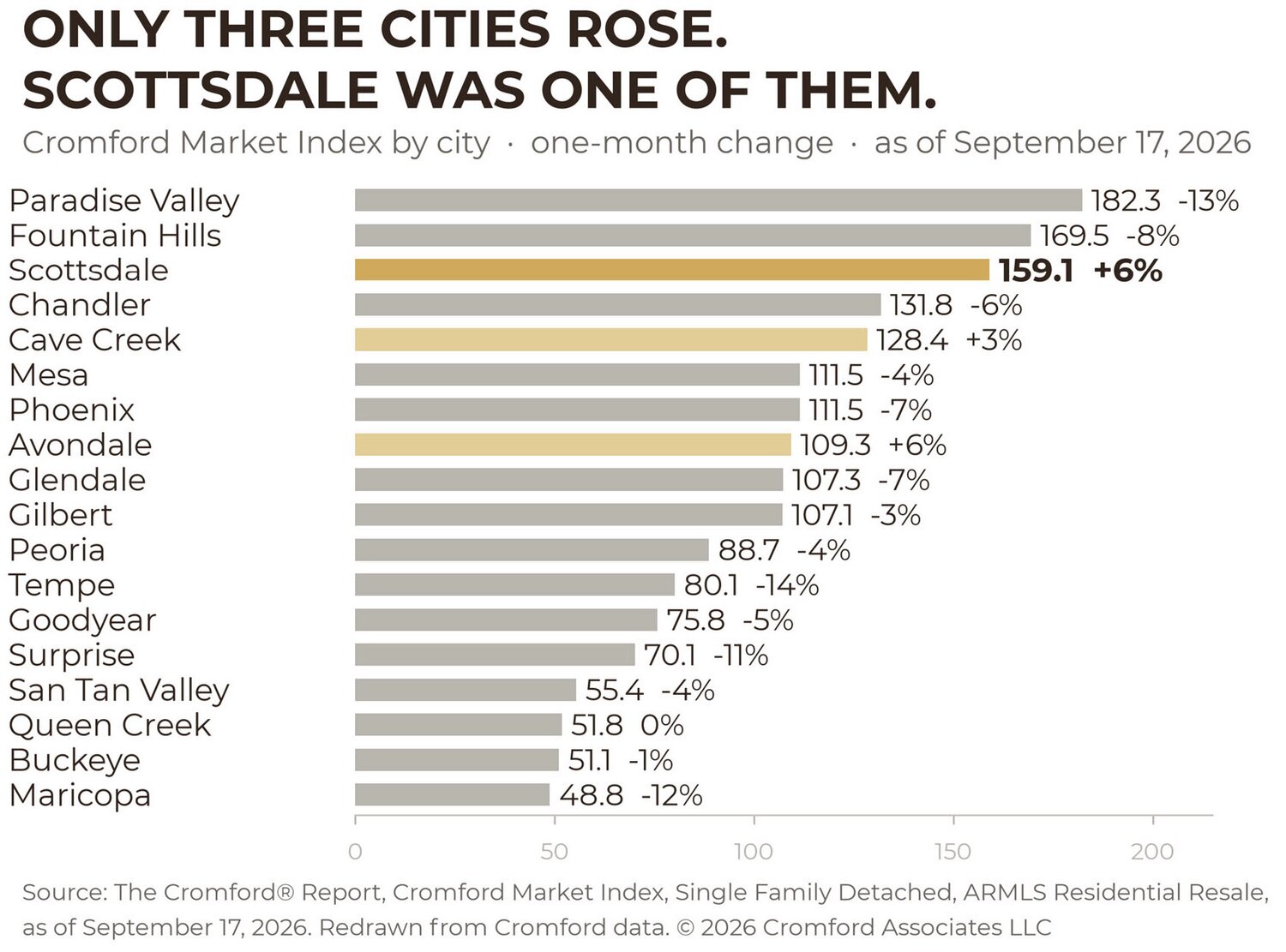
The first is the Cromford Market Index for Scottsdale, up 6% in a month to 159, where 100 is balanced. It sounds modest until you see the rest of the Valley. Chart 1 tells the story. Of the 18 cities Cromford tracks, fifteen cooled or held flat. Paradise Valley fell 13%. Tempe fell 14%. Only three cities strengthened, and Scottsdale was one of them. We now sit third in the Valley, behind only Paradise Valley and Fountain Hills.
The second is the one buyers actually feel: the mortgage rate. On September 16 the Federal Reserve raised its benchmark rate a quarter point, its first increase in more than three years. Freddie Mac's weekly average, in the mid-6s all summer, jumped to 6.95% that week, and daily quotes crossed 7%. The quarter point isn't the part that matters. The Fed said this may not be the last one.
You must be a member to read this story.
Join our family of readers starting at $5 for your first month and support local, unbiased journalism.
October begins our selling season. Before buyers arrive, here's what the summer did to the numbers. Two moved in September, and they point in opposite directions.
The first is the Cromford Market Index for Scottsdale, up 6% in a month to 159, where 100 is balanced. It sounds modest until you see the rest of the Valley. Chart 1 tells the story. Of the 18 cities Cromford tracks, fifteen cooled or held flat. Paradise Valley fell 13%. Tempe fell 14%. Only three cities strengthened, and Scottsdale was one of them. We now sit third in the Valley, behind only Paradise Valley and Fountain Hills.
The second is the one buyers actually feel: the mortgage rate. On September 16 the Federal Reserve raised its benchmark rate a quarter point, its first increase in more than three years. Freddie Mac's weekly average, in the mid-6s all summer, jumped to 6.95% that week, and daily quotes crossed 7%. The quarter point isn't the part that matters. The Fed said this may not be the last one.
So which number wins? That depends on who's selling, and how long they wait.
First, where the index came from. Spring was decent, not spectacular. Then in June both sides stepped back at once. Sellers, because most owners here have plenty of equity and don't need to sell unless life is pushing them somewhere new. Buyers, because they don't feel pushed either. In Terravita, where I track every contract, July produced zero. That hasn't happened in the sixteen years I've kept records.
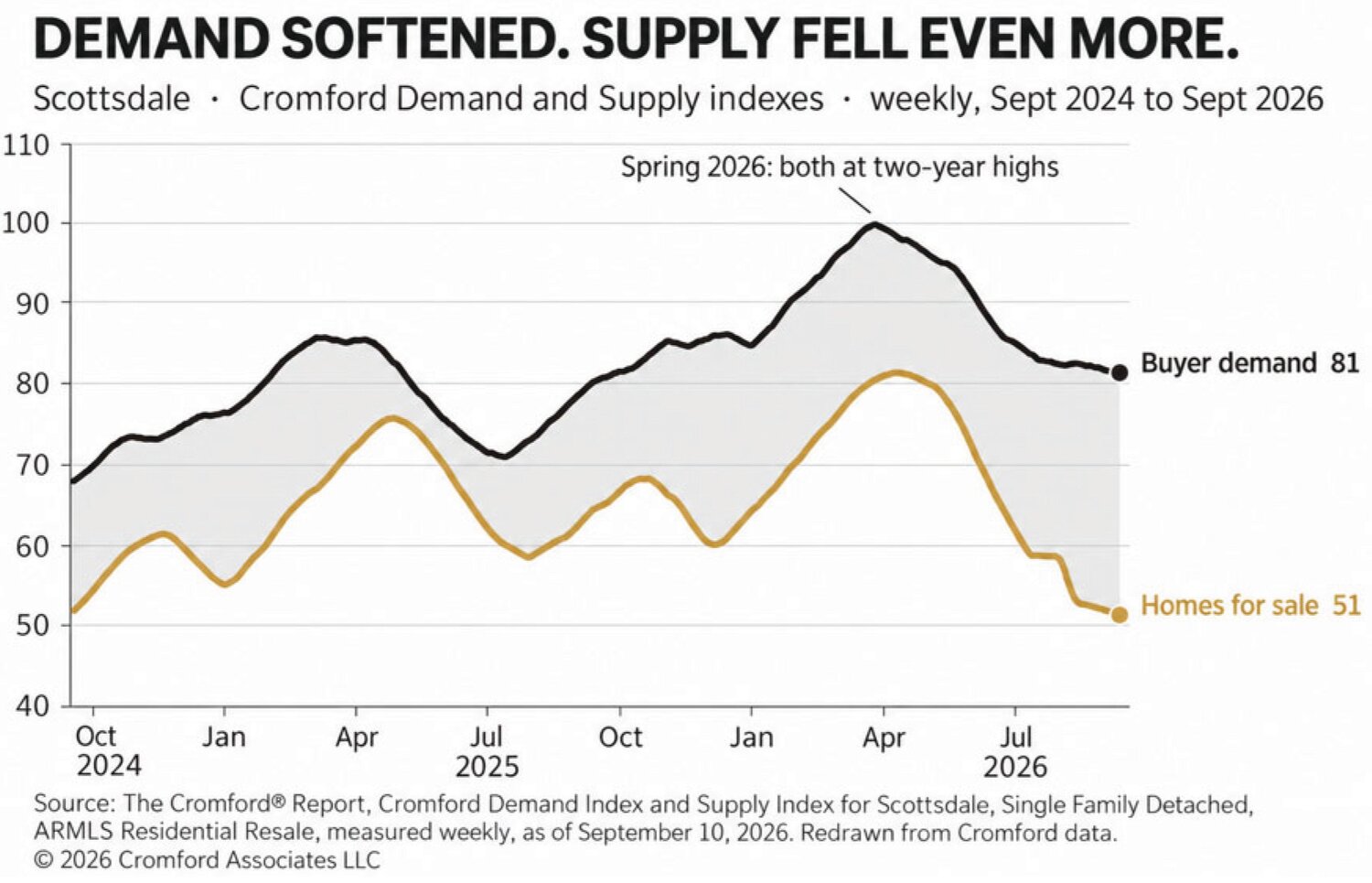
Chart 2 shows the result. Buyer demand eased. Homes for sale fell to a two-year low. The gap between those lines is what the index measures, and it's the widest in two years. Our sellers stepped further out than sellers anywhere else in the Valley, which is why Scottsdale broke upward while everyone else drifted down.
Now the catch. The index measures how many homes there are relative to buyers. It does not measure how badly anyone wants a deal. The buyers who stayed active this summer knew they were nearly alone, and they negotiated like it. Counters got pushed back. Inspections turned into a second negotiation. More than a few walked away from signed contracts. Those buyers spent the summer getting comfortable with rates in the mid-6s, then watched 7 arrive with a warning that it might not be the ceiling. Our buyers are mostly cash. A quarter point doesn't change the math much for a cash buyer, but it changes the mood, and mood is what was driving them.
Here's what that means if you're thinking about selling. The index says you have the least competition in two years, in the third-strongest market in the Valley. The Fed says the buyer pool could get thinner, and more cautious, with each meeting. The case for waiting got weaker in September. Every hike that follows trims what the financed minority can pay and gives every buyer, cash included, one more reason to sit tight.
The seller who does well this season doesn't wait for leverage. They take away the reasons to walk before the buyer goes looking for them. A pre-inspection, so nothing surprises anyone in week two. A price that reads as credible instead of hopeful. A listing that explains the home so nobody has to guess. Market conditions don't create urgency. Clarity does.
And in a market this thin, a home that's been prepared properly doesn't just compete. It stands out, more than it has in years.
I won't predict how many more hikes are coming. I'll just point out that supply has far less room to fall than demand, and the window where both numbers favor a prepared seller is open right now. It won't stay open on its own.
If you're thinking about a move this season, let's talk early. Good decisions are easier before there's pressure.





Comments
No comments on this item Please log in to comment by clicking here