The Guiding Growth Podcast candidate edition is presented by Modern Moments, Gilbert Independent/yourvalley.net and the Gilbert Chamber of Commerce. Candidates’ participation in this podcast does not constitute an endorsement expressed or implied by the podcast, its hosts, its sponsors or its production team. The purpose of these interviews is to provide listeners with insights into the journey perspectives and policies of various candidates. All candidates running for Gilbert Town Council were invited to participate. Listeners are encouraged to do their research and make an informed decision when casting their votes.
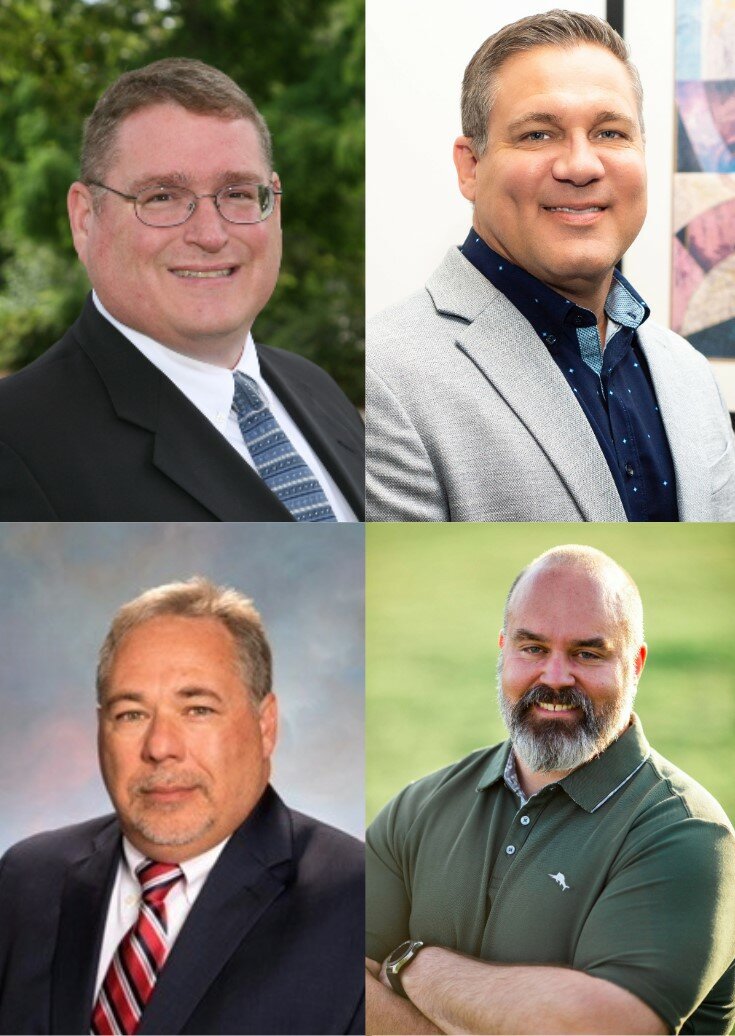
Gilbert has four candidates for two open council member seats this fall: Aaron Accurso, Kenny Buckland, Monte Lyons and Noah Mundt.
Aaron Accurso was born in Southern California and raised in a military family who was transferred around the country. He was primarily raised in Southeast Virginia and ended up attending the College of William and Mary. Upon graduation, he worked for Ferguson Enterprises for 17 years as a buyer, branch credit manager, branch operations manager and regional purchasing manager.
From there he took a few years to work in an area that he has been passionate about for most of his life and worked for the Catholic Church as a liturgical director. Once he accomplished his goals in this time of service, he returned to the business world. During the past seven years he has worked for a small family business in the east valley, Poco Verde Pools & Landscaping, and serves as its construction manager. Accurso has lived in Gilbert 17 years.
Kenny Buckland has spent the past 40 years refining his leadership skills. He began as a teenager managing the family business, progressed to become the second in command of a large police department, became a leader in long-range surveillance technology focusing on protecting our borders, and served as a global crisis manager. Currently, he serves as the senior director of sales in a second chance company, driven by purpose and duty as his North Star.
Buckland has a master’s degree in educational leadership and a bachelor’s degree in criminal justice and is a graduate of both the FBI National Academy Command College and Northwestern University’s School of Police Staff and Command. Buckland holds a third-degree black belt in Judo and has dedicated many years to coaching youth and adults in martial arts. Buckland’s wife of 10 years is also a public servant, currently serving as the chief deputy to the Maricopa County assessor.
Monte Lyons is a U.S. Air Force veteran and has worked in the aerospace industry for more than 40 years. He holds three degrees with a master’s degree in alternative dispute resolution. His career in aerospace included roles in manufacturing, quality, facilities, tooling, business operations, flight test, and operations.
Lyons has been married to his wife for 40 years. They have seven children, and seven grandchildren together. They have lived in Gilbert since 2019.
Noah Mundt has a career of more than two decades in the energy, water, and infrastructure sectors and currently leads as a senior engineer within the electric vehicle group at Salt River Project. At the forefront of SRP's managed charging initiatives, his role helps shape the future of electric vehicle integration. He has been named in the Phoenix Business Journal's 2018 40 under 40 for my impactful leadership and was a member of the 2023 class of the Flinn-Brown Fellowship through the Arizona Center for Civic Leadership.
As a registered professional engineer, certified energy manager and certified demand side manager, he specializes in leading complex projects to fruition. Outside of SRP, he is the chairman of the Gilbert Planning Commission, guiding urban planning and community development towards sustainability. Furthermore, as the founder and former president of Nexus Integrated Solutions, he helped establish the firm as a leader in sustainability solutions in Arizona.
To hear more answers about what they would do in office and learn more about the life journeys of the candidates, listen to their Guiding Growth Podcast candidate edition episodes.
Should you be elected, what would you consider to be your most significant responsibility in the position? And what would your top three priorities be?
Accurso: Government isn't supposed to be all inclusive in our lives or take care of everything. So we need to make sure that government really takes care of what it's supposed to take care of and allow people and businesses to do what they want to and what they can do to fully explore themselves, you know, push themselves out into the community without the restrictions of government.
Top three priorities, I want to get our leadership back to a families first, pro-business aspect. Public safety is very important to me, and right now we're as a community suffering from a perceived lack of safety. I don't think we're in an unsafe place by any means. But I think that we need to help guide our government groups, i.e. the police department and even the fire department and public works just to be more proactive with their engagement with the public and make sure that the public knows that they're there for them. And not sitting back and resting in laurels of past successes but continuing to push forward with that.
Buckland: So most important responsibility of council is to work together to set good policy for the staff to actually execute. Gilbert's one team. And so I get a head start because because I know what really needs to happen is set policy, get out of the weeds and don't meddle. Create the policy that the council feels is where the town needs to go as we head toward build-out and through it, and then get out of the way and let staff work it.
(Priorities) People will flee from here if it's not safe, period. Public safety is my No. 1. I think we need to make sure we have the appropriate number of officers to actually respond. We need to use data to help do that to staff and to deploy, and we need to have solid technology to help advance the expediency of these cases that the people want investigated and sent to the prosecutor immediately. Fire, you know. Absolutely. If my house is on fire, I want those guys there yesterday. If my wife has a medical incident, I want them there yesterday. We need to make sure we have strategically deployed our stations, and I and I feel confident that we have, but that that doesn't just stop once you're there. We need to keep looking at that because as the town grows.
We need diverse economic development in business. I was a business owner after I retired. I jumped in with my father-in-law. We were based in Oregon. Heavy regulations, COVID hit. There was restrictions that forced us, if we wanted to work, we had to lay off 75% of our staff. And then with that, we couldn't get the work done. Too many regulations. You had marijuana dispensaries that were essential, and we weren't, and we lost a business. My father-in-law lost years of work because of regulations. So I like limited regulations, allow businesses to thrive, obviously within reason. There has to be checks and balances. But for the most part, let the businesses do their job and have an opportunity to thrive.
Third is long-term infrastructure sustainability. I was here years ago when they were digging up all the roads, and they're putting the pipes in, and that was a long time ago, and time has passed, and things start to deteriorate. So I do think it's important that as a town, we are managing that very well. The little things cannot be overlooked because little details that get overlooked can create big impacts down the road.
Lyons: I think the most important thing honestly is the fiduciary responsibility with the fiscal health of the town.
We've got, I think it's quite close to a $2.3 billion budget for our community. And that's real money, and that belongs to the taxpayers that are paying into the community. I feel like you have an obligation to make sure the money is being spent on the appropriate programs in the appropriate manner. So managing capital budgets for these corporations, I'd ask myself three questions. Where are we going to spend our money? Why are we spending it there? And how are we going to spend it? And those would be questions that I would bring to bear on what we're looking at to make sure that stuff is going where it needs to go to maintain the affordability and the character of the community. I think there's competent people within our town government and they want to do good things and I feel like my role is to help them do that.
The second one, I think, would have to do with law enforcement. One of the things that really kind of got me looking at this, I knew somebody that was assaulted in town. The person that did it was arrested, but there was no prosecution of that person. When I asked about that, it was just like, ‘Well, it's not worth our time to do that because it's a minor thing and we need to put our resources to greater crimes and stuff.’ But the person who was assaulted had bodily injuries and, and to them, that's a big deal.
And I feel it sends two messages: one to the victim that, ‘Hey, we're going to judge you based on how valuable we think you are.’ And then it sends a message to the person doing it that you're not going to get prosecuted for, you know, minor things. I think that's a bad message to send. So looking at our policing, do they have the adequate resources to do what they need to do? Do they have the adequate training? So, looking at stuff like that, talking to the rank and file, talking to the leadership. What are your struggles? You know, where do you guys need assistance and what are your priorities?
The third thing would be positioning the town for the future. Like I said, I think we're in that point where we're getting into what I call a sustainment mode. The growth is, you know, arching out and now we got to look at how we're going to manage the property and the businesses that we have here from the town's perspective to make sure that we're successful and we're putting the right programs policies in place to help business and people experience the best of what Gilbert is.
Mundt: My biggest responsibility would be to ensure that I uphold my pledge to try to bring the voice of all Gilbert residents into the chambers, into the dais. I believe that there is a lot of people that don't understand how local government works or the impact that it has and things like that. I hope that the biggest responsibility I also have is I have a desire to be able to do a campaign of educating about all these processes, you know, whether it goes down to the Planning Commission, how land is developed, how all of these things happen.
Top three priorities, infrastructure, being as that I'm an engineer and in water and energy, and those are both very important topics here as well as you know, having to just had a water rate hike. And we're going to have more infrastructure issues coming up over the coming years because of the continued expansion and growth, which is great for economic development.
Planning properly and financially sound is something that I hope to bring local control and autonomy over decisions. You know, the state is currently pushing a lot of as it comes to giving developers the ability to decide how things can be developed without any regard to local planning and city or town councils. I think that is a mistake. And I think that we as a town should be pushing a little to say, “No, we actually know our town better than you do and we're trying to grow this properly and we don't want to just have a mess. Well, not a mess but a hodgepodge of just anything going up anywhere. There's reasons we plan it.
And then the last one is accountability. We had the terrible things with teen violence that have happened. We've had a lot of disagreements that have happened on the council and ethics things and there's been a lot of things that have caused what I think is a major distraction to a lot of the good things that happen.
The town is approaching build-out and some areas of the community are aging even as others continue to develop. How would you prioritize the needs of build-out with the needs of aging areas?
Accurso: They're both definitely priorities. One of the things that I've been very disappointed in with our current councils in the past number of years has been their willingness to stray from the general plan that was created by the council and voted on by the public. They've changed the general plan to accommodate what the new owners of those properties want to build out. I think that's inappropriate because the people next door and around the corner from those properties and even across town from those properties are expecting a particular type of business, a particular type of development in that area.
The plan is developed in order to accommodate the water infrastructure, the road infrastructure and things like that, and when changes are made, it can have a devastating impact. Now, the older areas of town, we need to make sure that we respect the existing property rights of those people. While at the same time doing our best to help improve the properties such as the roads and the aesthetics of the areas that are town owned.
It should be a good balance of both because we do have very good new areas of town, and we have some areas that have been around for quite a few years, but we have to respect property owners for sure.
Buckland: So I don't think you look at one and not the other when you're looking at vision. You have to look at the whole thing holistically, and you have to evaluate all the parts and pieces of that. You use the staff to provide you data and, and if they're not, then implement it. But we need to be very data driven. And what does that tell us to help us make smart decisions? Because I think you can do both. I don't think it's one or the other.
The northwest area of Gilbert is really our oldest area. There was a time when all the activity was over near Country Club and Guadalupe in that area, and we just expanded east and south. That area is older, but it's still part of Gilbert, and it's valuable to Gilbert, and they deserve attention too.
Lyons: That was one of the reasons why I took the time to talk with (Gilbert Economic Development Director) Dan Henderson was to understand what the town was looking at, what they were thinking.
I think the critical part of that is understanding. I mean, what are we, about 70 square miles, something like that, and looking at where we have developed things, and I know they've got zones set up where they're going to do certain type of developments in certain zones, which I think is a great idea. And he had talked about some light manufacturing-type businesses over on the east side of town near the airport. I think the critical thing is to think about what the end product looks like and then back into it from there.
And so there needs to be discussions about that. What does Gilbert look like 10 years from now? 20 years from now? And then how do we chart our course to get there? Because you can come up with a lot of good ideas to do things, but that doesn't necessarily mean it's a good idea when you think about the end results.
Mundt: This is a great question. I think that that's something that goes back to the theme that I said of how having some form of growing pains when you switch from being able to just have massive swaths of land done and developers building certain amenities at the behest of town's request. That's one way. Another way then is when you have the infill, which is you have these small pockets where you can do it.
And I think that in those cases, there's a lot more difficult decisions that have to be made. And what I would lean on is the expertise of the people in the industry as well as the town staff, which I’ve spent a lot of time working with on the planning commission and they spend a lot of time and energy, putting together capital improvement plans and other things, 10-year plans for growth areas and things like that. And my focus is going to be on utilizing those to the best capacity possible where they fit and finding ways to illuminate the reasoning behind it so that all of Gilbert can understand how it's a good thing for all of us in the long run.
How would you measure success?
Accurso: Not necessarily to the point of appeasing everybody, but, you know, maintain my principles, didn't get off my principles but came to an understanding, a full understanding of each of the projects and each of the issues that were going on. And I was able to make what I felt was a good decision based on all of the information. I think that's successful. I don't want to go in with any preconceived notions outside of my principles when approaching any topic. So I want to understand both and all sides of any issue that comes forward.
Buckland: Well, I hope and I expect that I stayed true to who I am. Everything I've done has been to serve people from a really young man in, in my early 20s in law enforcement to southern border, working with border patrol, and technology to Amazon to where I am now, Everything I've done has been to help people, to put others first. You only have one life, but I believe you have to do something with that every single day.
I don't want to be a guy that looks back at the very end of my life and say, “Man, I should have done something different.I could have helped here when I didn't.” I'm not doing this because I want this. I'm doing this because I think this is a time where it's so critical that I can help. And I believe that my leadership style fits perfectly for a time such as this.
My North Star is purpose. So I want to look back and say that I made a difference in Gilbert. I do believe when I left here in 2016, I had a hand in making Gilbert better than I found it, and I expect I will have that same result.
Lyons: As long as my name is not a verb, simple and easy.
Mundt: It's mostly just in the relationships that I'm able to build and sustain. I mean, as you meet more people along the way, it's easy in the single-serving world that we're in to be able to be a sales type individual and just say here's what you need to hear right now. But I hope in the long run that I can continue to accumulate a massive bag of relationships, and that I can continue to nurture those and grow them and expand them much like Santa Claus's gift sack that somehow holds unlimited gifts for every kid in the world (as he) travels faster than the Flash.
It's mostly just the feeling of the individuals that I'm able to impact in any way that I can. And I just hope that that's positive.



Comments
No comments on this item Please log in to comment by clicking here