As Gilbert reaches the halfway point on its 10-year redevelopment plan for the Heritage District, town officials are busy preparing how the next five years should unfold — and what might lie beyond that.
Council broke away for a couple days last month to consider those plans, giving direction to staff to begin preparing for another 10-year plan to follow the current one, adopted in August 2018.
And though Gilbert’s success over the past 30-plus years in rebuilding an aging downtown into a destination for residents has been a model to many other cities, town officials also took a step back to look at what other cities are successfully doing in their areas.
Officials spent a day visiting the downtowns in Phoenix, Mesa and Scottsdale, each with their own successes, and see if there are other approaches Gilbert should bring to the Heritage District.
As it does so, Gilbert is adopting a new mantra in downtown redevelopment — green, clean and safe. All have been considerations in the past, but perhaps not brought together in such a pithy way. Gilbert officials saw some of those things in all their visits.
“While keeping the Gilbert identity and keeping what’s important to Gilbert is first and foremost, understanding how others have been successful is equally as important,” Gilbert Economic Development Director Dan Henderson said.
“I think that that’s what council got out of this is that, yes, there are preferences and perspectives and constituent voices, but at the end of the day, we’re trying to deliver a clean, green and safe environment for all in the Heritage District. And sometimes taking a step out of your community and learning best practices from others really does that.”
The redevelopment plan is a guide, not a recipe, Henderson said, but it has helped the district continue to evolve. It has become an important economic driver for the town. One of every four visitors to Gilbert visits the Heritage District, according to town data.
Working on that continued evolution is a labor of love for the town, Henderson said.
“We enjoy curating and cultivating that environment,” he said. “And as you know, (former Mayor) John Lewis said it best, it is a 30-year overnight success. So it’s one of those things that constantly sort of feed and nurture, and it is definitely coming into its own.”
Renewal to date
Gilbert’s historic downtown, once an area of decaying old buildings from the town’s founding days, was declared a redevelopment district in 1989. That designation made it eligible for state funds set aside to help give new life to blighted areas.
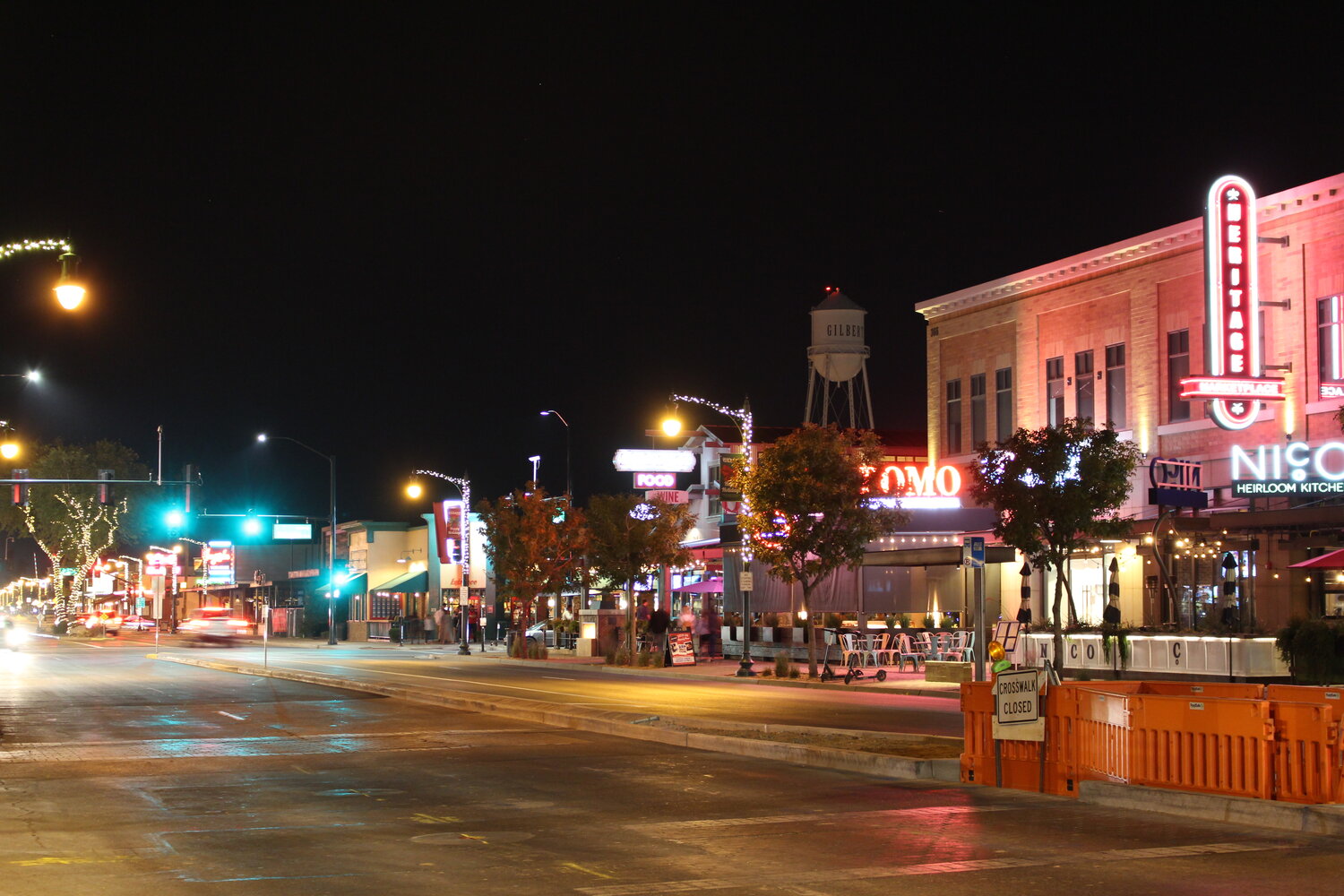
Since then, it has had four redevelopment plans. The opening of Joe’s Real BBQ in 1998 helped set its neon-marked restaurant row in motion.
Joe’s Real BBQ established the neon-sign motif that is characteristic of the Heritage District (Special for Independent Newsmedia/Arianna Grainey)
Independent Newspapers/Arianna Grainey
Since then, it has become a place with more entertainment, retail shopping and business options. The vintage buildings, which give it a small-town, nostalgic feel, have covered sidewalks for people to stroll and check in on small shops.
Gilbert has worked to get more retail spaces into the Heritage District so that it is not simply about Restaurant Row. (Special for Independent Newsmedia/Arianna Grainey)
Special for Independent Newsmedia/Arianna Grainey
The current redevelopment plan was the first to deliver more than goals, but more of a master plan for development, and its vision has been rapidly deployed.
The town has processed two requests for proposals that have resulted in the sale of land on both ends of the district, what the town has referred to as the north and south anchors.
The north anchor, to be called Heritage Park, will feature an 840,000-square-foot, mixed-use development with retail, restaurant and office space, 288 multifamily units, a 100-room hotel and park space with a splash pad.
The south anchor will have 182,000 square feet of mixed use with ground floor commercial uses and loft-above multifamily units.
As part of their agreements, the developers will put in the north and south ends of what the original plan called the Paseo but now will be known as Water Tower Way, a car-free pedestrian and bicycle path running between Juniper Avenue and Elliot Road.
Plans have been put in place for a renovation to the Water Tower Plaza with a tentative start date in January.
Water Tower Plaza will undergo a renovation and upgrades, tentatively scheduled for a January start. (Special for Independent Newsmedia/Arianna Grainey)
Special for Independent Newsmedia/Arianna Grainey
Eight newly constructed projects since 2018 have brought in 278,000 square feet of building area, including Culinary Dropout, the Hearne Way Parking Garage, Apsire HD townhouse community, the Collab mixed-use building, The Porch, Gilbert Shops commercial building with O.H.S.O., Creamistry and Dog Spaw, the Park at O.H.S.O., and Topo.
The town also has completed eight capital improvement projects, such as the parking garage, the buildout to the University Building’s fourth floor for the University of Arizona’s nursing program and improvements to Vaughn Avenue in preparation for the Vaughn Ventilator, which will give access to the Heritage District from the west side. Ground will be broken for that in summer 2024.
Gilbert is preparing to make Vaughn Avenue an access point from the west to and from the Heritage District. (Special for Independent Newsmedia/Arianna Grainey)
Independent Newsmedia/Arianna Grainey
The district’s design guidelines were updated in 2021 to promote continuity of the district’s character, strengthen the pedestrian environment, create a compact and diverse downtown, establish high quality architecture, create a distinct landscape character, create coherent and consistent street spaces, and ensure off-street parking does not impact the area’s historic character.
The success of the enhancements is measurable. With 26.9 million visitors to the district between 2018-2023, the district has seen a 75% increase in annual sales tax revenue and, according to the Maricopa County Assessor’s Office, the full cash value per acre of district land is up 77.3% to $2.05 million.
The district is now home to 155 businesses over 415,000 commercial square feet, up 66,000 square feet in the past five years, according to town data.
Seeing other downtowns
The Heritage District has been a model for other cities that want to revitalize their downtown areas. Henderson said Gilbert frequently has entertained communities that want to see what it is doing here that has worked so well.
But the council flipped that script before its workshop meeting about the town’s future plans.
“This last couple of weeks was a great reminder to us just how special downtowns are and the opportunity to go into Phoenix, Scottsdale, and Mesa and learn best practices from them was really eye-opening,” Henderson said. “Those communities are doing amazing things in and around their downtowns.”
In downtown Phoenix, they looked at the Roosevelt Row area, once a blighted street that was center to male prostitution activity in the city, but now an arts district that has become home to the popular First Fridays events.
The Roosevelt Row arts district in Phoenix has sprung from a blighted street to change the area’s fortunes. (Independent Newsmedia/Tom Blodgett)
Independent Newsmedia/Tom Blodgett
“We learned from Phoenix the policies that they’ve been able to use and incorporate and how they were able to bring those policies in and the great work that they did with their constituents and stakeholders, merchants, artists, activists,” Henderson said. “And the culmination of bringing all of those voices to the table was nothing short of impressive.”
Gilbert Town Council Member Jim Torgeson, the council’s liaison to the redevelopment commission and a former commission chairman, said some things, like the use of graffiti art, would not fly in Gilbert, but he still came away impressed.
“You saw in that area how before it was not doing anything for the entirety of the city of Phoenix, and now it’s actually a positive revenue generator,” he said.
One of his takeaways was how Phoenix dealt with increasing heights.
“It generally didn’t feel like you were in a tunnel the way they did it,” he said. “That was good. They had a great respect for old buildings. I think you had a little bit of a tussle there between multifloor redevelopment and preserving old buildings.”
Torgeson’s Sign King business is in downtown Mesa, so he has had a closeup look at how that city has cleaned up the area.
The Magnificent Mile has given the city nightlife options where none existed from taprooms and sidewalk cafes to live music and fine arts. (Courtesy city of Mesa)
Courtesy city of Mesa
“Mesa is just now starting to move on its redevelopment, and it’s taken a very long time,” he said. “It took them allowing, of all things, microbreweries there, and all of a sudden, they have a bunch of them that’s generating the interest down there.”
Henderson said they gained insight from Mesa on cultivating partnerships to create that green, clean and safe environment.
Meanwhile, in Scottsdale, Gilbert looked at how Scottsdale operates its popular Old Town.
“We had a chance to meet with the long-range planning folks as well as their PD team to learn some best practices about managing an entertainment district,” Henderson said. “They had some insights.”
Old Town Scottsdale’s pedestrian-friendly streets lined with galleries, museums, restaurants and retail shops give the city a vibrant nightlife. (Special for Independent Newsmedia/Arianna Grainey)
Special for Independent Newsmedia/Arianna Grainey
Those included parking and safety, he said.
Torgeson noted how Scottsdale handled density.
“I really, really liked — and I’ve noticed it for years — some of the buildings they have where they have green on each level — green meaning vegetation, plants, landscaping — and how they stepped back and it didn’t present a very ominous wall of … multimillion dollar condos,” he said. “What you had was things that were stepping back, something that was not damaged by height and it opened it up and it created more density, which created more revenue for them.”
Into the future
Generating additional revenue from the district will be something that the town looks at as it moves forward. In its special meeting on the district, council heard a presentation from Joe Minicozzi, a principal from Urban3, a private consulting firm in Asheville, North Carolina, specializing in land value economics, property tax analysis and community design.
Henderson said Minicozzi provided a perspective on Heritage District return on investment and how to use mixed-use environment to drive experience and also prove that return.
“I think what was a real eye-opener for all was how you can use the built environment with these design guidelines to deliver that clean, green and safe environment, but at the same time understand how those decisions that we make on those developments really drive revenue and experience,” Henderson said.
Torgeson said the town will have to consider how to maximize those revenues so that it can provide the services residents require. “As you plan forward, you need to be planning for that to make sure that we’re a completely sustainable town,” he said. “And there’s going to be hard discussions about it.”
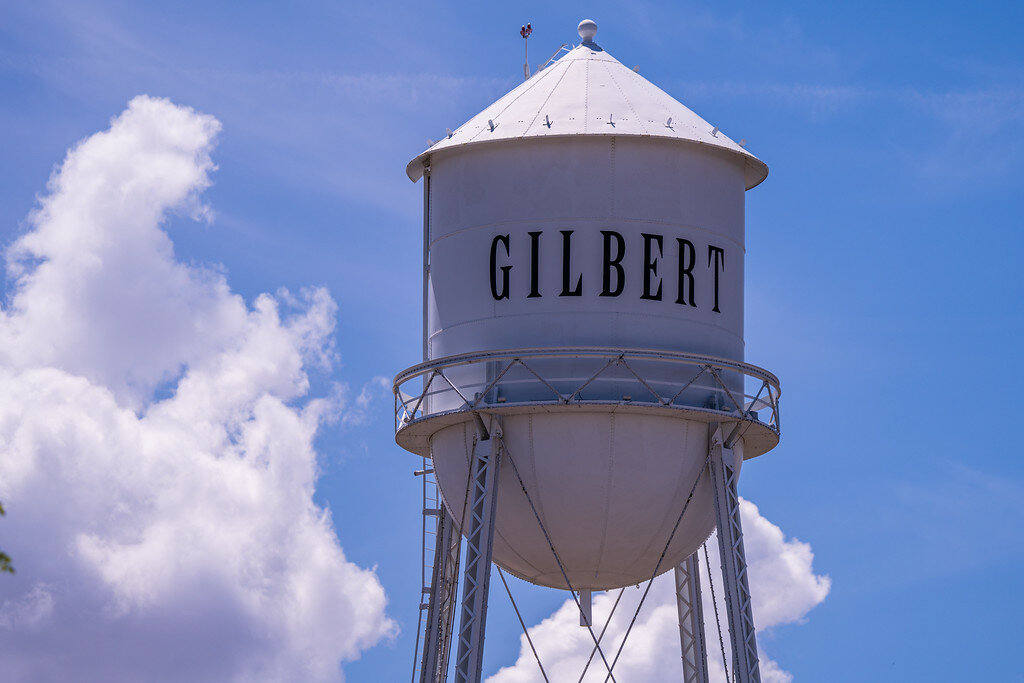
That may well affect design guidelines, notably Gilbert’s 55-foot building height-limit in the district, which preserves site lines on Gilbert Road to the town’s iconic Water Tower.
The Water Tower remains the icon not only for the Heritage District, but for all of Gilbert. (Special for Independent Newsmedia/Arianna Grainey)
Special for Independent Newsmedia/Arianna Grainey
“With such high cost of property there (in the Heritage District), if we don’t allow people to go vertical, it’s going to stop growing because you can’t afford to be one or two stories at that cost,” Torgeson said.
He pointed to the recent sale of the property on which Bergie’s Coffee Roast House sat for $3.1 million.
“And that thing’s a postage stamp compared to other pieces,” he said. “I am really amazed that somebody has a business plan together to pay that kind of debt.”
It requires businesses to go two, three or four stories to make the project pencil, Torgeson said.
“The more that dirt gets valuable … you have to have get more square footage vertically in order to make it work,” he said. “I’m not saying put high rises there or anything crazy, but I think there needs to be discussion about how high are we willing to go.”
Parking is another major point of discussion. The town has a free garage on each side of Gilbert Road in the Heritage District that helped the district keep pace with the demand. But the sale of the north anchor lot, upon which many people used for surface parking in recent years, puts an additional squeeze on parking.
Free garages have boosted the Heritage District’s fortunes, but parking will continue to be a point of discussion. (Special for Independent Newsmedia/Arianna Grainey)
Special for Independent Newsmedia/Arianna Grainey
“If we were to put a surface lot into the hands of developments, how might that impact our parking inventory?” Henderson said. “Where might we then need to direct and orient vehicles?”
Thus, parking remains a high priority for council but also for visitors to the district.
“The key takeaway is that parking is both your first and your last impression as you experience in the area,” Henderson said.
Council did give direction to staff to begin preparing for the next redevelopment plan. Input from stakeholders, particularly residents, will be a first step that will happen in the next couple years.
“We’re really trying to ensure that the experience that people have in the district is a consistent one and one that delivers at a high level,” Henderson said.
Tom Blodgett can be reached by email at tblodgett@iniusa.org or follow him @sp_blodgett on X. We would like to invite our readers to submit their civil comments, pro or con, on this issue. Email AZOpinions@iniusa.org.
Meet Tom Tom Blodgett joined Independent Newsmedia, Inc., USA, in 2022, when the company acquired Community Impact Newspaper's Phoenix-area properties. Raised in Arizona, he has spent more than 35 years in journalism in the state.
Community: He has served as an instructional professional in the Walter Cronkite School of Journalism and Mass Communication since 2005, and is editorial adviser to The State Press, the university's independent student media outlet. He also is director of operations for an 18U girls fastpitch softball team from Gilbert.
Education: Arizona State University with a BS in Journalism.
Random Fact: He lived in Belgium during his freshman year of high school.
Hobbies: Tweeting enthusiastically about ASU softball (season-ticket holder) and grumpily about other local sports (pessimistic fan).

 By
By 




Comments
No comments on this item Please log in to comment by clicking here