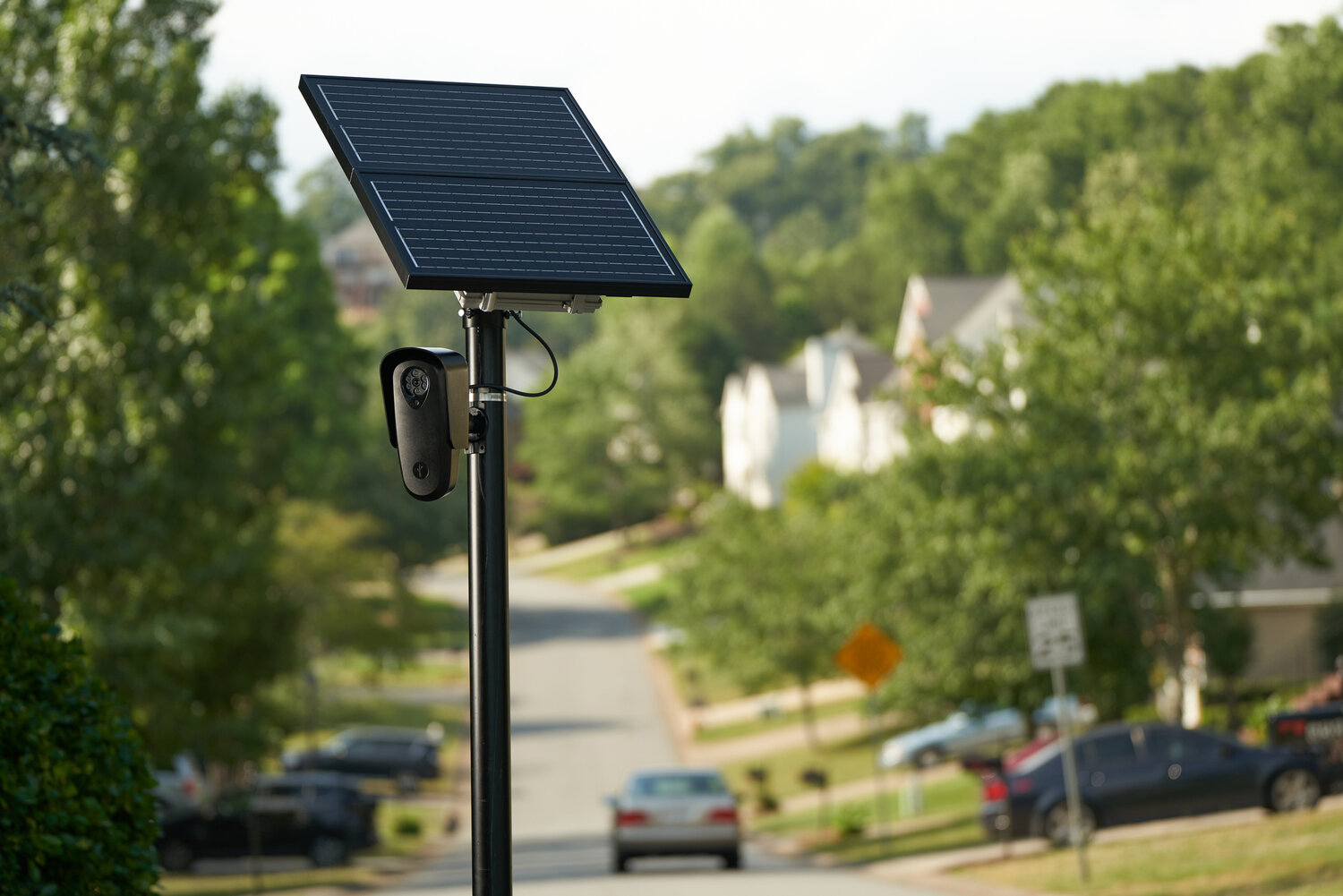
The city of Apache Junction has 25 Flock pole-mounted license-plate readers.
Courtesy Flock Safety
Posted
Michael Pooley
AJPD
The camera at Lost Dutchman Boulevard and Meridian shows 1,200 to 1,500 vehicles a day, Police Chief Michael Pooley said during the Feb. 20 council meeting. On Sunday, Feb. 18, with the Lost Dutchman Marathon being held locally, there were 3,361 vehicles, he said.
License-plate cameras at 25 locations in Apache Junction during a month-long period identified 206 hits from the National Crime Information Center that ranged from stolen vehicles to missing persons.
The data was shared with the city council during a recent meeting by Police Chief Michael Pooley.
“We know in the last 30 days — from Jan. 22 to Feb. 20 — we’ve had 2.6 million reads of license plates here in the city of Apache Junction,” Pooley said during the Feb. 20 council meeting.
“Just in the last 30 days we’ve had 206 hits. What that means is it could be a sex-offender, it could be a stolen vehicle — it could be a lot of different things,” he said. “One of the things that we had were 22 stolen vehicles that passed through these cameras as well as six missing persons,” he said.
The city of Apache Junction has 25 Flock pole-mounted license-plate readers. Ten in a $80,350 two-year agreement with Flock LLC were approved by council in May 2022 and an additional 15 were approved in a $315,500 five-year master services and license agreement with Flock Group Inc.
“These are license-plate readers. We call them LPRs,” Pooley said during the council meeting.
“Basically what they do is it is a camera that takes a snapshot in time of the rear of the vehicle and the side of the vehicle. It does not take pictures of the drier or the occupants. It is not a speed camera. It is only for the license plate and basically the make/model of the vehicle,” he said.
“Some of the things we do with this is we look for stolen vehicles, we look for missing persons, we look for people that are wanted. If there’s a missing child, it will alert us. What it does is anything the police departments throughout the country put into the national crime search information center, we’re able to get a hit on that,” Pooley said. “(I)t helps us to deter crime and also to fight criminals that are out there causing some chaos in our city as well as surrounding cities.”
The cameras are used to help solve crimes, he said.
“We had an incident a couple months ago where there was an accusation of an elderly lady that was assaulted by a man that threw her to the ground. She did not have a very good description except for the color of the vehicle and the type of car it was. We were able to pull into that database — Flock put in the type of vehicle as well as the color — and we were able to identify the alleged suspect of the vehicle, registered owner and locate him and be able to close that case out,” Pooley said.
The pole-mounted cameras also helped to find a suspect from at a fatal hit-and-run incident this past summer, he said.
“There was grainy video of the vehicle that had hit a pedestrian, left the scene, and it was our officers that just happened to be driving by and located the victim laying in the road. When we got to him he had already passed away. We were able to find surveillance video — very grainy, hard to tell even the type of car — but we knew it was a truck and the dark features. We were able to put it in our Flock camera system and locate the vehicle, get the driver identified and we’ve submitted that case for charges in the Pinal County attorney for the hit-and-run fatality,” he said.
Council discussion
Councilmember Peter Heck asked how quickly the images snapped by the cameras are available to police.
“For example, if you have a car that’s stolen and the camera reads that, how quickly does that get — it would be available — to your officers?” he asked.
The image is available within 1.5 minutes of the vehicle passing the camera, the police chief said.
“So that’s good. I mean, they’re not going to get far,” Heck said.
“Correct. Yeah, and with the cameras we have in the city now we’ve been able to cover a lot of the area of the city so it will hit one camera and then go to the next. So it’s been very, very helpful,” Chief Pooley said.
Councilmember Bryan Soller, who works in law-enforcement, said he knows how the Flock cameras help.
“And I just want everybody to understand this is a great first step to real-time crime. And real-time crime is additional cameras that we can follow vehicles and actually see vehicles that suspects or missing persons are in and we can trace them across our city and even into other cities,” he said. “Flock is a big part of real-time crime centers — the first step — and I’m glad we’re taking it. This is cutting-edge technology and it makes a huge difference. So I’m glad we got it.”
The item was for discussion only and no vote was made. Vice Mayor Robert Schroeder was absent from the Feb. 20 meeting.
Richard H. Dyer can be reached at rdyer@iniusa.org, or on X @rhdyer. To voice your opinion on this story, connect with us at AzOpinions@iniusa.org.
Meet Richard Richard Dyer has worked at Independent Newsmedia Inc. USA since 1987, starting his career in Apache Junction as a copy editor and being promoted over the years to work as the editor of the Mesa Independent, news services editor for the East Valley office in Apache Junction, managing editor for the East Valley office, news services editor for the East Valley office and eventually also for the newspapers at INI’s then-Chandler office, managing editor again and as a news editor covering Apache Junction/Gold Canyon and Queen Creek. He helped start the Florence Independent while the news editor covering Apache Junction and Mesa news. In January 2023, he became associate managing editor for the East Valley newspapers and in August 2023 became managing editor for the East Valley newspapers of Chandler/Tempe, Gilbert, Queen Creek, Florence, Mesa and Apache Junction/Gold Canyon, while also reporting on Mesa and Apache Junction/Gold Canyon.
Community: Since 2009, he has worked as a volunteer to design The Blue Guitar Magazine, Blue Guitar Jr. magazine and Unstrung magazine, which are projects of The Arizona Consortium for the Arts; and since 2014, has been overseeing the art submissions.
Education: University of Arizona with a master of arts in journalism and a bachelor of science in agricultural communication. Also continuing education at Mesa Community College in welding in a metal art sculpture class.
Random fact: Saw his first tornado on May 31, 2010, which was classified as an EF-2, as part of a stormchasing tour group.
Hobbies: He is an artist of welded-steel sculptures, selling his artwork at juried and non-juried art shows.



 By
By 


Comments
No comments on this item Please log in to comment by clicking here