New data shows Phoenix and Tucson are two of the nation's most dangerous cities in which to ride a motorcycle.
Motorcycle crashes claimed 424 lives in Phoenix between 2015 and 2024, giving the city the highest number of fatalities among the 10 U.S. cities with the highest annual motorcycle death rates relative to population.
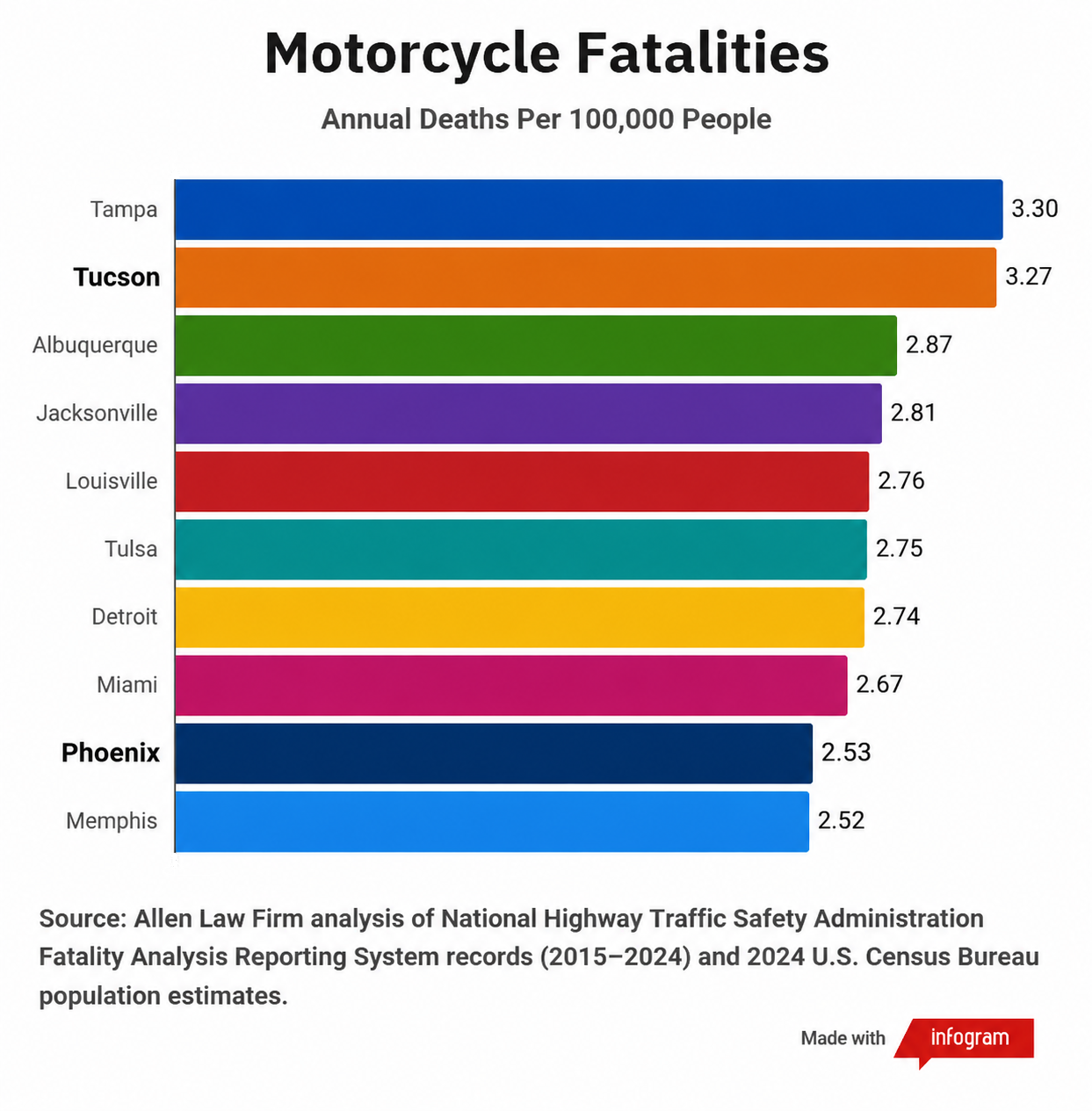
A study conducted by Allen Law Firm, which examined federal traffic fatality records, ranked Phoenix ninth among the 50 most populous U.S. cities. Phoenix averaged 2.53 motorcyclist deaths per 100,000 residents annually, amounting to approximately 42 fatalities each year.
The numbers tell two different stories when population is taken into account. Although Phoenix had the largest overall death toll among the top 10 cities, several smaller cities recorded higher fatality rates relative to their populations.
Tucson ranked second nationally, averaging 3.27 motorcyclist deaths per 100,000 residents annually. The city recorded 181 fatalities during the decade, putting it just behind Tampa, Fla., which led the rankings at 3.30 deaths per 100,000 residents.
Albuquerque, N.M., ranked third at 2.87, followed by Jacksonville, Florida, at 2.81. Louisville, Ky., Tulsa, Okla., Detroit, Mich., and Miami, Fla., rounded out the next five positions. Phoenix placed ninth, narrowly ahead of Memphis, Tenn., which recorded an annual rate of 2.52 deaths per 100,000 residents.
The findings put two Arizona cities among the nation’s 10 highest-ranking cities for motorcycle fatalities. Tucson’s higher rate, despite having fewer than half as many deaths as Phoenix, illustrates how population-based comparisons can produce a different picture than looking at fatality totals alone.
Alcohol and speeding emerge as contributing factors
The study also examined circumstances surrounding fatal motorcycle crashes, including alcohol involvement and speeding.
According to Allen Law Firm’s analysis of National Highway Traffic Safety Administration (NHTSA) records, alcohol was involved in 104 of Phoenix’s 424 motorcycle deaths between 2015 and 2024. That represents approximately 24.5% of all motorcyclist fatalities recorded in the city during the period.
Speeding was identified in 181 fatal crashes, accounting for 48.4% of cases in which speeding status was known.
The figures highlight two factors frequently examined in fatal traffic investigations. However, they should be interpreted separately. Alcohol and speeding categories can overlap, meaning a single fatal crash could involve both factors. The speeding percentage also excludes cases where investigators did not have a known speeding status.
While the study identifies how frequently these factors appeared in fatal crashes, it does not establish that alcohol or speeding was responsible for every collision in which they were recorded.
Phoenix’s numbers stand out nationally
Phoenix’s ninth-place ranking by population-adjusted rate might initially appear less concerning than the numbers recorded in cities above it. However, its total of 424 fatalities stands out.
Among the 10 cities in the ranking, Jacksonville had the second-highest death toll with 284 fatalities. Tucson recorded 181, while Louisville and Detroit each reported 177.
Phoenix’s total was substantially higher than any of the other cities in the top 10, underscoring the number of lives lost on the city’s roads over the decade.
The distinction between total fatalities and deaths per 100,000 residents is important when comparing cities of different sizes. A larger population can produce more deaths overall, even when the rate relative to population is lower. Conversely, a smaller city can have fewer fatalities but a higher population-adjusted rate.
For Arizona, the results put the state’s two largest cities in prominent positions in a national comparison of motorcycle safety.
Bill Allen, founding attorney of Allen Law Firm, said population-based rankings offer a useful way to compare communities but cannot explain the circumstances behind individual crashes.
“Population-based comparisons show a different picture from death counts alone, but they cannot tell us what caused an individual collision,” Allen stated in a press release. “Investigators still need to examine driver actions, road conditions and the evidence from the scene.”
“Preserving that evidence early matters," added Allen. “Dashcam footage can be overwritten, witnesses can become harder to reach and vehicles may be repaired before they are examined.”
How the cities were ranked
For the analysis, Allen Law Firm examined the NHTSA’s Fatality Analysis Reporting System (FARS), which maintains records of fatal motor vehicle crashes nationwide. Researchers reviewed data from 2015 through 2024, counting deaths involving motorcycle operators and passengers classified under the agency’s BODY_TYP 80–89 motorcycle and motored-cycle categories.
The comparison covered the 50 most populous incorporated U.S. cities, using 2024 population estimates from the U.S. Census Bureau. Metropolitan areas and surrounding communities were excluded.
The study measured average annual motorcyclist deaths per 100,000 residents, allowing researchers to compare fatality rates across cities with different population sizes.
Matt Loeschman has had two separate stints at Independent Newsmedia. He began as a reporter covering Peoria and later Surprise from 2000-2009. In 2018, he returned to Arizona and INI as the news editor of the Daily News-Sun (now the Phoenix Independent). He previously covered the Arizona Rattlers of the Indoor Football League for more than a decade.
Community: During high school football season since 2018, he contributes live postgame radio reports to the AIA Friday Night Football Wrap Up Show. He supports organizations such as Phoenix Children’s, Boys and Girls Clubs of the Valley and the American Cancer Society.
Education: The University of Texas at Austin majoring in Journalism-News and Public Affairs.
Random Fact: He can sing and he has been fortunate to meet many famous people during his journalism career including First Lady Hillary Clinton, King of Country Music George Strait and Oscar-winning actor Matthew McConaughey. Attended all 4 home games of the 2001 World Series.
Hobbies: Watching and playing a wide variety of sports, including golf, tennis, pickleball and softball. Playing PlayStation 5, working out, shopping and reading.


 By


Comments
No comments on this item Please log in to comment by clicking here