Medivac helicopters carrying blood to save patients, but ground ambulances lag
Organizations look for ways to make more transfusions possible
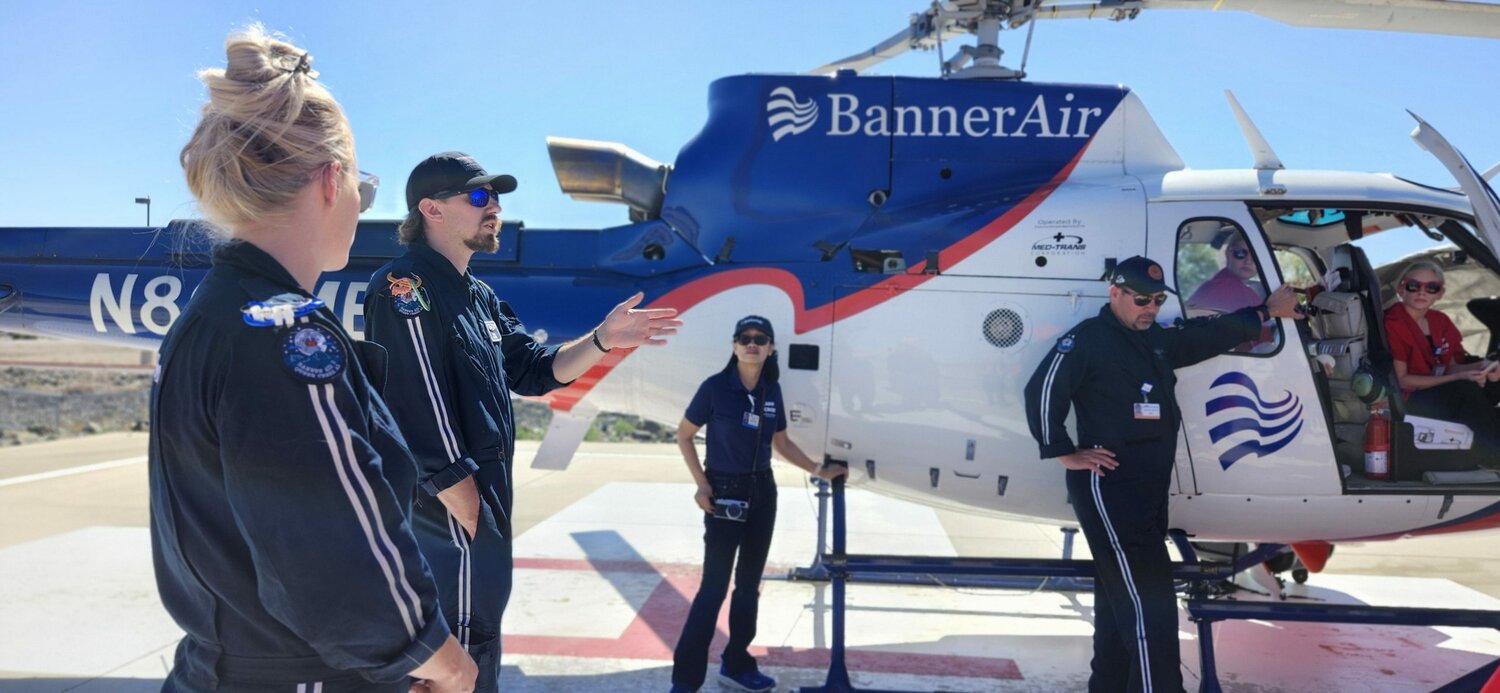
A BannerAir flight crew and staff are pictured in front of a medevac helicopter on the Banner Ironwood Medical Center helipad in Queen Creek. (Photo courtesy of BannerAir)
PHOENIX — Time was running out as the medevac helicopter made its way from rural Arizona to a nearby hospital. The patient was in critical condition, and flight paramedics worked against the clock. Only one thing could save him — blood.
BannerAir flight paramedics worked to save the patient, who was losing large amounts of blood due to an ATV accident. If the flight team did not have access to the life-saving blood, the patient could have died.
Quick access to blood, whether at the hospital or at the scene, could be the difference between life and death.
You must be a member to read this story.
Join our family of readers starting at $5 for your first month and support local, unbiased journalism.
Click here to see your options for becoming a subscriber.
Register to comment
Click here create a free account for posting comments.
Note that free accounts do not include access to premium content on this site.
I am anchor
Health care
Medivac helicopters carrying blood to save patients, but ground ambulances lag
Organizations look for ways to make more transfusions possible
A BannerAir flight crew and staff are pictured in front of a medevac helicopter on the Banner Ironwood Medical Center helipad in Queen Creek. (Photo courtesy of BannerAir)
Posted
By Taylor Mazock | Cronkite News
PHOENIX — Time was running out as the medevac helicopter made its way from rural Arizona to a nearby hospital. The patient was in critical condition, and flight paramedics worked against the clock. Only one thing could save him — blood.
BannerAir flight paramedics worked to save the patient, who was losing large amounts of blood due to an ATV accident. If the flight team did not have access to the life-saving blood, the patient could have died.
Quick access to blood, whether at the hospital or at the scene, could be the difference between life and death.
Many Americans aren’t so lucky as not all emergency units carry blood on board. While companies like BannerAir can perform blood transfusions at the scene or en route to the hospital, it is not common in ground transportation ambulances in Arizona.
“There’s a whole bunch of data that’s been gathered over the last 10 years since programs started carrying blood around the country,” said Andrew Hasler, BannerAir flight paramedic. “Everything that’s been studied has shown that the sooner patients get transfused, the better their outcomes are.”
Ambulance units in states including Texas, Pennsylvania and Alabama all carry blood in some ground transportation ambulances. From doing this, they have already seen changes in patient survival numbers.
In Arizona, carrying blood is not a requirement for ground transportation ambulances, but within the past year and a half, medevac helicopters have started to carry blood on board.
According to Hasler, BannerAir has done around 70 transfusions since launching the blood program in April 2023 and organizers have already seen success.
“We’ve had some patients that essentially would not have made it off the scene if our crews didn’t have blood to resuscitate them prior to taking off,” Hasler said.
In order to carry the blood, they need a special cooler approved by multiple agencies. Blood needs to be kept at a certain temperature — roughly 39 degrees Fahrenheit.
“So basically every two days we take a blood cooler, which is a specific rated cooler designed to carry blood over to the blood bank. We’ll get our two units of blood, we’ll get it sealed up, and then our crew will carry that cooler with them for two days,” Hasler said.
Equipment like this, along with other costs, training and a complicated process are reasons why ambulance programs in Arizona are hesitant to carry blood. Hasler mentioned there are many Food and Drug Administration regulations involved, along with difficulty sourcing blood products.
It took nearly a year and a half for BannerAir to get the blood program implemented.
The idea of carrying blood on board stems from studies performed on the battlefield. According to a study published in the Journal of Emergency Medical Services, soldiers who were deployed in Iraq and Afghanistan were 20 times more likely to survive in trauma cases if they received blood within 34 minutes of injury.
“The importance of timing is exceptional. So really it’s all about getting blood to them in a very rapid fashion. So those are the patients that we’re really focused on as it relates to emergent use of blood transfusion,” said Dr. Joe Sucher, trauma services medical director at HonorHealth Deer Valley.



Comments
No comments on this item Please log in to comment by clicking here