Judge who made donations to Mayes won’t be removed from Arizona fake electors case
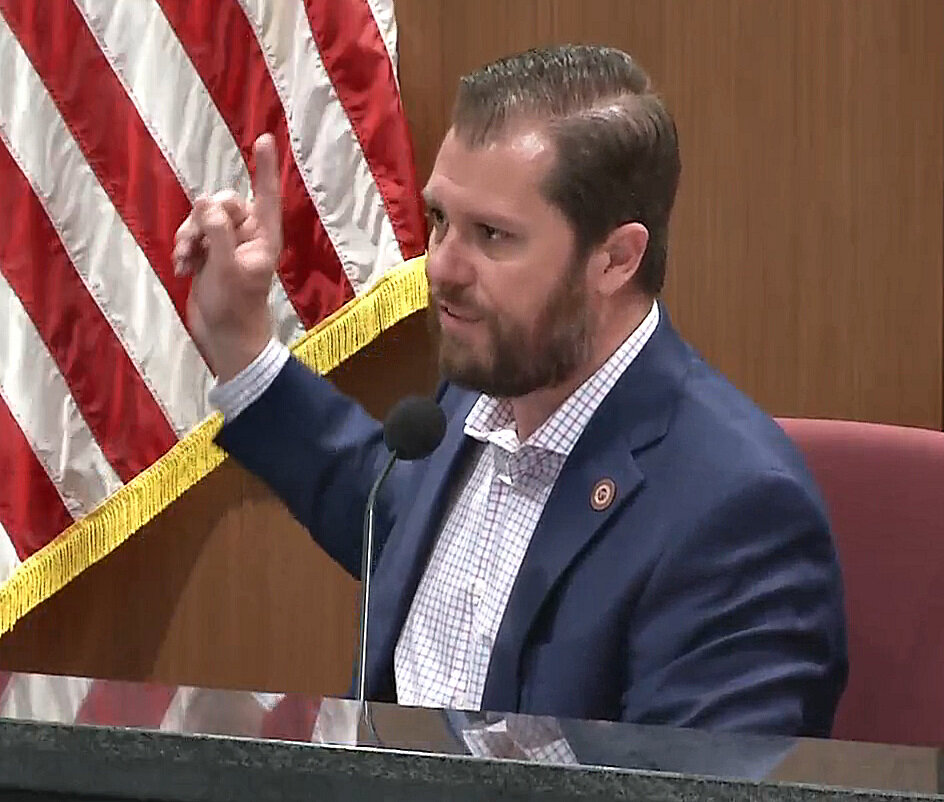
Arizona Supreme Court justices tossed a claim by Sen. Jake Hoffman, R-Queen Creek, one of those indicted last year, that Andrew Jacobs should not be on a three-judge panel deciding what could be a crucial issue in determining whether the charges against him should be allowed to go to trial. No reason was given for the order. (Capitol Media Services/Howard Fischer)
PHOENIX — A pair of $250 donations by someone who is now an appellate judge to Kris Mayes isn’t enough to conclude he should be removed from hearing an issue in the case of the fake electors she is prosecuting, the Arizona Supreme Court has ruled.
The justices tossed a claim by Sen. Jake Hoffman, one of those indicted last year, that Andrew Jacobs should not be on a three-judge panel deciding what could be a crucial issue in determining whether the charges against him should be allowed to go to trial. No reason was given for the order.
In doing so, the high court affirmed a ruling by David Gass, the chief judge of the appellate court, who concluded the donation by Jacobs, given before he was placed on the bench, did not affect his ability to be impartial. Nor was Gass concerned one of those donations from Jacobs came after Mayes, not yet elected — and long before she got a state grand jury to indict Hoffman and others — already had publicly made statements about the guilt of electors.
You must be a member to read this story.
Join our family of readers starting at $5 for your first month and support local, unbiased journalism.
Click here to see your options for becoming a subscriber.
Register to comment
Click here create a free account for posting comments.
Note that free accounts do not include access to premium content on this site.
I am anchor
Legal
Judge who made donations to Mayes won’t be removed from Arizona fake electors case
Arizona Supreme Court justices tossed a claim by Sen. Jake Hoffman, R-Queen Creek, one of those indicted last year, that Andrew Jacobs should not be on a three-judge panel deciding what could be a crucial issue in determining whether the charges against him should be allowed to go to trial. No reason was given for the order. (Capitol Media Services/Howard Fischer)
PHOENIX — A pair of $250 donations by someone who is now an appellate judge to Kris Mayes isn’t enough to conclude he should be removed from hearing an issue in the case of the fake electors she is prosecuting, the Arizona Supreme Court has ruled.
The justices tossed a claim by Sen. Jake Hoffman, one of those indicted last year, that Andrew Jacobs should not be on a three-judge panel deciding what could be a crucial issue in determining whether the charges against him should be allowed to go to trial. No reason was given for the order.
In doing so, the high court affirmed a ruling by David Gass, the chief judge of the appellate court, who concluded the donation by Jacobs, given before he was placed on the bench, did not affect his ability to be impartial. Nor was Gass concerned one of those donations from Jacobs came after Mayes, not yet elected — and long before she got a state grand jury to indict Hoffman and others — already had publicly made statements about the guilt of electors.
What’s significant about all this is the Court of Appeals — with Jacobs on the panel — will be deciding what could be a decisive issue in the case: whether Mayes brought the charges against the defendants to suppress their First Amendment rights.
Maricopa County Superior Court Judge Sam Myers ruled earlier this year the defendants had provided sufficient reason to believe that was the case. But he withheld a final decision on whether the charges ranging from fraud to conspiracy, should be thrown out.
Mayes responded by asking the Court of Appeals to review Myers’ decision. That resulted in Hoffman seeking to have Jacobs removed from the panel.
What the appellate court decides could determine whether the defendants go on trial in January or the highly publicized case goes away.
The indictment charges Hoffman and 10 other Republicans with committing fraud by preparing documents and sending them to Washington after the 2020 election declaring Donald Trump had won the popular vote in Arizona and that they should be the ones whose electoral votes are counted. That assertion, however, was not true, with Joe Biden outpolling Trump by more than 10,000 votes.
Also indicted were others in the Trump orbit, including his chief of staff during his first term in the White House, accused of being part of the scheme. Trump himself was named an unindicted co-conspirator.
The defendants have said they did nothing wrong and simply prepared the documents in case litigation would show Trump actually won. But the indictment says the move here — and in other states — was part of a larger plan to deny Biden the necessary 270 electoral votes he needed, throwing the decision on the race to Congress.
Before the case can go to trial, there’s the question of the state’s anti-SLAPP law, short for Strategic Law Against Public Participation.
These statutes generally are seen as a way to bar civil lawsuits designed to silence free speech. But the Republican-controlled Legislature in 2022 — when there was first talk about indicting the fake electors — expanded the statute to cover criminal prosecutions.
Attorney Michael Columbo who is representing Hoffman, said there’s more than enough evidence to show Mayes had a “retaliatory motive” in seeking the indictment.
In July 2022 — still running for office — she made a statement that the electors had committed a crime.
A month later, she referred to the electors’ actions as a “criminal conspiracy to overturn the results.” And there was a comment by Mayes saying the electors were “the people directly tied to the Jan. 6 insurrection.”
It was Myers’ ruling in February that the defendants had provided enough evidence to conclude they might be entitled to anti-SLAPP protection that sent the case to the appeals court — and created the question of whether Jacobs could be impartial.
Columbo said Jacobs made multiple donations to Democratic campaigns in Arizona, including a $250 contribution for Mayes on June 18, 2022, and an identical donation on Aug. 11, 2022.
“Notably, Judge Jacobs’ second contribution followed Mayes’ statements about the electors that Sen. Hoffman raised in his anti-SLAPP motion,” Columbo said.
Columbo added that the contributions indicated Jacobs supported Mayes’ platform, including bringing criminal charges against Hoffman and the other electors.
What that means, the attorney said, is Jacob’s impartiality “might reasonably be questioned.” And, if nothing else, leaving Jacobs on the three-judge panel “created, at a minimum, an appearance of partiality.”
Gass, in the ruling just upheld by the Supreme Court, tossed the request to disqualify Jacobs.
He said there is a question of whether rules about disqualifying judges applies to appellate judges. And Gass said that Hoffman “offers nothing more than bare allegations of bias and prejudice that do not overcome the presumption of impartiality.”
There’s also the fact Jacobs was still in private law practice at the time of the donations. But Gass said even if that were not the case, nothing in ethical rules governing the conduct of judges prohibits them from donating to candidates and political organizations.

 By
By 


Comments
No comments on this item Please log in to comment by clicking here