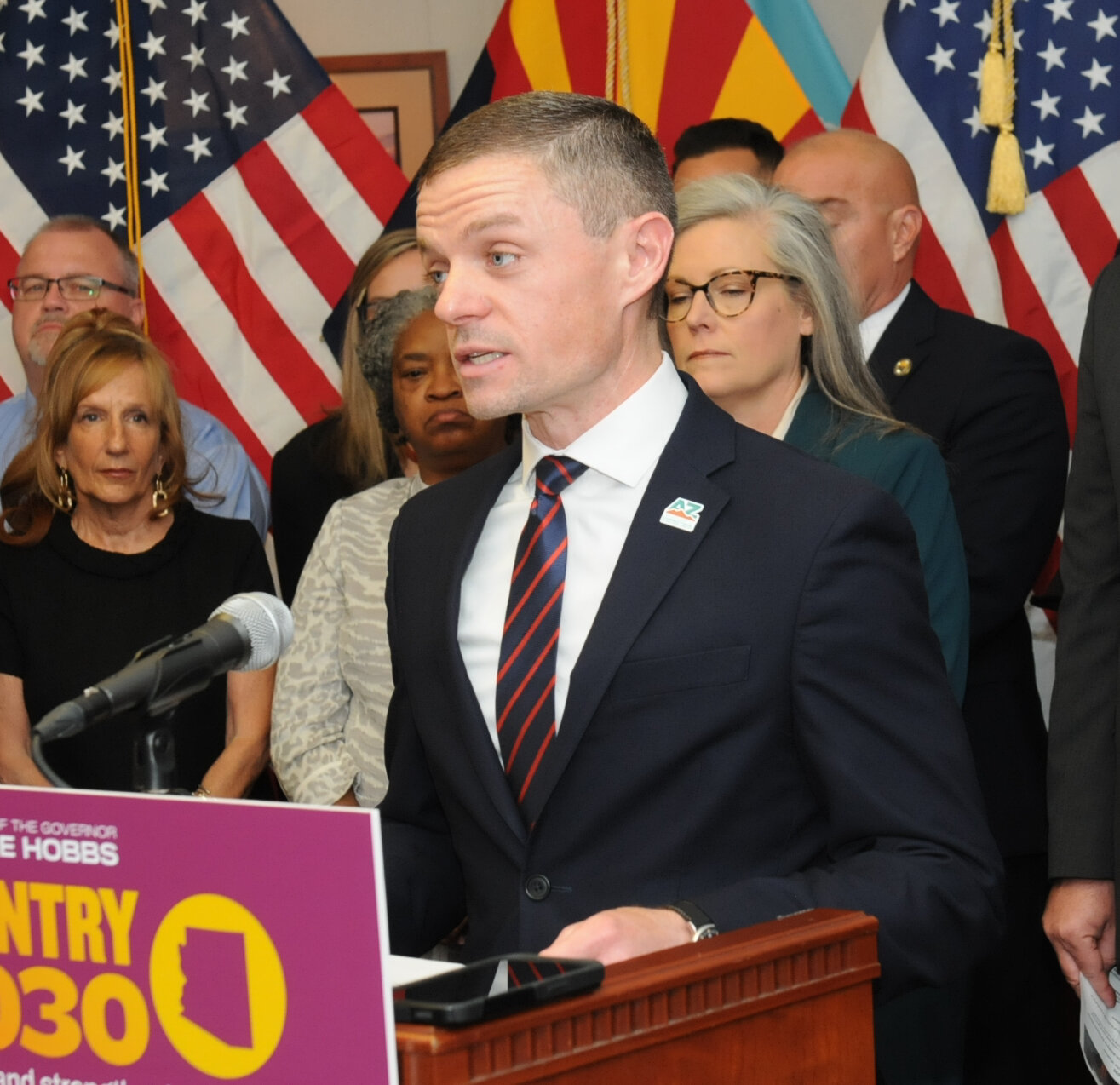
Corrections Director Ryan Thornell explains Tuesday why he supports a program to provide more employment training to inmates. (Capitol Media Services/Howard Fischer)
PHOENIX — Arizona is going to use federal funds to provide more job training for inmates in a plan to reduce recidivism — and, as the state’s prison chief says, to cut down on violence behind bars.
Gov. Katie Hobbs, in announcing the program Tuesday, said there is a need to do something more than what is happening now to end the revolving door. “In Arizona, approximately one in three people has a criminal record,” she said, quoting from figures from the Clean State Initiative that says there are more than 1.9 million adults who have “a conviction or non-conviction record.”
You must be a member to read this story.
Join our family of readers starting at $5 for your first month and support local, unbiased journalism.
Click here to see your options for becoming a subscriber.
Register to comment
Click here create a free account for posting comments.
Note that free accounts do not include access to premium content on this site.
I am anchor
Government
Arizona debuts new plan for prison job training
Aim is to reduce reentry, officials said
Corrections Director Ryan Thornell explains Tuesday why he supports a program to provide more employment training to inmates. (Capitol Media Services/Howard Fischer)
PHOENIX — Arizona is going to use federal funds to provide more job training for inmates in a plan to reduce recidivism — and, as the state’s prison chief says, to cut down on violence behind bars.
Gov. Katie Hobbs, in announcing the program Tuesday, said there is a need to do something more than what is happening now to end the revolving door.
“In Arizona, approximately one in three people has a criminal record,” she said, quoting from figures from the Clean State Initiative that says there are more than 1.9 million adults who have “a conviction or non-conviction record.”
Hobbs said about 95% of those behind bars will eventually be released, a figure that translates to about 17,000 a year.
At the same time, she said less than half of those who have been released were employed a year later.
The timing of the announcement of Arizona’s Reentry 2030 comes as there is increasing scrutiny of the Department of Corrections, Rehabilitation and Reentry.
A federal judge, who has been reviewing the system for decades, now is threatening to appoint a receiver to take over the management of health care for the more than 35,000 inmates.
More recently, Sen. Kevin Payne launched a probe after an inmate currently serving 16 life sentences allegedly murdered three other inmates at the state prison complex in Tucson.
Corrections Director Ryan Thornell said what’s in this program may help deal with the violence behind bars, both among inmates and attacks on guards.
“We know that giving opportunities to individuals who are incarcerated, under the supervision of staff and with support of staff creates a safer prison environment,’’ he said. Thornell called it “one of many strategies to support the overall effort to create safer prisons.”
That, however, many not be enough to satisfy Payne.
“What transpired within this prison is inexcusable and incredibly troubling,” said the Peoria Republican who chairs the Senate Public Safety Committee in a prepared statement. “I fear for the lives of the correctional officers and staff who are reporting to duty every day and risking their safety in a facility that has proven it cannot prevent dangerous criminals from inflicting violence.’’
Thornell, pushed on the question of violence, said there is no “common thread” among the various instances. Instead, he called it “a lot of various complicating factors.”
“It’s not an isolated situation,” Thornell said. “It’s not one isolated factor,”
“We’re putting together a very robust plan in response to it,” he said, promising to share details later this week with the governor’s office. “It’s a combination of many things that we think will bring better solutions to statewide incarceration.”
What’s behind Monday’s announcement goes back to 2008 when Congress approved the Second Chance Act, which provides dollars through the U.S. Department of Justice. Marshall Clement, the interim director of the Council of State Governments Justice Center, said six other states have started similar programs with those funds.
“The challenge of improving reentry outcomes is not new,” he said, with programs across the nation, including in Arizona, involving state governments and nonprofit organizations. “This initiative was born with the understanding the time has come to scale up what we have seen working in reentry and that we know is critical to success.”
Clement said there is evidence existing programs can make a difference.
He said recidivism in Arizona went from 38% in 2009 to the current figure of 29%. But Clement said what is in Reentry 2030 “is very different’’ and can further help to reduce that figure.
That, he said, involves removing all existing barriers to training that are unnecessary to promote prison safety. For example, he said this includes things such as continuing health care services and special support services for those with serious mental illness. It also means more vocational training.
One program benefit from, Hobbs said, is that all the cash is coming from the federal government.
She said no state dollars are involved. Conversely, the governor said, reducing recidivism will save money for the state.
All that, of course, is depending on this federal dollars not disappearing.
Clement said the dollars should be there, particularly as they have been approved by Congress. But he did not dispute that, since taking office in January, President Donald Trump has issued a series of directives to end federal programs despite their congressional authorization.
Clement said, however, he believes this program is likely to survive.
He pointed out the program was reauthorized in 2018 as the First Step Act, legislation that was approved by Trump during his first administration.
“This is work that he signed into law,” Clement said.
“This is work that he supported,” he continued. And Clement said the program “enjoys bipartisan support in Congress.”
That still leaves the related issue of health care behind bars in Arizona.
Inmates filed a class action lawsuit in 2012 claiming cruel and unusual punishment due to poor medical and mental health care.
The state in 2015 agreed to a settlement, promising to do better. Yet the state was fined $1.4 million in 2018 for failing to live up to the performance measures to which it agreed, with U.S. District Court Judge Roslyn Silver imposing another $1.1 million penalty in 2021.
A year later, in a 200-page order, Silver said the care provided by the state is “plainly grossly inadequate” and that state officials were acting “with deliberate indifference’’ to the substantial risk of harm to inmates.
Now, claiming no real progress, the American Civil Liberties Union, which is representing inmates, wants the court to transfer management of health care operations in state prisons to a third party under the direction of a court-appointed receiver. A hearing on that is scheduled for July.

 By
By 


Comments
No comments on this item Please log in to comment by clicking here