Arizona AG to continue pursuit of 'fake electors' case
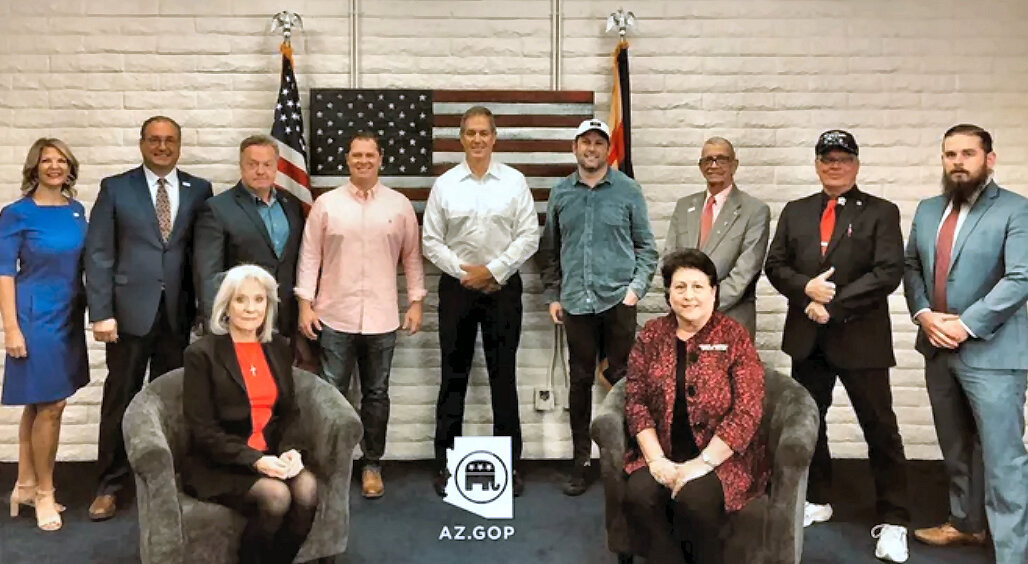
Republicans indicted in the Arizona “fake electors” case are, standing from left, former Arizona Republican Party Chairwoman Kelli Ward, Michael Ward, former state Sen. Anthony Kern, state Sen. Jake Hoffman, Jim Lamon,Tyler Bowyer, COO of Turning Point USA, former Gila County Republican Party leader Samuel Moorhead, former Cochise County Republican Committee Chairman Robert Montgomery, former Arizona Republican Party Executive Director Greg Safsten, seated from left, Nancy Cottle and Loraine Pellegrino.
Arizona GOP
PHOENIX — Attorney General Kris Mayes is going to continue to pursue the 11 Republicans who claimed to be the state’s legally elected electors despite the actual results of the 2020 presidential race.
A spokesman for Mayes confirmed Friday she will seek Supreme Court review of a ruling that quashed the original indictment. It names not just those who signed the certificates saying a majority of Arizonans voted for Donald Trump in 2020 — they did not — but also seven others in the Trump orbit, including several attorneys and Trump’s chief of staff from his first term as president.
Mayes contends they, along with the electors, were part of a scheme to undermine the results of the 2020 election by creating enough doubt in the results in Arizona and other battleground swing states by submitting paperwork claiming they were the legal electors.
You must be a member to read this story.
Join our family of readers starting at $5 for your first month and support local, unbiased journalism.
Click here to see your options for becoming a subscriber.
Register to comment
Click here create a free account for posting comments.
Note that free accounts do not include access to premium content on this site.
I am anchor
Legal
Arizona AG to continue pursuit of 'fake electors' case
Arizona GOP
Republicans indicted in the Arizona “fake electors” case are, standing from left, former Arizona Republican Party Chairwoman Kelli Ward, Michael Ward, former state Sen. Anthony Kern, state Sen. Jake Hoffman, Jim Lamon,Tyler Bowyer, COO of Turning Point USA, former Gila County Republican Party leader Samuel Moorhead, former Cochise County Republican Committee Chairman Robert Montgomery, former Arizona Republican Party Executive Director Greg Safsten, seated from left, Nancy Cottle and Loraine Pellegrino.
PHOENIX — Attorney General Kris Mayes is going to continue to pursue the 11 Republicans who claimed to be the state’s legally elected electors despite the actual results of the 2020 presidential race.
A spokesman for Mayes confirmed Friday she will seek Supreme Court review of a ruling that quashed the original indictment. It names not just those who signed the certificates saying a majority of Arizonans voted for Donald Trump in 2020 — they did not — but also seven others in the Trump orbit, including several attorneys and Trump’s chief of staff from his first term as president.
Mayes contends they, along with the electors, were part of a scheme to undermine the results of the 2020 election by creating enough doubt in the results in Arizona and other battleground swing states by submitting paperwork claiming they were the legal electors.
That was designed to get Vice President Mike Pence, who was the presiding officer of the Senate, to refuse to accept official results from Arizona and other states, preventing Biden from getting the necessary 270 electoral votes, a move that could have allowed Congress to give Trump an immediate second term.
Mayes could face an uphill battle.
Maricopa County Superior Court Judge Sam Myers threw out the original indictment against all 18 earlier this year.
He concluded grand jurors were not provided with a key piece of information that could have backed up their claim there was no intent to defraud anyone because an 1887 federal law addresses the possibility of competing electors slates from a state and how Congress must handle them.
The contention of the electors and those indicted with them was that the results in Arizona were not clear — there was a legal challenge — and they were simply submitting the GOP slate to Congress should it turn out that Biden actually lost.
That decision was upheld unanimously by a three-judge panel of the Court of Appeals.
It is that decision Mayes hopes to overturn.
But even if the high court agrees, that does not mean the case will go to trial as scheduled next year.
First there is another legal issue that has to be resolved: whether Mayes violated the state’s Strategic Lawsuit Against Public Participation law.
SLAPP, as it is known, is designed to prevent public officials from using the court to punish and prevent speech on political issues. Myers, in a preliminary ruling in February, said there was enough presented to him to believe that the indictment appeared to attack what is “at least in part some arguably lawful speech.”
The judge at the time gave the attorney general’s office 45 days to respond. But that issue was put on the back burner until there was a resolution on the question of whether there case would proceed after the indictment was thrown out.
There’s also a separate bid by Christina Bobb, one of Trump’s former lawyers who is among those indicted, to have Mayes — and her entire office — disqualified from hearing the case.
She says much of the case was prepared not by the attorney general’s office but instead by States United Democracy Center.
A copy of the organization’s 47-page report, obtained by Capitol Media Services, shows States United provided a time line of the events leading up to the 11 Republicans submitting their false statement about the election results to Congress and claiming they were the true electors.
It also included a list of charges that States United said could be brought against not just the GOP electors but also against others in Trump’s orbit — like Bobb — who it said could be charged with being part of a conspiracy.
At this rate, the case actually could run into the 2026 election where Mayes is seeking a second term. And if Mayes were defeated — she won her first race by only 280 votes — it would leave any decision whether to pursue the case to a Republican successor.

 By
By 


Comments
No comments on this item Please log in to comment by clicking here