Dunn wants nondiscrimination ordinance for the city
Screenshot
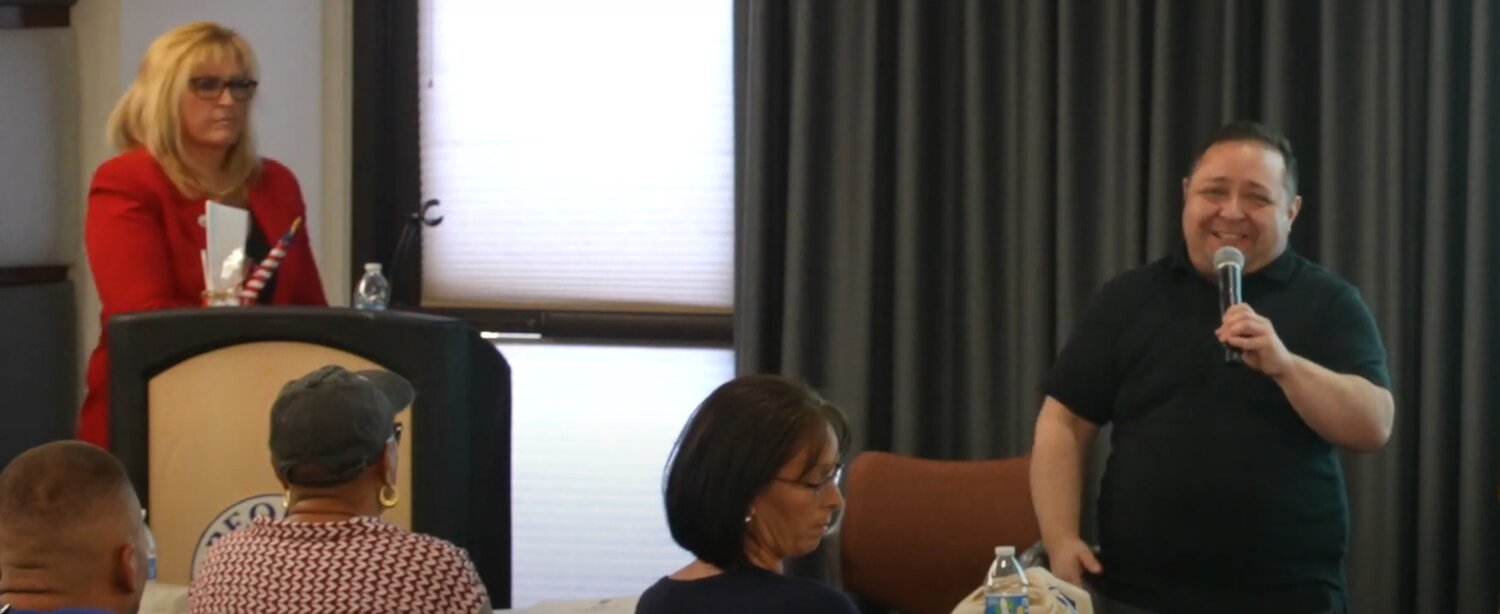
Michael Soto, chief advocacy officer at One Community, speaks at a public meeting in Peoria about the non-discrimination ordinance. Pine District Councilmember Denette Dunn (left) would like the city council to consider the ordinance for Peoria.
Posted
What about public education?
In this country 21 states and 330 cities have a nondiscrimination ordinance. In Arizona as a transgender person, it depends on where you live if you are protected or not. Eleven cities in Arizona have non-discrimination ordinances providing protections to LGBTQ+ individuals to various degrees as of 2022, including Chandler, Glendale, Mesa, Phoenix, Scottsdale, Tucson and Tempe. A NDO approved by Peoria City Council would not include the Peoria Unified School District. Title IX of the Education Amendments of 1972 protects students from discrimination based on sexual orientation and gender identity.
Have an opinion on this issue?
Want to get in on the conversation? Send your letters to phaldiman@iniusa.org.
Peoria Pine District Councilmember Denette Dunn wants a nondiscrimination ordinance for the city, but some don’t like it.
An LGBTQ+ inclusive nondiscrimination ordinance, which the city does not have, would fully protect LGBTQ+ families and individuals from discrimination in public accommodations, employment and housing in the city of Peoria.
Simply put, protecting people from discrimination is about treating others equally, Dunn said.
“This ordinance is about equal treatment, not special treatment. The principles of nondiscrimination are rooted in core American values of fairness, equality, and opportunity,” she said. “All hard-working people, including those who are LGBTQ, want to do their jobs and provide for their families. LGBTQ people want the same thing as everyone else.”
Such a move has been undertaken by various Valley cities in part to ensure protection of all their residents, but also in part because of the economic impacts of not doing so.
During the past year, one in three LGBTQ+ people have reported some kind of discrimination, according to the Center for American Progress, in conjunction with NORC at the University of Chicago.
Michael Soto, chief advocacy officer with One Community and a transgender man, said the ordinance wouldn’t provide special rights to the LGBTQ+ community, but only give them a level playing field.
In more than half the nation, he said, state and municipalities current nondiscrimination laws and ordinances are not inclusive of sexual orientation and gender identity, meaning it is still legal to fire someone, deny them housing, or refuse them service simply for who they are or who they love.
Protecting LGBTQ+ Arizonans means updating the existing law to include sexual orientation and gender identity, he said.
More than 650 anti-LGBTQ+ laws have been introduced in U.S. Congress and state legislatures during the past year, according to USA Today.
Soto said those kinds of laws were in the dozens previously, and now those laws are meant to cause division.
With discrimination on the rise, nondiscrimination measures are more important than ever, Soto said
“Reports are increasing in Arizona and they are increasing in our country,” Soto said. “These are things we want to see not happen in our country. We want Arizona and Peoria and this country to be a place where all people can work, can thrive and can contribute to society, and we know that discrimination can keep people from doing that.”
Request for discussion
A nondiscrimination law expansion in Peoria would keep transgender people from being denied housing, from being fired or not hired or being denied public accommodation based on discrimination.
A study session on the subject has not been requested, but Dunn said she has spoken about the nondiscrimination ordinance to Mayor Jason Beck and a few council members.
She also held a Pine District Citizens Advisory Committee meeting and invited advocacy group One Community to speak and explain the need for a nondiscrimination ordinance in Peoria.
As far as asking for an item on the agenda, Dunn said she would be grateful to Beck and the rest of the council to allow a study session to be held and consider an NDO for the city.
This should be one of Peoria’s priorities to attract and retain businesses and employees to the city, do better for residents, as well as grow economic development, she said.
“I’m not asking for special rights, I’m asking my colleagues on council to consider equal rights for everyone, regardless of sexual orientation or gender identity,” Dunn said. “I ran for Peoria City Council to make a difference in my community and serve all those who live, work and play here.”
Opposition
Some conservative circles in Peoria have not taken to the ordinance and have spread misinformation about it.
Arizona LD 28 Republican Party and Peoria AZ Grassroots Ambassadors, both local conservative groups, have voiced opposition to the ordinance on their Facebook groups.
Opposition groups have claimed the ordinance regulates the operations of local businesses through mandates.
Peoria resident Lori Bango, who is the LD 28 chairman and Peoria AZ Grassroots Ambassadors founder, said during the Oct. 10 council meeting that the city does not need a NDO.
She said during the September meeting of the Arizona LD 28 Republican Party, 125 attendees were an “absolute no” on the ordinance.
Bango cited the 14th Amendment as regulation enough to guarantee people of all genders equal treatment and due process under the law.
She added there is a bill going through Congress, the Equality Act, which would essentially have the same effect as a local NDO.
“We already have these issues covered as far as I am concerned. Bringing them to a city level is absolutely not necessary and is how we have gotten to where we are today, compromising these things,” she said during the council meeting. “Peoria is a very conservative area for the most part. Because we all represent our constituents, we need to listen to the people, and it is an overwhelming no as our legislative district goes.”
At the September council meeting, Peoria resident James Miller asked how many ordinances are needed to ensure everyone in the city is protected against any and all forms of discrimination, as well as, what exactly is discrimination today and what forms does it take in order to be offensive or not inclusive?
“Do we need an ordinance to protect the rights of men who are less than 5 feet tall or more than seven-and-half feet tall? Do we need an ordinance to protect the rights of women who are less than four-and-a-half feet tall, or even over or under a certain weight? ... When does it stop? When do we realize that all we are doing is pitting groups against each other, and in the end, we live in a society where everyone is safe from everything and no one is free,” Miller said.
NDOs attract businesses
Discrimination is bad for business — states and municipalities that lack equal protections actively damage their economy’s competitiveness and ability to thrive, according to One Community.
NDOs support tourism as well as attract top businesses and top talent.
Despite what has been shared by some residents at recent council meetings, LGBTQ+ individuals in Peoria can still be discriminated against when it comes to employment, housing, and public accommodations, said Peoria Chamber of Commerce President and CEO Rhonda Carlson.
Research indicates the implementation of an anti-discrimination ordinance serves as a great catalyst for attracting talent and businesses as well as helps spur economic growth, she said.
“In the West Valley, we speak so often about workforce challenges and the need to enhance our talent pool due to the continued development in our region. Yet, a very clear hindrance to these efforts exists in cities that do not have anti-discrimination protections in place,” Carlson said. “The lack of equal protections for all residents damages our ability to be competitive, and is just simply not the right thing to do for our community. Who you choose to love should have no bearing on how you are served as a resident.”
Eleven cities in Arizona have NDOs providing protections to LGBTQ+ individuals to various degrees, as of 2022. Tempe is one of those cities, which implemented and approved their NDO in2006, and expanded it in 2014 to protect LGBTQ+ people.
Tempe Mayor Corey Woods said at a panel last year that in the last decade, more than $3.6 billion of mixed-use, commercial and industrial development has occurred, with $120 million of that occurring in the first five months of 2022, according to a report from Az Big Media.
Officials said having a nondiscrimination ordinance has helped with that growth.
Tempe supports LGBTQ+ events such as Pride. The city also supports Black, Indigenous, and people of color, and holidays such as Juneteenth, Cesar Chavez Day and Indigenous Peoples’ Day, as well as adaptive sports, according to the city.
Kris Baxter-Ging, Tempe’s interim communication and marketing director, said the city has expanded the ordinance over the years to be more inclusive. Most recently, the city has added Crown Act protections, and is now exploring adding source of income protections.
“Our nondiscrimination ordinance is the foundation for ensuring Tempe’s welcoming atmosphere,” Baxter-Ging said. “Many top employers have cited an open and welcoming atmosphere as reasons to locate here. ... We know that by welcoming everyone, and ensuring that all people feel safe and included, that our community thrives.”
Tempe Tourism Office President/CEO Michael Martin reinforced that sentiment.
“Our office does make a strong effort to support the image and brand that Tempe is a welcoming city,” he said. “If the city of Tempe did not have those ordinances and protections, then we as a destination marketing organization would not be able to market the city as a welcoming destination. Therefore, we applaud and appreciate the city’s lead in ensuring that Tempe is accommodating and welcoming to everyone.”
Resident Support
Peoria resident Vicki James said she has no opposition against an ordinance that many Valley cities have implemented and one that would allow for equality to all.
“It does not affect the schools, it does not affect the churches, but it does provide equal rights, housing and medical. Basically it is what all of us ask for as Americans — equality. Somebody should not be denied housing because of race, creed, color, religion or gender or sexual orientation. Whatever they want to be, let them be. But we do need them to feel welcome, we want their tourism dollars, we want them as employees,” she said. “With as fast as the West is growing, we are going to need those people to fill positions whether you like it or not. They are no different than you or I. All they want is exactly what we as Christians preach and fail to do — what Jesus said, ‘Love as I have loved you.’ That’s what we’re all asking for — equality and the right to be us.”
Philip Haldiman can be reached at phaldiman@iniusa.org, or on Twitter @philiphaldiman. We’d like to invite our readers to submit their civil comments, pro or con, on this issue. Email AZOpinions@iniusa.org.
Meet Philip Haldiman is an award-winning journalist who most recently took first place for investigative reporting in 2023 from Arizona Newspapers Association. He joined Independent Newsmedia, Inc., USA, in 2015, covering Sun City West his first year. Since 2016, he has covered the city of Peoria. Prior to coming to INI, he was a reporter with The Arizona Republic for seven years, covering numerous cities throughout the Valley. Before that, he was a freelance writer.
Community: Haldiman spearheads the Peoria Independent Hometown Heroes Awards program, honoring local individuals and businesses that give back to the community. He has hosted local candidate forums over the years and is a member of the Society of Professional Journalists. Haldiman also served as a member of the Journalism Program Community Advisory Board at Glendale Community College. Outside journalism, Haldiman served as a member of the city of Peoria Complete Count Committee for the Census, 2019-2020. Lastly, he has served as a member of his HOA governing board since 2021.
Education: Arizona State University with a BA in Journalism and Mass Communications and a BA in Theater.
Random Fact: Haldiman is a fourth-generation Arizonan as well as wrote and produced an autobiographical comic book about his time spent in Hollywood and his life as a cult film star.
Hobbies: He enjoys hiking Arizona’s mountainous landscapes and is currently working on a play for the stage.

 By


Comments
No comments on this item Please log in to comment by clicking here