With media inquiries and questions from the public as well as the continued evolution of the science around the “forever chemical” known as PFAS, officials at Arizona Department of Environmental Quality are working to raise awareness about contamination and its potential health risks.
The chemical has been found in water wells throughout the Valley and has led to remediation at Luke Air Force Base as well as the closure of a Peoria well.
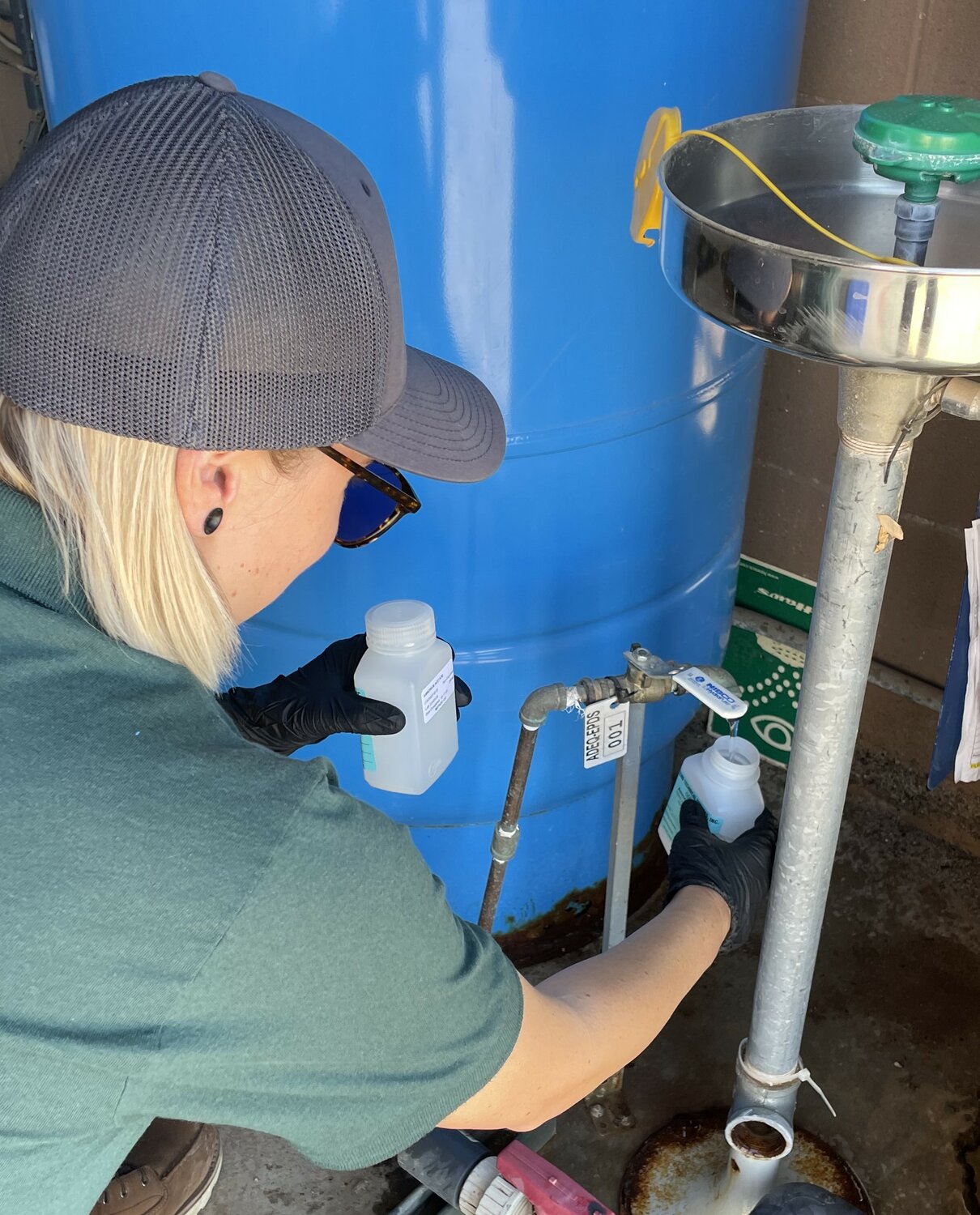
Matthew Narter, a hydrologist and the PFAS lead at ADEQ, said the state agency has a page on its website dedicated to PFAS with details about the compound and numerous links.
Over the past few years, ADEQ has worked closely with the Environmental Protection Agency and Arizona Department of Health Services to educate the public about PFAS, Narter said.
ADEQ has also worked with water providers, like the city of Peoria, giving them support and information as new details about PFAS emerge.
Officials with ADEQ have given presentations to Arizona county board of supervisors and other applicable boards and commissions.
Narter said PFAS have a bio-cumulative aspect that gives them a unique ability to cumulate in the environment and in people, as well as the ability to resist breaking down.
“That’s why the EPA is looking at low concentrations and we are being proactive about this,” Narter said. “By the time regulations finalize, we will already have a head start. Our public water systems will have head start and will know what is in their water and will be able to better understand solutions and secure funding.”
New regulations
PFAS, or per-and polyfluoroalkyl substances, are man-made, widely used, long-lasting chemicals that break down very slowly over time.
The U.S. Environmental Protection Agency says exposure to these chemicals over time can cause potential health risks, and while the federal agency has no set PFAS regulations at this time, that is changing.
In March, EPA proposed maximum PFAS contaminant levels for drinking water. Among those levels are PFOA and PFOS at 4 parts per trillion.
The most studied PFAS compounds in the environment are those two — perfluorooctanoic acid (PFOA) and perfluorooctane sulfonic acid (PFOS).
PFAS particles are extremely small. For a reference point, 1 part per trillion is equal to a single drop of water in 20 Olympic-sized swimming pools.
Regulations have not been officially completed, but the EPA has indicated it would like to finalize them by the end of 2023, with drinking water standards expected to go into effect three years after they are finalized, giving states and water providers time needed to address contamination.
These are just a few PFA developments expected in the coming years.
These proposals were developed by EPA to account for chronic exposures to low levels of PFAS over time. At concentrations typically found in drinking water, they are not dangerous in the same way as acute water contaminants like E. coli, which may be dangerous if consumed even once, according to EPA.
“Through this proposed rule, EPA is leveraging the most recent science and building on existing state efforts to limit PFAs to provide a nationwide, health-protective level for these specific PFAS in drinking water,” the EPA states.
Peoria well
Jennifer Peterson, environmental resources manager in Peoria’s Water Services Department, said city workers have sampled 12 of its 24 active water wells for PFAS and found one well, at the field entry point to distribution, with PFAS above the proposed levels, at 6.47 parts per trillion.
Peterson said the city has shut down the well as a precaution and is evaluating mitigation options.
Sampling for the remaining 12 wells have been completed and results show now contamination, based on proposed levels.
The science on PFAS is evolving and the city will continue sampling for the chemicals, but treatment of the well could be costly, ranging from $5 million to $10 million to fix, Peterson said.
“Protection of public health is our number-one priority,” she said. “Our hope is that we can proactively identify any potential challenges before there is a regulation in effect.”
Other local issues
Liberty Utilities, a water system that serves more than 1 million customers largely in North America, has a water well in the area of Luke Air Force Base, near El Mirage and Camelback roads in unincorporated Litchfield Park, that shows a high concentration of PFOS at 170 ppt, 42 times the newly established EPA proposed standard of 4 ppt, according to ADEQ.
Tested in 2021, the well also shows traces of PFOA 12 times the standard at 50 ppt.
Additionally, Liberty Utilities’ water well in east Litchfield Park, just north of Goodyear, showed concentrations of PFAS-related chemicals in a 2022 sampling, according to ADEQ. PFOAs in the Litchfield well result was 5.4 ppt, slightly above the 4 ppt standard.
In Glendale, Liberty’s well results for PFOS and PFOA were 6.3 ppt and 8.5 ppt, respectively. Another Liberty well in Glendale showed results for PFOS and PFOA at 15 ppt and 17 ppt, respectively.
In 2015 and 2021 at Luke Air Force Base, sampling results indicated the presence of PFOAS and PFOS — at levels above the EPA’s lifetime health advisory for drinking water. The chemicals were traced to an aviation industry-standard firefighting foam Luke began using in the 1970s.
Peterson said when the levels were found to be high at Luke in 2021, the city of Peoria sampled its two southern-most wells for PFAS and found no trace. However, that has not been the case for water wells in the Litchfield Park area, as mentioned above.
More about PFAS
PFAS have been used by various industries since the 1940s. They are found in water resistant clothing, nonstick cookware, stain-resistant carpets, packaging material, firefighting foam and many other items.
There are thousands of PFAS chemicals, and they are found in many different consumer, commercial and industrial products, which makes it challenging to assess the potential human health and environmental risks, according to the EPA.
Scientific studies have shown exposure to some PFAS in the environment may be linked to harmful health effects in humans and animals.
Since 2000, many industries have phased out the use of some PFAS.
Still, there are 29 detectable PFAS compounds, out of thousands, in drinking water.
“Because of their widespread use and their persistence in the environment, many PFAS are found in the blood of people and animals all over the world and are present at low levels in a variety of food products and in the environment,” according to the EPA. “PFAS are found in water, air, fish, and soil at locations across the nation and the globe.”
Philip Haldiman can be reached at phaldiman@iniusa.org, or on Twitter @philiphaldiman. We’d like to invite our readers to submit their civil comments, pro or con, on this issue. Email AZOpinions@iniusa.org. Independent Newsmedia reporter Michael McDaniel contributed to this report.
Meet Philip Haldiman is an award-winning journalist who most recently took first place for investigative reporting in 2023 from Arizona Newspapers Association. He joined Independent Newsmedia, Inc., USA, in 2015, covering Sun City West his first year. Since 2016, he has covered the city of Peoria. Prior to coming to INI, he was a reporter with The Arizona Republic for seven years, covering numerous cities throughout the Valley. Before that, he was a freelance writer.
Community: Haldiman spearheads the Peoria Independent Hometown Heroes Awards program, honoring local individuals and businesses that give back to the community. He has hosted local candidate forums over the years and is a member of the Society of Professional Journalists. Haldiman also served as a member of the Journalism Program Community Advisory Board at Glendale Community College. Outside journalism, Haldiman served as a member of the city of Peoria Complete Count Committee for the Census, 2019-2020. Lastly, he has served as a member of his HOA governing board since 2021.
Education: Arizona State University with a BA in Journalism and Mass Communications and a BA in Theater.
Random Fact: Haldiman is a fourth-generation Arizonan as well as wrote and produced an autobiographical comic book about his time spent in Hollywood and his life as a cult film star.
Hobbies: He enjoys hiking Arizona’s mountainous landscapes and is currently working on a play for the stage.
media inquiries,
science,
forever chemicals,
PFAS,
Arizona Department of Environmental Quality,
raise awareness,
contamination,
health risks,
Litchfield Park,
Peoria,
Arizona,
Luke Air Force Base

 By


Comments
No comments on this item Please log in to comment by clicking here