As Arizona prepares for another closely watched election cycle, Secretary of State Adrian Fontes says the state's biggest election challenges are not technological weaknesses but public misunderstanding of how elections are administered.
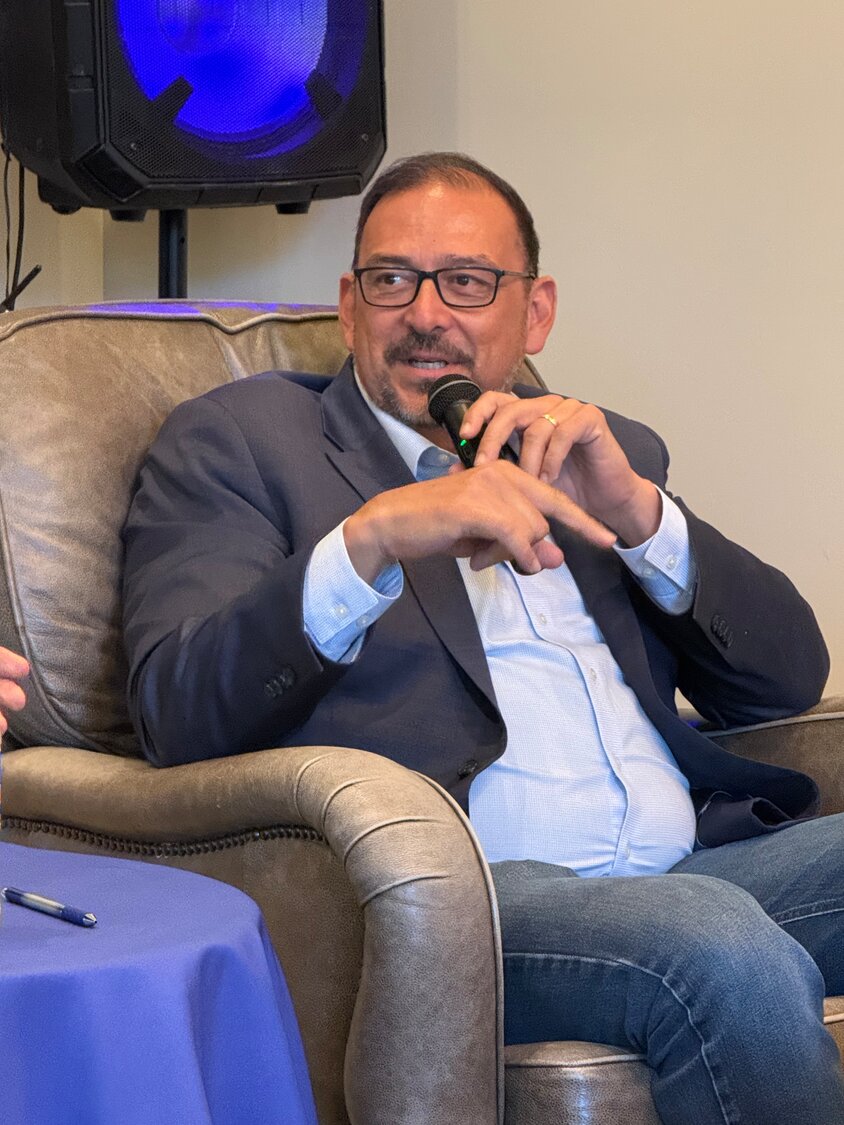
Speaking at a bipartisan, invitation-only meet-the-candidates event hosted by Gilbert Vice Mayor Chuck Bongiovanni, Fontes discussed election security, voter confidence, transparency and civic education as Arizona heads toward the 2026 elections.
Throughout the conversation, Fontes, a Democrat who is running for reelection this fall, repeatedly pushed back on the idea that election security and voter access are competing priorities.
"Election security and access are not mutually exclusive," Fontes said.
He argued Arizona's election system provides voters with more options than most states while maintaining strong safeguards through a network of county election officials, law enforcement agencies, cybersecurity partners and federal and state security organizations.
Fontes noted his office serves primarily in an oversight and certification role, while Arizona's 15 counties administer elections. He described a multilayered security system that includes cooperation with local law enforcement, the Arizona National Guard, the Arizona Department of Homeland Security and the Arizona Counter Terrorism Information Center.
As an example, Fontes said Arizona election officials successfully addressed 15 bomb threats reported on Election Day in 2024 without major disruptions to voting.
While he expressed confidence in Arizona's election systems, Fontes said greater transparency could further improve public trust.
He repeatedly advocated for making ballot images available alongside cast vote records, allowing voters to review election data for themselves.
"I've got enough confidence in the system that I think it would show exactly what it has always shown," Fontes said. "And that is this many voters who were on the voter rolls, this many ballots, this many votes were cast and off we go."
Fontes also challenged the notion that election workers deserve suspicion from the public, emphasizing that elections are administered by thousands of ordinary Arizonans.
"Those folks don't deserve that," Fontes said. "These are good, honorable people. They come from all of our communities all over Arizona."
He argued much of the public skepticism surrounding elections stems from a lack of understanding about how the system operates behind the scenes.
"I think the biggest misconception is we just don't collectively have a deep enough understanding of how the system works," Fontes said.
That theme led into one of the evening's most well-received discussions, a call for renewed civics education.
Fontes said schools, community organizations and government leaders should work together to help residents better understand how government functions and how elections are administered.
"I think we need to bring civic education back," Fontes said.
He lamented what he described as a decline in public knowledge about governmental structures and responsibilities, arguing that self-government depends on citizens understanding the institutions that serve them.
"We are about to celebrate our semi-quincentennial — 250 years since we told King George III we will not be ruled without consent of the governed," Fontes said. "How can the governed give intelligent consent if they don't know what the heck is going on?"
The remarks drew positive reactions from audience members across the political spectrum, reflecting an issue that appeared to generate broad bipartisan agreement during the discussion.
Fontes also argued Republicans, Democrats and independents agree on more election-related issues than public debate often suggests. He pointed to support for ballot-by-mail, online voter registration, early voting and post-election audits as examples of policies that have gained acceptance across party lines.
Looking beyond election administration, Fontes said declining trust in public institutions remains a broader challenge facing the country.
"I think we have to allow ourselves a little bit more grace to stop being so suspicious of one another," Fontes said.
Fontes, a Democrat, is seeking reelection in 2026. Republicans Alexander Kolodin and Gina Swoboda are competing for their party's nomination to challenge him in the general election.
But during the Gilbert event, the focus remained largely on election administration and public confidence in the electoral process rather than campaign politics.
For Fontes, the path to greater trust lies in transparency, education and civic engagement.
"I think we all need to come together after that deep breath and that collective sigh and say, 'What am I envisioning my behavior to be better at? How can I do this better?'" Fontes said.
Please submit comments at yourvalley.net/letters or email them to AzOpinions@iniusa.org. We are committed to publishing a wide variety of reader opinions, as long as they meet our Civility Guidelines. Tom Blodgett can be reached by email at tblodgett@iniusa.org or follow him on X at @sp_blodgett.
Meet Tom Tom Blodgett joined Independent Newsmedia, Inc., USA, in 2022, when the company acquired Community Impact Newspaper's Phoenix-area properties. Raised in Arizona, he has spent more than 35 years in journalism in the state.
Community: He has served as an instructional professional in the Walter Cronkite School of Journalism and Mass Communication since 2005, and is editorial adviser to The State Press, the university's independent student media outlet. He also is director of operations for an 18U girls fastpitch softball team from Gilbert.
Education: Arizona State University with a BS in Journalism.
Random Fact: He lived in Belgium during his freshman year of high school.
Hobbies: Tweeting enthusiastically about ASU softball (season-ticket holder) and grumpily about other local sports (pessimistic fan).

 By


Comments
No comments on this item Please log in to comment by clicking here