Phoenix is one of the nation’s stronger markets for small-business expansion, but Tucson is facing a more challenging economic outlook, according to a new study comparing 56 major U.S. metropolitan areas.
The ranking, published by Clarify Capital, a business financing platform, puts Phoenix at No. 13 nationally and Tucson at No. 49. The 36-place gap highlights the different economic conditions confronting businesses looking to grow in Arizona’s two largest metropolitan areas.
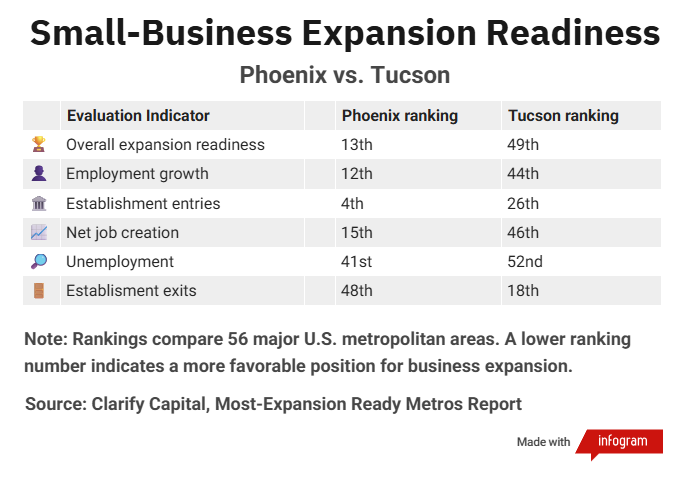
Phoenix benefits from stronger employment growth, job creation and new business activity. Tucson, meanwhile, ranks near the bottom nationally for employment growth and unemployment, making it a less favorable market for businesses seeking to expand.
To develop its rankings, Clarify Capital examined five economic indicators: one-year employment change, 2023 business establishment entry and exit rates, 2023 net job creation, and preliminary unemployment figures from July 2026. Employment growth carried the greatest weight in the final rankings.
Phoenix stands out for new business activity
Phoenix’s strongest showing came in new business establishment entries, where it ranked fourth nationally, behind only Orlando, Austin and Miami.
The metro also ranked 12th for one-year employment growth and 15th for net job creation. Those results helped Phoenix secure a place among the nation’s 15 best markets for small-business expansion. Phoenix also outperformed several major metropolitan areas, including New York City, which ranked No. 17, Miami at No. 20, Atlanta at No. 31 and Denver at No. 32.
The results suggest Phoenix offers businesses a comparatively favorable combination of employment growth and new business activity. However, the city’s performance was not strong across every category. Phoenix ranked 48th nationally for establishment exits, one of its weakest results.
While new businesses are entering the market at a relatively high rate, the low ranking for establishment exits suggests that business turnover remains an important consideration.
The study does not explain why establishments leave the market or distinguish between business closures, relocations and other reasons for exiting. Still, the contrast shows a strong market for new businesses does not necessarily mean existing establishments face fewer challenges.
Tucson struggles with employment and job creation
Tucson’s overall ranking tells a different story. The metro placed 44th for one-year employment growth and 46th for net job creation, putting it among the weaker performers in the national comparison.
Unemployment was another area of concern. Using preliminary July 2026 figures, Clarify Capital ranked Tucson 52nd out of 56 metros on its unemployment indicator, placing it among the five lowest-ranked markets for this measure.
Tucson also fell behind Phoenix in new business establishment entries. It ranked 26th nationally, compared with Phoenix’s fourth-place finish.
Together, the results point to a more difficult environment for businesses seeking to expand in Tucson, particularly those that depend on a growing workforce or an expanding local economy.
Still, Tucson did outperform Phoenix in one category: establishment exits. Tucson ranked 18th nationally, while Phoenix placed 48th.
That was Tucson’s strongest relative advantage in the study and the only one of the five indicators in which it ranked ahead of Phoenix. The finding offers a reminder that Tucson’s lower overall position does not mean it performs poorly on every measure of business activity.
A wide gap between Arizona’s two largest metros
The difference between Phoenix and Tucson was especially pronounced in employment growth and job creation.
Phoenix ranked 12th nationally for employment growth, while Tucson ranked 44th — a 32-position gap. In net job creation, Phoenix placed 15th and Tucson 46th, a difference of 31 positions.
The gap in new business establishment entries was also substantial, with Phoenix ranking fourth and Tucson 26th.
Phoenix held the stronger position in the unemployment category as well, ranking 41st compared with Tucson’s 52nd. In this measure, a lower numerical ranking indicates a more favorable position.
The establishment-exit rankings went the other way. Tucson’s 18th-place finish was considerably stronger than Phoenix’s 48th-place ranking.
These differences help explain why the two metros landed so far apart in the overall standings. Phoenix’s stronger performance across four of the five indicators outweighed Tucson’s advantage in establishment exits.
Nashville tops national list
Nashville, Tennessee, ranked No. 1 in Clarify Capital’s study, followed by Raleigh, North Carolina, and Austin, Texas.
Salt Lake City took fourth place, followed by Charlotte, North Carolina, at No. 5. Houston, Dallas-Fort Worth, Cincinnati, Fresno and San Jose rounded out the top 10.
At the opposite end of the list, Portland-Vancouver-Hillsboro, Oregon-Washington, ranked last among the 56 metros. Virginia Beach-Chesapeake-Norfolk placed 55th, followed by Rochester at No. 54, Sacramento at No. 53 and Memphis at No. 52.
Tucson ranked 49th, just behind San Francisco-Oakland at No. 48 and ahead of Baltimore at No. 50. Its position put it among the 10 lowest-ranked metros in the study.
What the rankings mean for Arizona
For Arizona businesses considering expansion, the findings suggest location may make a significant difference.
Phoenix’s strong employment growth, job creation and new business formation helped it secure a place near the top of the national rankings. Tucson’s weaker performance in those areas points to greater challenges for businesses looking to grow.
Matt Loeschman has had two separate stints at Independent Newsmedia. He began as a reporter covering Peoria and later Surprise from 2000-2009. In 2017, he returned to Arizona and INI as the news editor of the Daily News-Sun (now the Phoenix Independent). He previously covered the Arizona Rattlers of the Indoor Football League for more than a decade.
Community: During high school football season since 2017, he contributes live postgame radio reports to the AIA Friday Night Football Wrap Up Show. He supports organizations such as Phoenix Children’s, Boys and Girls Clubs of the Valley and the American Cancer Society.
Education: The University of Texas at Austin majoring in Journalism-News and Public Affairs.
Random Fact: He can sing and he has been fortunate to meet many famous people during his journalism career including First Lady Hillary Clinton, King of Country Music George Strait and Oscar-winning actor Matthew McConaughey. Attended all 4 home games of the 2001 World Series.
Hobbies: Watching and playing a wide variety of sports, including golf, tennis, pickleball and softball. Playing PlayStation 5, working out, shopping and reading.


 By


Comments
No comments on this item Please log in to comment by clicking here