Valley Starbucks employees try to keep organized labor momentum
Eight local stores voted to have unions
Ted S. Warren/Associated Press file
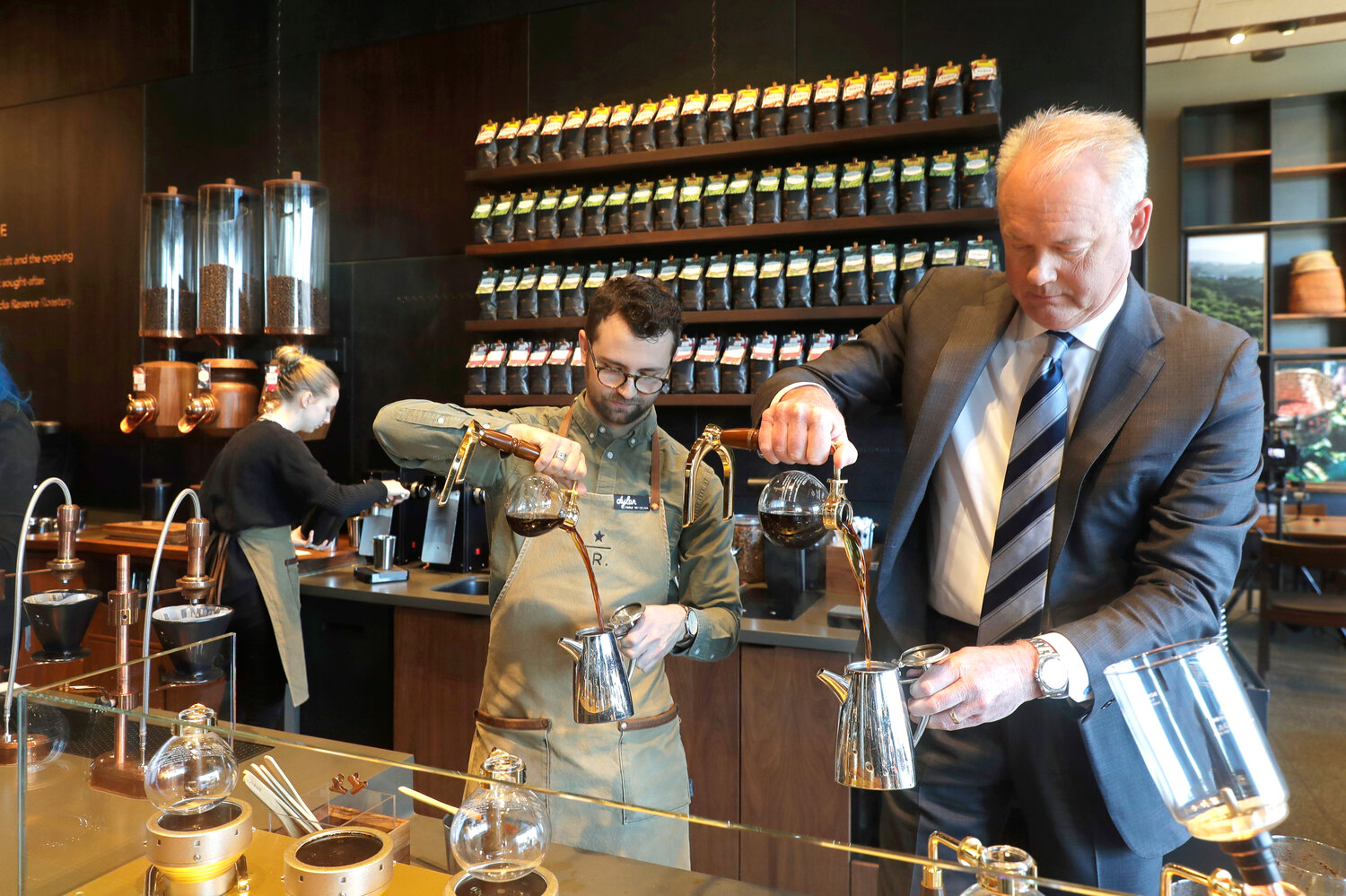
In this 2019 photo, Kevin Johnson, right, then-CEO of Starbucks, makes coffee using a siphon method alongside a barista during a visit to the company’s Starbucks Reserve store at the company headquarters in Seattle. There are now eight union Starbucks stores in the Valley.
Posted
UNION STARBUCKS IN ARIZONA
• Avondale: Southeast corner of 107th Avenue and Indian School Road.
• Litchfield Park: Northeast corner of Camelback and Litchfield roads.
• Gilbert: Southeast corner of McQueen and Guadalupe roads.
• Gilbert: Higley Road, just north of Baseline Road.
• Mesa: Southeast corner of Power and Baseline roads.
• Mesa: Southwest corner of Crismon Road and Southern Avenue.
• Phoenix: Seventh Street and Bell Road.
• Tucson: Southeast corner of Euclid Avenue and University Boulevard.
More than 400 Starbucks coffee shops have unionized across the U.S, and that effort has made inroads in the Valley.
With nine union stores in Arizona, including eight in the Valley, Starbucks is among the national companies dealing with a surge in union votes that has ranged from online retailer Amazon to automakers with plants in traditional right-to-work states.
The company’s employees have lost out in some key hearings and court decisions, though private-sector union momentum appears to be picking up steam everywhere.
Yet while high-profile organizing at companies like Starbucks shows there may be interest in unions, growth in them hasn’t changed much in the past few years, according to the most recent data from the Bureau of Labor Statistics.
The first Starbucks to organize in Arizona was at Baseline and Power roads in southern Mesa, voting by a 25-3 count to unionize in February 2022. Since then, a second Mesa store, two in Gilbert and one each in Phoenix, Avondale, Litchfield Park and Tucson have followed.
Michelle Hejduk, who was involved in the union vote at the Baseline and Power store as a Starbucks shift supervisor, said Arizona employees are among the 10,000 represented by the union that began contract negotiations last month in Atlanta.
“Arizona partners are included in the 10,000 workers,” Hejduk told Independent Newsmedia in an email. “We are working with partners all across the country and standing strong together.”
Starbucks unionization started in December 2021 when workers at a Buffalo, New York, store voted to unionize.
Two and a half years later, more than 430 of Starbucks’ 9,000 company-owned U.S. stores have unionized, but none have reached a first contract with the company.
“We have continued to grow at a steady pace since the campaign started,” Hejduk wrote. “We filed 21 stores in a single day in February.”
A small presence of union Starbucks has cropped up in multiple Canadian provinces; unionization efforts have been successful in Chile and New Zealand.
This store at Baseline and Power roads in Mesa was one of the first U.S. Starbucks outside the state of New York to vote to unionize in February 2022. Now, there are nine union Starbucks stores in Arizona, with eight in the Valley.
Independent Newsmedia/Jason W. Brooks
Pushback from corporations has a long history in labor movements around the world, and Starbucks’ efforts are no exception. The company’s fights against unions have ranged from closing stores, such as all five locations in the college town of Ithaca, New York, to contesting union action in both court and with labor boards.
After the Seattle-based coffee giant said revenue for the January-March period dropped 2% to $8.56 billion, short of projections, Starbucks announced it was cutting prices and offering more specials, according to The Associated Press.
Starbucks Corp. stock fell 12% on the day of the announcement in after-hours trading.
Starbucks CEO Laxman Narasimhan told investors changes were on the way this year, including the brand’s first energy beverage, other new drinks and sugar-free customization options for most of its beverages.
Unionization, and negative press from it might not be hurting the company as much as inflation or other macroeconomic factors, but unions certainly aren’t helping. The drop in revenue in the first quarter this year marked the first time that’s happened since the fourth quarter of 2020.
Union representation may be in the news more recently, but numbers from BLS show union membership and representation around the U.S. did not change much from 2022, when its survey showed about 10.1% of workers were represented by a union, to 2023, when that number stood at 10% of those 16 and older.
Arizona has one of the lowest percentages of union membership among states for its workforce at 4.2% as of 2023. That number mirrors other long-time right-to-work states like those in the South.
Hawaii has the highest union membership at 24.1%, with South Carolina the lowest at 2.3%, according to BLS.
Nicole Cervi, an economist with Wells Fargo Economics, told the Daily Independent that while union members’ share of total private sector employment has steadily fallen since the early 2000s, the number of employees who are a member of a union increased 3% in 2022 and another 3% in 2023.
“Over the past decade, the agriculture, motion picture, radio and television, finance, and leisure/hospitality industries have seen their union member share of industry employment rise,” Cervi wrote. “We can also see that total compensation growth among union members has picked up and recently surpassed non-union members’ compensation growth. That said, non-union members saw more robust wage gains after the pandemic than union members did.”
Cervi wrote that as for public perception of unions, the Pew Research Center reported in March that “majorities of adults see decline of union membership as bad for the U.S. and working people,” which suggests perception remains favorable. But it’s still a state-by-state battle.
“The number of union employees in Arizona fell in 2023, which suggests that while some retail shops are gaining traction with unions, falling union membership in other industries is offsetting their gain,” Cervi wrote.
Benjamin Fong, an associate director for the Center for Work and Democracy at Arizona State University, told the Daily Independent that just because union action over the past four years has “yet to bear any real fruit,” the momentum is evident.
“I think in terms of public opinion, unions are doing quite well,” Fong said. “There are indications there’s a sea change happening. The interest level in unions is high — especially among young people.”
Fong points out that yes, the recent Mercedes Benz union vote defeat in Alabama and Amazon defeats in Alabama and New York were high-profile and sometimes involved large numbers of workers. However, there is also meaning in winning unionization votes by the dozens at places like Arizona’s small Starbucks stores.
“There are a lot of good things happening for unions over the past four years,” Wong said.
The Biden Administration’s investments in semiconductors, electric vehicles and other manufacturing could be a boon for unions, Wong said.
“If they think it through, the opportunity might be there,” Wong said. “I don’t think anyone’s yet answered the question of how to start and sustain the kind of huge union upsurge we saw in the ’60s and ’70s.”
Starbucks said in a statement progress in April national-level talks with Workers United was “significant.”
“We are pleased to confirm that in-person talks will continue the week of May 27,” according to a statement from the company. “We anticipate further progress on the framework intended to be the foundation of each single-store contract. For those partners who have chosen to freely associate and bargain collectively, Starbucks remains focused on supporting all partners and on progressing negotiations at every store where partners have elected union representation.”
Hejduk said while Starbucks employees aren’t formally working in conjunction with other high-profile labor efforts, such as Trader Joe’s, Amazon or auto workers, moral, verbal and social media support makes a difference.
“We have solidarity with others in the same fight,” she wrote.
Hejduk said having the AFL-CIO in your corner makes a positive impact, too.
“The AFL-CIO, here in Arizona, has been an incredible support for us,” she wrote. “They have supported all of our strikes, and have shown up to support at vote counts.”
Hejduk said one of the most devastating actions the Starbucks Corp. took in the past few years was to withhold benefits from unionized stores in 2022, though that was later reversed.
“They have just agreed to give all union stores the withheld benefits, including back pay,” she wrote: “This is huge for unionized stores. They were given their full raises plus credit card tips that they had been denied.”
Hejduk said while the big centerpiece of organized labor is negotiating signed contracts with management, it’s possible to also force small short-term changes in stores simply by making enough noise publicly.
“We are currently bargaining with the company, and hope to see improvements in all union stores,” she wrote.
Hejduk said if Valley residents want to support workers is to visit union stores and tell the partners working and to keep strong and show solidarity.
“Partners love seeing the community’s support,” she said. “When there are strikes or events, we love when they show up to support as well.”
Staff serve customers on a recent morning at the Starbucks store at Southern Avenue and Crismon Road in Mesa. The store is one of eight to follow the Power/Baseline Mesa location in voting to unionize since February 2022.
Independent Newsmedia/Jason W. Brooks
Jason W. Brooks News Editor | Chandler Independent
Jason W. Brooks joined Independent Newsmedia, Inc., USA, in July 2021 as an associate editor. After a year covering Buckeye, he has covered Chandler since the fall of 2022, in addition to assisting the Daily Independent throughout his time at INI.
Education: University of New Mexico, bachelor of arts in journalism and mass communication, print emphasis, English minor.
Random Fact: He and his siblings witnessed a Space Shuttle launch and landing in the same year in person, on opposite coasts.
Hobbies: Karaoke, bicycling and American Sign Language.

 By
By 


Comments
No comments on this item Please log in to comment by clicking here