Judgment against Maricopa County causes ripple effects
The Associated Press/Ross D. Franklin
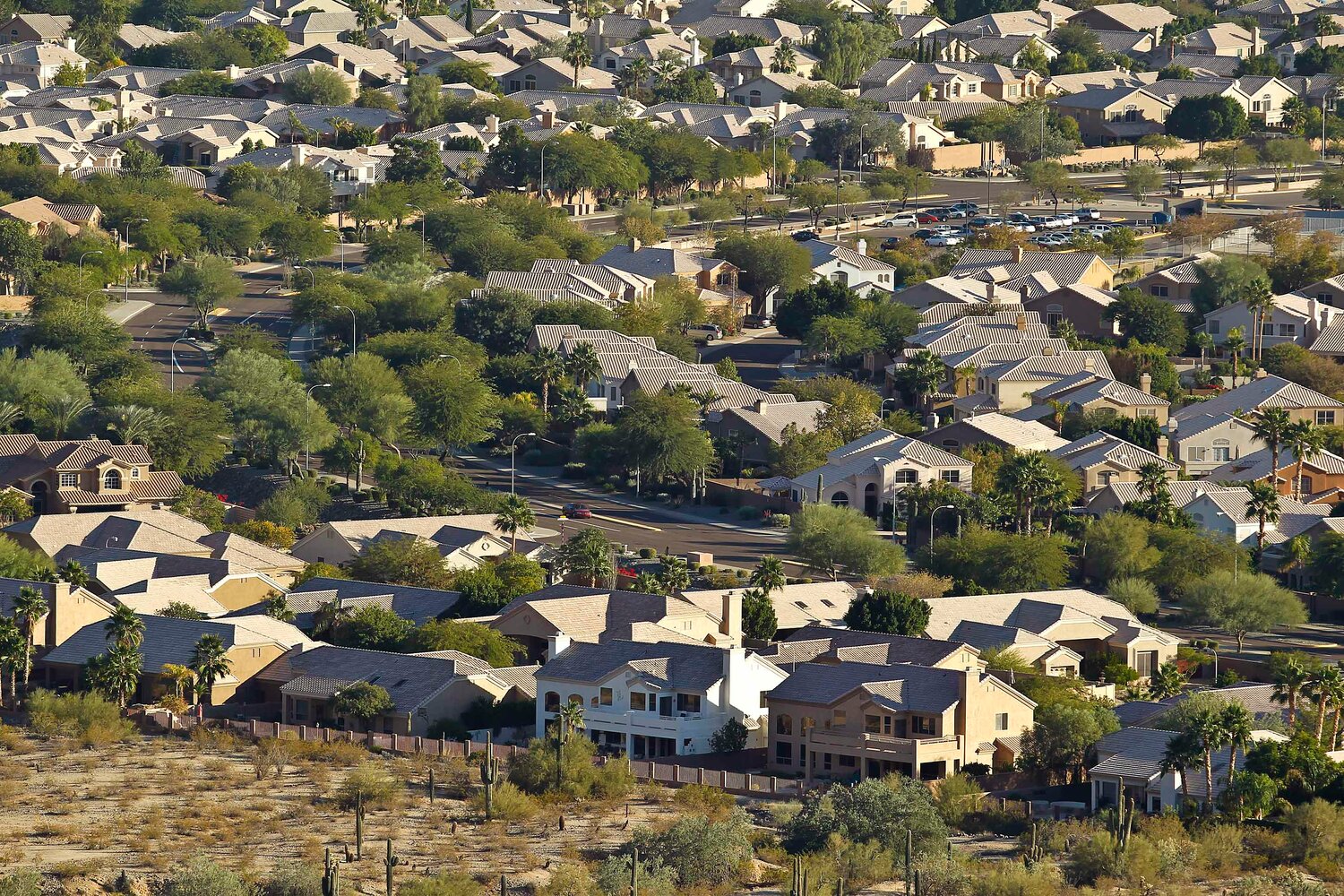
A housing development sits nestled into the South Mountain foothills in the Ahwatukee neighborhood. About 200,000 residential Maricopa County properties had to be revalued and hundreds of entities must pay back property tax dollars as a result of a class-action lawsuit.
About 200,000 residential Maricopa County properties had to be revalued and hundreds of entities must pay back property tax dollars as a result of a class-action lawsuit.
The lawsuit — Qasimyar v. Maricopa County — stems from a resident challenging the way the county calculated how it charged residential homeowners for property taxes.
The resident who challenged the calculation — Ahmad Zaky Qasimyar — said the county incorrectly taxed the effected properties, which had a change in use from a primary residence to a non-primary residence or vice-versa from 2015 to 2021.
In 2021, the Arizona Court of Appeals upheld a decision that said a “property’s limited property value must be calculated using a specific statutory calculation” if there is a change in use from a primary residence to a non-primary residence or rental or vice-versa, according to a Maricopa County press release.
The method in which Maricopa County calculated taxing residential property taxes was done the same way in all the other counties in Arizona, said Jason Berry, a spokesman for Maricopa County.
“Only Maricopa County got sued over the issue,” Berry said.
Those impacted will receive a refund check in the mail for each of the seven years plus interest that’s accrued along with a letter explaining the reason for the refund, according to Jordan Dale, a spokesman for the Office of the Arizona State Treasurer.
The result of the lawsuit is far-reaching.
The Arizona Fire & Medical Authority Deputy Chief Kane Nixon told the Daily Independent the case effects the agency to the tune of about $5.9 million, which must be paid within one year.
The requirement “will rattle” the department’s financial stability and require the Arizona Fire & Medical Authority to take “drastic” measures, he said.
The ruling effects at least 18 Arizona cities or towns, 32 elementary school districts, 16 school districts, Maricopa County, community college districts and fire districts among others, according to the list on the Maricopa County website.
The class-action lawsuit “alleges that Maricopa County improperly and erroneously assessed and collected real property taxes” from some property owners in Maricopa County from the affected tax years 2015 to 2021, a summary of the lawsuit said.
However, in 2022, the Arizona Legislature passed Senate Bill 1267, a bill that said property owners who change between primary and non-primary residences or vice versa will not trigger a change in use for tax purposes.
Arizona Court of Appeals Division 1 Judge Michael J. Brown delivered the opinion of the case and its plaintiff, Ahmad Zaky Qasimyar.
Taxpayers contend reclassifying the “properties because they were owner/occupied primary residences was a change in use that required the (limited property values) to be calculated pursuant to “Rule B,” the opinion stated.
The case is a complicated one that doesn’t happen often, said Lucas Frei, property tax attorney at Phillips Law Group in Phoenix.
“This type of case is not common — especially as it is a class action against the taxing authorities,” Frei said. “I cannot remember another specifically with property tax like this.”
The attorney said there are always ambiguities in statutes.
“It is extremely hard to get something to ‘ironclad’ status,” Frei said. “There are always loopholes, or different ways of interpreting things.”
Rick Medina, spokesman for the Arizona Department of Education, said it’s too early to tell how schools and school districts will be effected.
But student enrollment numbers for the 2024-25 school year will help “determine the effect” of what comes next. He said the funding will come from the basic state aid appropriation line item — but he did not provide further details.
“This is still really fresh and developing,” Medina said.
The Office of the Arizona State Treasurer offered more insight about how schools and school districts can pay back the money.
“The Treasurer’s Office generates refund checks when the correction is processed,” Dale said.“A reverse apportionment is applied to the applicable taxing districts at the time each refund check is generated.”
Sun City Independent Reporter Scott Tynes contributed to this story.
Brent Ruffner joined Independent Newsmedia, Inc., USA, in 2021 where he writes about developments at TSMC and Maricopa County issues, including election topics.
He's written about stories that range from accusations that a Mesa monkey breeding facility is unsafe to what to do if you encounter a rattlesnake in the desert.
Community: He is a supporter of the American Cancer Society.
Education: Bachelor's degree in Journalism and Mass Communication, Arizona State University, May 2007.
Random Fact: He met former San Francisco Giants outfielder Willie Mays at a Phoenix Firebird game after winning a contest for an autographed baseball.
Hobbies: Hiking in the woods and collecting sports memorabilia.

 By
By 


Comments
No comments on this item Please log in to comment by clicking here